What Is an AI Marketing Platform? Definition, Features, and How It Works


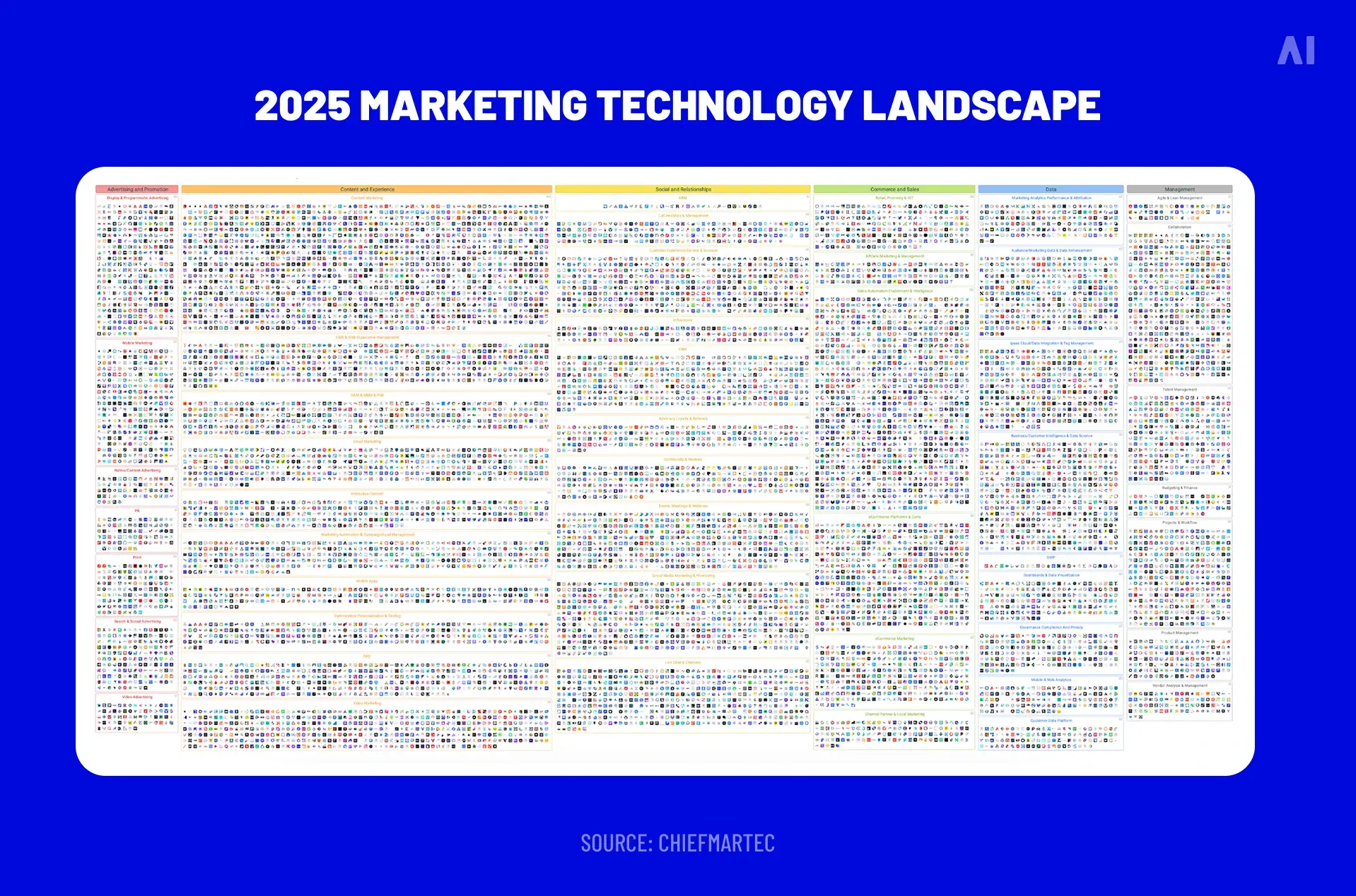
Marketing teams today operate across more channels, with more data, and under more pressure than at any point in the past decade. Budgets have stalled, customer signals are scattered across dozens of systems, and the average martech stack now runs to between 17 and 20 platforms. The landscape itself pushed past 15,384 tools—a number that says less about abundance than about fragmentation. Decisions get slower, attribution gets fuzzier, and the gap between what a campaign could deliver and what it actually delivers widens every quarter.
AI marketing platforms are one response. Rather than adding another tool to an already crowded stack, they consolidate data, analytics, media execution, and reporting into a single intelligence layer, with machine learning handling work that previously required a team of specialists moving between dashboards.
This article sets out what an AI marketing platform actually is, how it differs from AI tools and automation software, which features are worth paying for, and how to evaluate options against your real business problems.
AI marketing platform definition
An AI marketing platform is a unified system that ingests marketing and customer data from multiple sources, applies machine learning to analyze and act on that data, and automates marketing activity across channels.
That's a different category from the point tools and automation software most marketers have been stacking for years.
- A point tool handles a single job—an email builder, a social scheduler, an ad optimizer.
- Automation software connects tools and moves work between them.
A platform is broader: it brings research, planning, execution, optimization, and measurement into one environment, where customer data and the AI models acting on it sit in the same system rather than stitched across vendors.
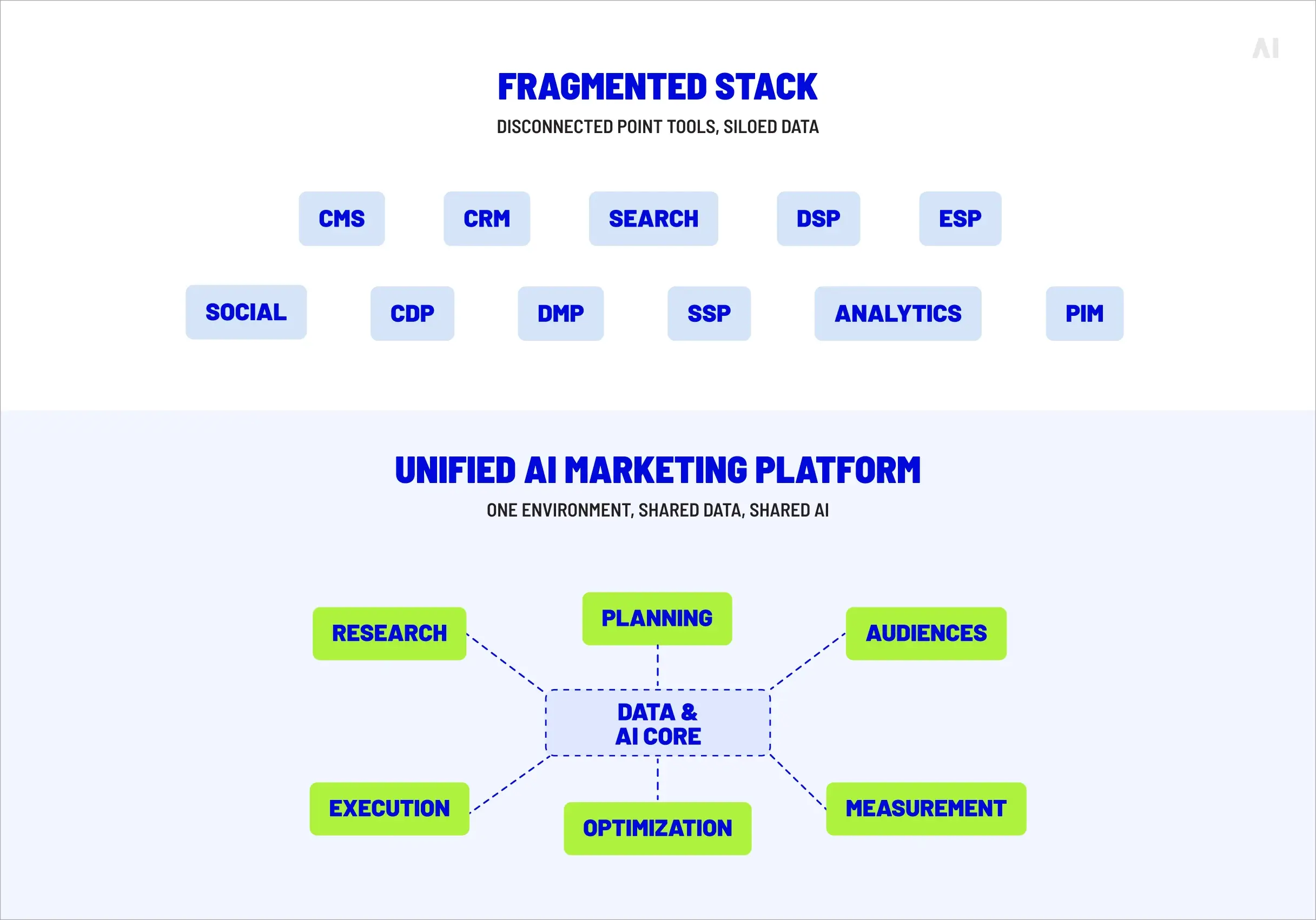
In practice, that comes down to three capabilities working together.
- The first is consolidation—pulling signals that normally sit in isolated systems (CRM records, ad platform pixels, first-party web behavior, offline conversions, third-party data) into a coherent picture.
- The second is intelligence—machine learning models running continuously on that unified dataset to surface patterns, forecast outcomes, and recommend actions.
- The third is execution—insights feeding directly into media buying, creative decisioning, lifecycle journeys, and reporting, so there is no gap between what the data says and what the campaign does.
The problem this architecture solves is specific. Marketers are not short of information; they are short of usable, connected, trustworthy information that can drive a decision faster than the competitor’s next campaign launch. The 2025 State of Marketing Attribution Report found siloed data to be the single biggest barrier to effective measurement, cited by 65.7% of marketers—above budget, skills, or tool complexity. Platform architectures have moved from nice-to-have to structural priority as a result.
💡 Related reads: AI in digital marketing
AI marketing platform vs AI tools vs automation
The three terms are used interchangeably—often, it should be said, by vendors who have a commercial interest in keeping the boundaries vague. They are not the same thing, and the differences are not trivial.
- An AI tool does one thing well—generating subject lines, predicting churn, optimizing a single bid stream—and slots into an existing workflow. It inherits the data quality of whatever it’s plugged into.
- Automation software moves work between tools according to rules you define in advance; it speeds up execution but doesn’t think about whether the execution is correct.
- A platform sits below both: it owns the data, the identity resolution, the measurement framework, and the AI models that run on top. Tools and automation can live inside it, but the platform is what makes their outputs trustworthy.
The distinction is practical. Adding an AI tool to a fragmented stack often produces worse results than not adding it at all—the tool performs well in isolation and amplifies distortion in aggregate. Adding automation on top of broken data automates the wrong decisions at scale. Only a platform addresses the layer where those problems live.
{{26-What-Is-an-AI-Marketing-Platform-1="/tables"}}
Key features of AI marketing platforms
Platforms vary in scope, but four capabilities appear in the genuinely useful ones: integrated data, predictive analytics, campaign automation, and media optimization. Each solves a specific problem that disconnected tools cannot.
{{26-What-Is-an-AI-Marketing-Platform-2="/tables"}}
💡 Related reads: Creating a data-driven marketing strategy | Performance marketing strategy
Data integration
Integration is the foundation. Without it, every downstream capability is compromised. A platform pulls data from CRM systems, web analytics, ad platforms, offline sources, and third-party providers into a single schema, resolves identities across devices and channels, and maintains that view in near real time. Only 31% of marketers in Salesforce’s State of Marketing research report full confidence in their ability to unify customer data, meaning most AI and analytics tools today are running on data their own users don’t fully trust.
💡 Related reads: Data management platform
Predictive analytics
With unified data underneath, machine learning models can do genuinely useful work: identifying which users are likely to convert, which channels are likely to underperform, which creative variants resonate with which segments. Predictive analytics is what turns historical reporting into forward-looking strategy, generating audience recommendations, forecasting campaign outcomes, and catching problems before they become budget drains.
💡 Related reads: Ad personalization
Campaign automation
Automation inside a platform is different from standalone automation software because it acts on unified intelligence rather than isolated rules. Setup, creative rotation, bid adjustments, budget reallocation, and audience suppression happen across channels based on what the data says is working now, not what was working in the last reporting cycle. Human teams spend less time adjusting dials and more time on work that requires judgment.
💡 Related reads: AI in marketing automation
Media optimization
Media optimization is where platform intelligence meets budget. AI models assess placement quality, supply path efficiency, viewability, fraud risk, and actual outcome attribution to keep spend flowing to the combinations that perform. AI Digital’s Smart Supply is one worked example: it filters for premium, brand-safe inventory through direct SSP relationships and reduces the ad-tech tax that accumulates when supply paths are left unoptimized. The outcome is straightforward—more working media per dollar and more transparency about where budget actually ended up.
⚡ The confusion is understandable but costly. A platform is not a tool with more buttons. It is the connective tissue that holds the stack together— the thing that ensures one tool's output does not become another tool's problem.
Benefits of AI marketing platforms
The benefits of an AI marketing platform are not conceptual. They appear in metrics CFOs care about: cost efficiency, response speed, team capacity, and, over a longer horizon, revenue.
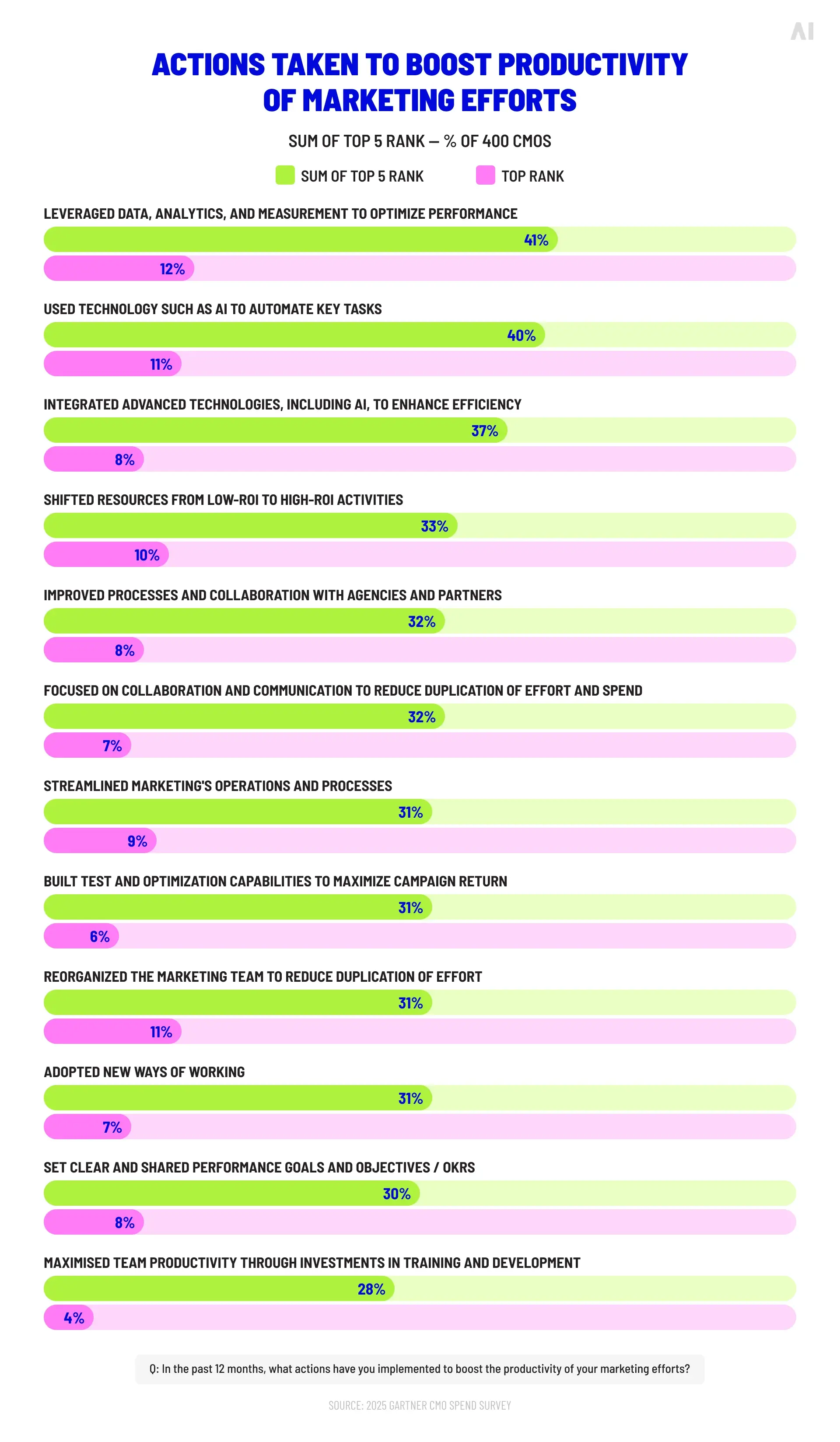
Gartner’s 2025 CMO Spend Survey—based on 402 senior marketing leaders across North America, the UK, and Europe — found that CMOs investing in GenAI report measurable returns in time efficiency (49%), cost efficiency (40%), and capacity to handle more content or business (27%). None of this is happening in a comfortable budget climate: marketing spend has flatlined at 7.7% of company revenue, and 59% of CMOs said their budget was insufficient to execute their 2025 strategy. Doing more with less is the brief, and platforms are where that work tends to land.
The specific outcomes cluster into four areas.
- Sharper targeting, because identity resolution works when data lives in one place.
- Faster decisions, because analysts aren’t reassembling data from four dashboards to act.
- Higher ROI, because optimization happens continuously rather than in weekly review meetings.
- Less manual work, because the operational layer runs itself under human supervision.
AI Digital’s Elevate platform, as one example, reports a 5–20% uplift in client retention from its Marketing Mix Modeling module alone—a figure reflecting the compound effect of turning data into usable insight rather than into another unread report.
💡 Related reads: Programmatic ad targeting: best strategies, tools, and tactics in 2026 | AI targeted advertising
Examples of AI marketing platforms
The AI marketing platform category is broader than most vendor marketing would suggest. Depending on where the center of gravity sits, a platform might be CRM-first, experience-first, media-first, or lifecycle-first, and those are not interchangeable choices. The right fit depends on where your actual bottleneck is.
{{26-What-Is-an-AI-Marketing-Platform-3="/tables"}}
CRM and marketing platform
HubSpot is the best-known example of a platform built around the CRM as the system of record, with marketing automation, content, and AI-assisted workflows layered on top. It suits mid-market B2B organizations where the customer lifecycle is tightly coupled to sales conversations. Its AI features lean toward productivity—content drafting, send-time optimization, lead scoring—rather than deep media decisioning.
Enterprise experience platform
Adobe Experience Cloud occupies the opposite end: a set of tightly integrated applications for content, personalization, journey orchestration, and analytics, built for enterprise buyers who prize configurability over out-of-the-box simplicity. Its strength is depth across the experience layer, with Adobe’s AI (Sensei, Firefly) embedded throughout, and it rewards the investment where personalization at scale is the defining pressure.
Enterprise CRM and AI platform
Salesforce, now re-positioned as Agentforce Marketing, extends CRM-centric logic to enterprise scale. Data Cloud serves as the unification layer, Marketing Cloud handles execution, and embedded AI agents do the intermediate work across analytics, segmentation, and journey orchestration. It fits organizations already standardized on the Salesforce ecosystem, where the CRM is the canonical source of truth. The recent renaming signaled a clearer bet on agentic AI as the operating model rather than the feature.
AI advertising platform
Smartly.io exemplifies the ad-tech-focused platform: automated creative production, multi-platform delivery, and AI optimization concentrated on the paid side. It is narrower than the CRM-centric options but goes deeper on the creative and media dimensions that performance advertisers prioritize—suiting organizations where the volume and velocity of paid social and display creative is itself the operational problem.
AI automation platform
Ortto represents the lifecycle automation category—tools built around journey orchestration, segmentation, and behavioral automation. Where CRM-first platforms start from the contact record, lifecycle platforms start from the event stream. That orientation suits product-led or subscription businesses where the behavioral signal matters more than the static profile.
Unified cross-channel AI marketing platforms
Unified cross-channel platforms are a newer category. The center of gravity is media performance rather than the CRM or the lifecycle. These platforms combine analytics, media optimization, and execution into a single system working across every paid channel — programmatic display, CTV, OTT, audio, social, search, native — with AI trained on media performance data specifically. Basis Technologies is one example; Basis Platform pulls planning, buying, and measurement across display, video, CTV, native, and social into one workflow, with an AI assistant layered on top.
AI Digital works in and around this category as a programmatic, AI-native consultancy rather than a single platform product. It brings together three components for clients:
- Elevate as the intelligence platform that unifies data, audience segmentation, media planning, and marketing mix modeling in one system;
- Smart Supply as the SSP curation and supply path optimization engine on the buy side; and
- the Open Garden Framework as the connective philosophy that keeps execution vendor-agnostic across the 15+ DSPs and 9+ SSPs clients already use.
This category fits brands and agencies whose primary performance pressure comes from paid media at scale.
💡 Related reads: What we do | Types of AI marketing platforms: automation, analytics, personalization, and performance.
How AI marketing platforms work in practice
Theory only gets you so far. The most useful thing is to walk through a working example. AI Digital is not a platform vendor—it is a programmatic consultancy, AI-native in its architecture and deliberately agnostic about whose technology it uses. But its stack is a clean illustration of how the three layers operate together: Elevate handles data and analytics, Smart Supply manages media optimization, and Open Garden provides the framework that keeps the entire system vendor-neutral. Let’s break that down.
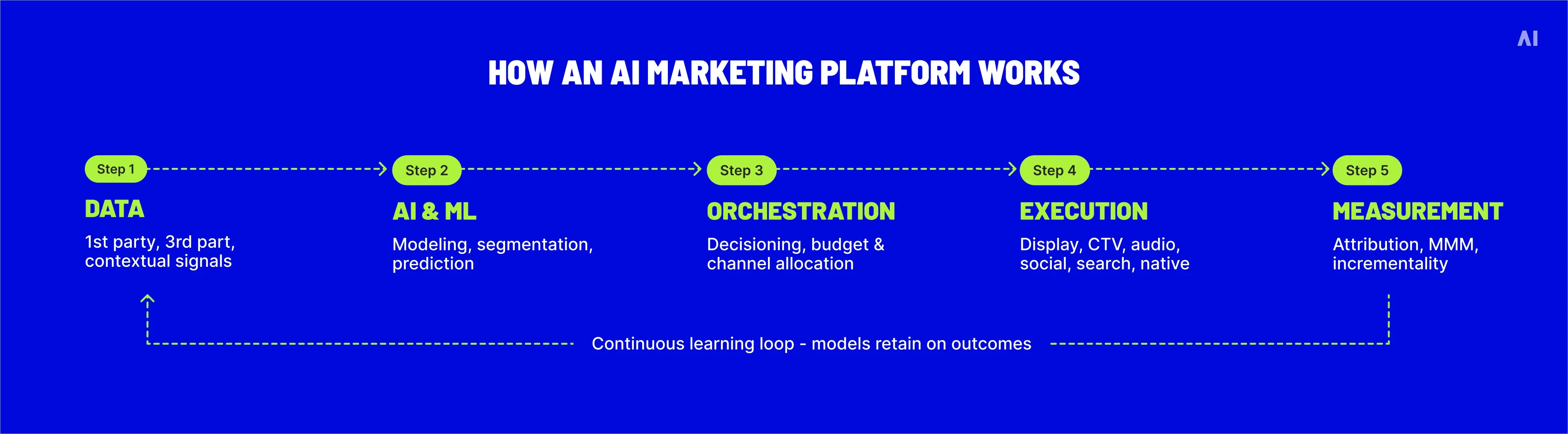
Elevate: data and analytics layer
Elevate is the intelligence layer. It unifies research, planning, optimization, and reporting in a single environment, drawing on more than 150 billion monthly data points and 10,000+ audience attributes to generate audience segments, personas, and media plans in minutes rather than days.
The AI-assisted media planner is trained on data from 8,000+ campaigns across 12+ DSPs—depth that matters because platform performance is only as reliable as what the models have seen.
Advanced attribution, Marketing Mix Modeling, and Path-to-Conversion modules sit inside the same environment, so the analysis informing the plan and the analysis measuring the plan are looking at the same data.
Smart Supply: media optimization layer
Smart Supply is the execution efficiency layer. It curates premium, brand-safe inventory through direct relationships with top-tier SSPs, uses AI-powered supply path optimization to reduce the ad-tech tax that accumulates across fragmented supply chains, and filters out low-viewability or fraudulent placements before they reach a campaign.
Advertisers end up with more working media per dollar spent, without sacrificing transparency.
Smart Supply runs in concert with Elevate—the analytics layer identifies which inventory types are performing, and the media optimization layer acts on that signal in near-real time.
Open Garden Framework: unified ecosystem approach
The Open Garden Framework is the connective philosophy rather than a product. Most large ad platforms operate as walled gardens: advertisers can buy media inside them, but they can’t see across to other platforms, and the measurement sits inside the wall.
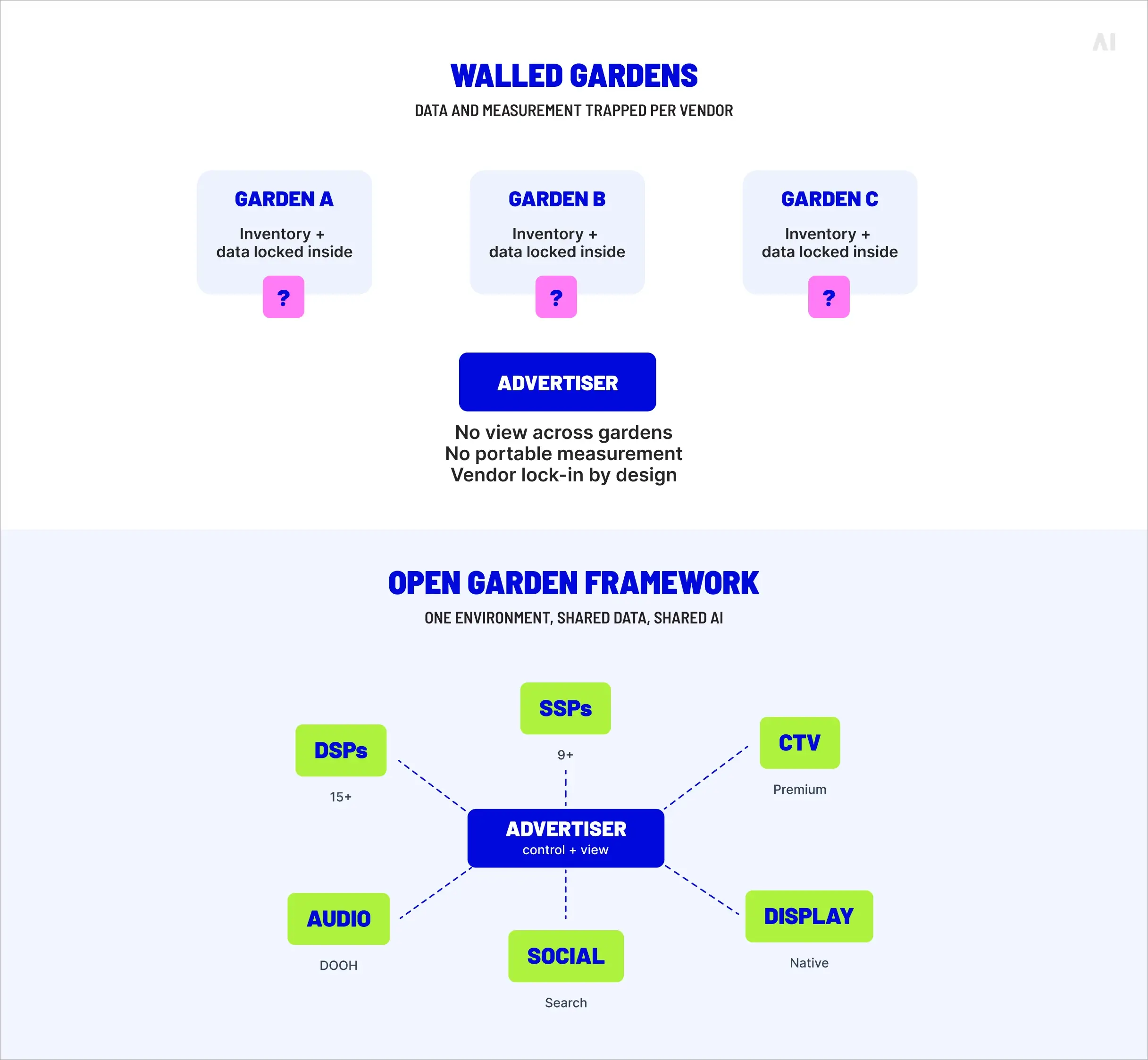
Open Garden inverts that model. It connects to 15+ DSPs and 9+ premium SSPs, keeps data and decisioning transparent across them, and gives advertisers control over where their budget actually lands removing the vendor lock-in that otherwise fragments the data and the decisioning.
💡 Related reads: Walled Gardens vs Open Internet: Control, Transparency, and Trade-Offs | The Open Garden Framework: a new operating model for programmatic advertising.
⚡ The platforms that work best are the ones that disappear into the workflow. The answer is there before anyone has to hunt for it. Nobody remembers the tool. They just remember that the decision was easy.
How to choose an AI marketing platform
There is no universally correct AI marketing platform, and the procurement process is where most of the value is either captured or lost. Seven criteria distinguish the platforms that work from the ones that arrive with fanfare and sit underused six months later.
1. Define your business goals and use cases
Start from the problem, not the category. If the real bottleneck is paid media waste, a CRM-first platform will not fix it. If it’s lifecycle fragmentation, a media-first platform will not fix it either. Identifying the one or two outcomes that matter most prevents the common failure mode of buying a platform that solves problems you don’t have.
2. Evaluate data integration and ecosystem compatibility
A platform is only as useful as its ability to connect to the systems that already hold your data. Check for native integrations with your CRM, analytics, ad platforms, CDP, and any proprietary data sources. Check how identity resolution works, where the data lives, and what the latency looks like.
Approaches like the Open Garden Framework illustrate how unified ecosystems improve transparency by connecting to multiple DSPs and SSPs rather than locking buyers into a single proprietary supply chain.
💡 Related reads: Transparency in advertising
3. Assess AI capabilities
"AI" has become a category label applied to everything from a rules engine to a genuine large language model. Ask what the models actually do. Are they predictive or rule-based with a modern interface? How often do they retrain? What data do they train on? A platform with meaningful AI should be able to explain in plain language how its models decide what to decide.
4. Consider scalability and cross-channel support
The platform you buy today has to work against the channel mix you’ll have in three years, not the one you have now. Check which channels are natively supported—search, social, CTV, OTT, audio, programmatic display, DOOH—and how the platform handles new channel additions. AI Digital’s platform, for example, was built explicitly for cross-channel programmatic orchestration.
💡 Related reads: Programmatic advertising
5. Review usability and team adoption
A platform your team won’t actually use is an expensive shelf. Look at the interface honestly: what’s the learning curve, where are the rough edges, how much day-to-day work can be done without vendor support? The best platform is the one your analysts, planners, and managers reach for unprompted.
6. Analyze pricing and total cost
Sticker price is the smallest part of the calculation. Factor in implementation, data migration, training, integration work, ongoing licensing for connected tools, and the opportunity cost of work that doesn’t happen during deployment. Solutions like Smart Supply, which focus on supply path optimization and inventory filtering, can offset platform costs directly by reducing wasted media spend.
💡 Related reads: Media Mix Optimization: How to Use MMM for Budget Allocation
7. Evaluate analytics and insights
Reporting is where platforms earn trust or lose it. Look at whether analytics are actionable rather than just visual, whether insights are available in real time or only in post-campaign review, and whether the platform supports the attribution approach your business actually uses. Platforms like Elevate turn raw campaign data into performance insights and recommended actions—the difference between a dashboard and a decision-support system.
💡 Related reads: The problem with platform-reported data: why you can’t trust the numbers.
⚡ AI is very good at eliminating grunt work. It is considerably less good at knowing which grunt work should have been done and which should never have existed. That part is still yours.
Conclusion on marketing AI platforms: from tools to platform ecosystems
The pattern across the last five years is clear enough. Marketing organizations started with a handful of tools, added more to solve specific problems, and ended up with stacks that obscure the performance they were meant to illuminate. The landscape hit 15,384 products last year; most teams are running 17 to 20 of them simultaneously. The tool-centric model is not sustainable at the current rate of channel and data growth.
AI marketing platforms are not a silver bullet—no technology is—but they represent a structural response to structural fragmentation. By unifying data, applying machine learning across the full signal set, and automating execution inside a single environment, they reduce the overhead that drains budget and attention from strategic work. The shift from tool-first to platform-first thinking is what separates marketing organizations that compound performance gains from those that compound integration debt.
AI Digital works with brands and agencies making that shift in the context of paid media. Through managed services built on the Open Garden Framework, Smart Supply for media optimization, and Elevate as the intelligence layer, we give advertisers a unified view across every major channel—without the walled-garden lock-in that defines most of the alternatives. Get in touch to talk through what a platform approach could look like for your business.