Native advertising has moved from test-and-learn to table stakes. Instead of interrupting like banners, native placements live inside feeds, stories, and recommendation slots — matching the look and rhythm of the content people already chose to see.
Audiences are harder to reach than ever. 29.5% of internet users worldwide — an estimated 1.77 billion people — block ads at least sometimes, per GWI data from Q2 2025, so traditional display keeps losing ground. Native slips past that resistance by reading as part of the experience.
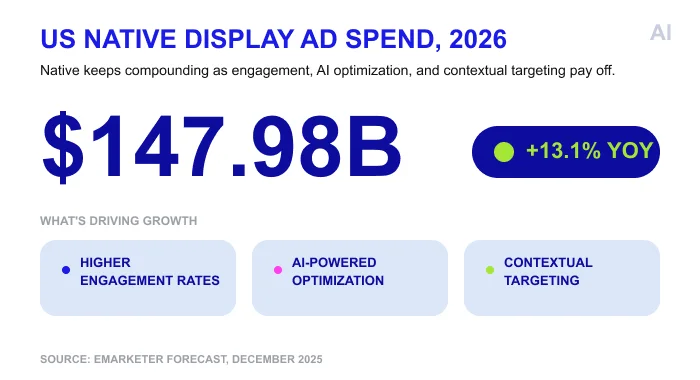
The dollars follow the results. US marketers will put $147.98 billion into native display in 2026, up 13.1% year over year, according to eMarketer's December 2025 forecast — growth driven by higher engagement rates, AI-powered optimization, and the rising importance of contextual targeting.
What follows is a practical walkthrough: types of native ads and where they fit, the mechanics of setup and bidding, what native costs, the platforms worth testing, and a measurement plan that ties clicks and on-page engagement to brand lift and outcomes.
TL;DR
- Native ads match the look and feel of the content around them — and they work: US native display spending hits $147.98 billion in 2026, up 13.1% year over year.
- Every format, however new, maps to one of three IAB types: in-feed, content recommendation, or branded content.
- Costs run $0.25–$0.90 per click on discovery networks, $5–$12 CPM programmatically, or flat fees from a few hundred dollars to $200,000+ for publisher-made content.
- Native beats banners on viewability (81% vs. 64%) and click-through — but it must always be clearly labeled as an ad.
- Measure beyond clicks: attention, brand lift, and assisted conversions tell the real story.
What is native advertising
Native advertising is paid media designed to match the form and function of the environment in which it appears. In practice, that means the ad uses the same layout, typography, and behavior as surrounding content (for example, an article inside a publisher feed or a short video inside a social stream). Industry bodies define it this way and require that it be clearly identified as advertising with labels such as "Ad" or "Sponsored."
⚡ Native ads match the page's form and function, but they're still ads. Clear 'ad' labels belong near the headline or thumbnail.
How it differs from banners/display
Display banners are separate, standardized ad containers (think 300×250, 728×90, or their responsive successors) that sit alongside content rather than inside it. They're specified in the IAB ad portfolio and are typically bought and trafficked as discrete placements.
Native units, by contrast, are assembled from components (headline, image, source/brand) and rendered to look and behave like the host content, while still carrying a clear disclosure.
Here's the practical split marketers should keep in mind:
- Placement and presentation. Banners occupy predefined slots outside the editorial stream; native appears in-stream/in-feed or within a content recommendation module and mirrors the page's look and feel.
- Creative assembly. Banners are uploaded as finished files that fit standard sizes; native creatives are modular and templated by the publisher or platform to match local styles.
- User expectation. Banner ads are obviously promotional; native is content-like and therefore must include prominent, proximate disclosure so people can tell ads from editorial at a glance.
- Formats. Banners cover display and rich media sizes from the IAB portfolio; native spans in-feed, sponsored/branded content, native video, and recommendation widgets, each using the publisher's own templates.
And at a glance:
{{nag-1}}
For how those differences play out on brand metrics, see the display-vs-native effect data in the measurement section below — Nielsen's numbers show native ahead on awareness, consideration, and preference.
💡 For a deeper comparison of when to choose each format, see Native Ads vs. Display Ads and When to Use Each.
Types of native ads
Native advertising covers a family of formats that mirror the look and behavior of the surrounding content while remaining clearly labeled as ads.
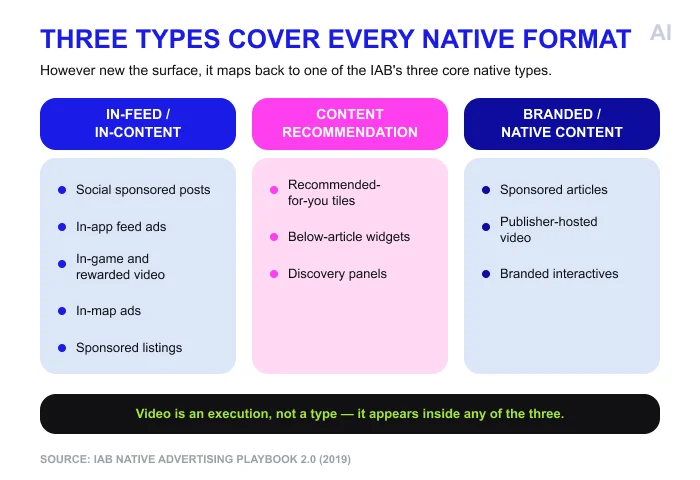
The IAB's current taxonomy groups the core formats into
- in-feed/in-content ads,
- content recommendation ads, and
- branded/native content.
Video can appear in any of these (for example, in-feed video or out-stream video inside an article).
All native units must include prominent disclosures so people can distinguish ads from editorial.
In-feed ads
In-feed ads appear directly inside content feeds on publisher sites or social platforms and mimic the page's layout and typography so the scroll experience feels continuous. They're assembled from components (headline, image or video, brand/source) and carry a clear label such as "Sponsored" or "Ad."
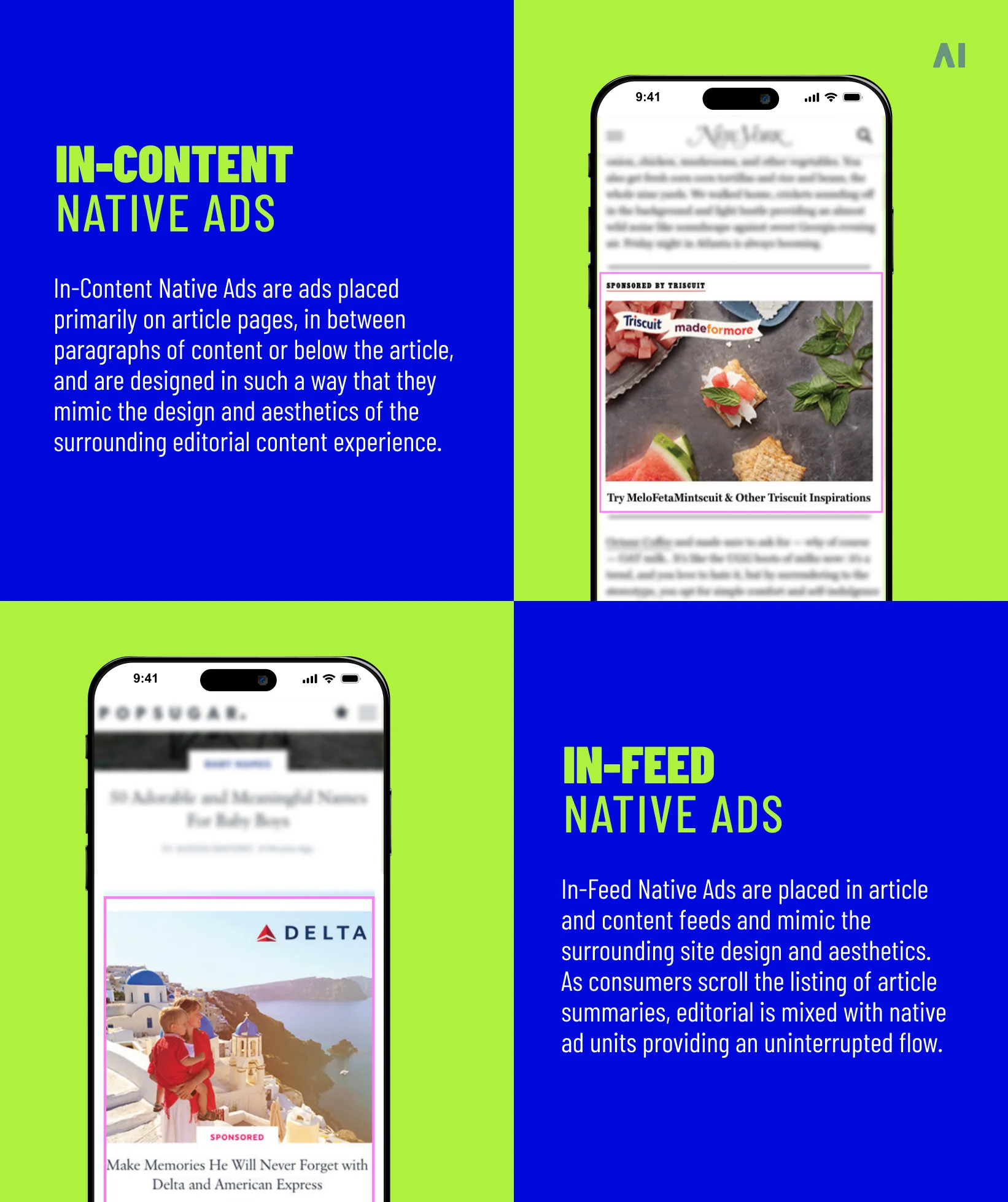
In-feed units can run on content feeds, product feeds, or social feeds (for example, sponsored posts in Facebook, Instagram, or LinkedIn). Clicking can keep the user on-site (to a native article page) or take them to an external landing page.
Sponsored posts (social). On social platforms, the in-feed unit takes the form of a sponsored post that looks like any other post in the feed but is marked as paid and targeted to an audience. Social in-feed ads are explicitly called out as a primary context for in-feed native.
Sponsored content
"Sponsored content" is often used generically, but in the IAB framework it maps to branded/native content: paid content created with or by the publisher and published in the same format as full editorial (article, interactive, or video) on that site. This content can then be promoted by in-feed units or recommendation widgets. It lives on the publisher's domain, follows the publisher's design, and includes clear sponsorship disclosure.
Branded/native video
Video can be rendered natively in feeds (e.g., short videos in a publisher or social feed) or out-stream within an article where no video player existed before.
Out-stream and in-feed video are classified by the IAB as video that plays outside of a traditional in-stream video (pre/mid/post-roll) and are common native executions when the surrounding context is article-based.
💡 For a deeper, more tactical take, see Programmatic Video Advertising Explained: Smarter Campaigns for the Streaming Era.
Recommendation widgets
Also called content discovery units, these are "You might also like"/"Sponsored" panels typically placed below or alongside articles. Each tile is a native ad (article, video, or product) that, when clicked, redirects off-site or to another URL controlled by the source. The widgets match the site's styling but remain clearly labeled as paid. Examples of suppliers in this category include Taboola, Teads, Revcontent, Yahoo, and MGID.
📌 To align our taxonomy with the IAB, note that the 2019 Native Advertising Playbook 2.0 recognizes three core native types: In-Feed/In-Content, Content Recommendation Ads, and Branded/Native Content. Video isn't a separate type in this model; it's an execution that can appear within these categories (e.g., in-feed or in-article video). The update also consolidates prior buckets: Promoted Listings are folded into In-Feed, and Paid Search is no longer treated as a native type. Use our detailed sub-sections for planning, but anchor classification to these three IAB types.
Native formats in the wild
Beyond the three core types, you'll meet native on more surfaces than the taxonomy names. Each maps back to an IAB parent, which keeps planning and reporting clean:
- In-app native (feeds and content streams inside apps) → In-Feed/In-Content
- In-game native (rewarded video and units styled to the game environment) → In-Feed/In-Content, with rewarded video as the execution
- In-map ads (sponsored pins and promoted places) → In-Feed/In-Content
- Sponsored listings on retail sites and marketplaces → In-Feed; the IAB folded promoted listings into this type in 2019, and commerce media has since made it one of the largest native surfaces
- Out-stream and in-article video → an execution of In-Feed or Branded Content rather than a separate type
- Recommendation tiles below and beside articles → Content Recommendation
New surfaces keep appearing. The three-type backbone still classifies all of them.
How to recognize native ads
Native ads are paid messages designed to match the surrounding content, but they must still be identifiable as advertising.
The clearest signal is a visible disclosure — labels like "Ad," "Sponsored," or similar — placed close to the unit so readers can see it before engaging.
The FTC's business guide and enforcement policy make this the central test: if the format risks misleading people about a message's commercial nature, a clear and prominent disclosure is required.
An advertisement or promotional message shouldn't suggest or imply to consumers that it's anything other than an ad. — Federal Trade Commission
Practical cues to look for:
- Labeling that's obvious and near the focal point. Disclosures should sit immediately in front of or above the headline (or on the image/thumbnail if that's the focal point). Labels placed far to the right or below the unit are less likely to be noticed.
- Readable presentation on any device. The FTC expects clear, plain-language disclosures in a font/color that stands out, with video/audio disclosures long and loud enough to be understood.
- Disclosure on every page a user can land on. If people can reach the sponsored article or video without first seeing the teaser card, the click-into page also needs a disclosure near the headline.
- Individual labels in recommendation widgets. In a grid of links below an article, each sponsored tile should be labeled; a single blanket label for a mixed set isn't sufficient.
- Consistent identification when content is shared. When native content is republished in search, social, or email, disclosures should travel with the link or snippet so the ad nature remains clear.
- Publisher- or platform-standard treatments. Industry bodies (IAB) stress that disclosure must be clear and prominent regardless of the unit type; many publishers add borders or shading in addition to text labels.
⚡ If the disclosure isn't visible before you click or tap, fix the placement. The label should be obvious on the unit and on the landing page.

These cues come directly from the FTC's Native Advertising: A Guide for Businesses and its Enforcement Policy Statement on Deceptively Formatted Advertisements, which set the U.S. standard for how native ads should be disclosed and recognized.
Why marketers use native advertising
Marketers choose native advertising because it fits the way people consume content today, scales across major platforms and the open web, and can be measured from attention to brand lift to conversions.
- It reaches people where they actually spend time. In-feed environments command large, growing budgets: advertisers will spend over $121 billion on US social networks in 2026, with social claiming close to 32% of US digital ad spending, per eMarketer's H2 2025 forecast — evidence that in-feed placements have become a primary way brands buy reach.
- It earns more meaningful attention than standard display — and you can optimize for it. Verification providers now publish attention and in-view time metrics that let buyers compare placements and creative quality, not just viewability. Lumen's 2023 research links higher attention to stronger brand outcomes. The IAB is also formalizing Attention Measurement Guidelines to make these metrics comparable across platforms.
- It lifts awareness and consideration when the content is the message. Nielsen's 2023 analysis of 1,000+ U.S. brand-lift studies found branded content can add ~9–10 points to awareness metrics, underscoring why advertisers use native to move upper-funnel outcomes (and not only clicks).
- It benefits from trusted contexts. Large-sample studies of news environments report brand-lift advantages when ads appear alongside reputable journalism (for example, a 2024 Stagwell experiment with ~50,000 U.S. adults testing ad adjacency across news content). While methodology differs by study, the direction is consistent: credibility of the host environment supports brand impact.
- It's built for privacy-forward, contextual strategies. As third-party cookies fade, native's alignment with contextual signals (category, topic, semantics) gives planners durable targeting levers, supported by IAB Tech Lab's Content Taxonomy and broader IAB guidance on privacy-by-design measurement.
- It scales and optimizes programmatically. Native is not just bespoke publisher deals; it's widely transacted via OpenRTB with modular creative components that platforms render to match each site or app. Programmatic now represents the bulk of U.S. digital ad revenue, giving native buyers standard controls for frequency, bidding, pacing, and brand safety.
Native advertising: pros and cons at a glance
Native earns attention other formats can't buy, but it makes you work for it:
{{nag-2}}
When people see ads for longer, they're much more likely to remember the brand — Lumen Research
💡 For a deeper, point-by-point breakdown, see 10 Reasons to Use Native Advertising.
Business impact of native advertising
Native advertising delivers when three pieces line up: a clear objective, content people choose to engage with, and precise delivery. Done well, it improves visibility in trusted environments, strengthens mid-funnel intent, and lowers acquisition costs as you refine targeting and creative. Here's how those gains show up in practice.
⚡ Optimize for attention and quality of engagement, then watch awareness, consideration, and conversion lift follow.
Better brand visibility
Native placements sit where attention already flows — inside feeds and article streams — making them well suited to reach and awareness objectives. In a 2024 TripleLift and Cint campaign study for a major snack brand, native advertising produced a 7-percentage-point lift in aided awareness among exposed consumers. The format can therefore support upper-funnel outcomes as well as clicks, particularly when the creative fits the surrounding content and the campaign is measured through brand-lift research rather than CTR alone.
Full-funnel performance
Native does not stop at the top of the funnel. More recent evidence links sustained attention with outcomes further down the customer journey.
- A 2024 analysis by Havas, Lumen and Brand Metrics combined attention data with more than 9,000 brand-lift studies and found that attention correlated with awareness, consideration, preference and purchase intent, with total attention time emerging as the strongest indicator of preference and intent.
- A separate 2025 Lumen study covering 110 campaigns across 19 categories and nine markets also found that higher attention was strongly associated with higher click-through rates, while interactive formats generated roughly four times the attention per thousand impressions of standard display.
Attention measurement is also becoming more usable in practice: the final IAB and MRC guidelines, released in November 2025, establish common definitions, methodological requirements and validation principles for comparing attention signals across digital and cross-media environments.
Increased ROI
Because native ads can be optimized to hold attention and encourage qualified engagement, they may improve efficiency beyond the click. In a 2025 IAS and NCSolutions study for Kimberly-Clark, households exposed to above-average-attention media generated a 313% higher sales lift than those exposed to below-average-attention placements. Attention scores also rose 36% between campaign tests, strengthening the case for optimising towards attention quality alongside viewability and contextual relevance.
💡 See our page How to Measure TV Advertising ROI: Smarter Metrics for the CTV Era for a step-by-step ROI framework.
Optimization and targeting
Modern native is programmatic. Using the IAB Tech Lab's OpenRTB Native spec, buyers send modular creative assets (headline, image, logo, etc.) and platforms render them to match each site or app — enabling standard controls for bid strategies, frequency, privacy flags, and event tracking. Major exchanges and platforms support this workflow, including Google's Authorized Buyers.
💡 To go further, explore AI Digital's supply-side guidance: Supply-side optimization with AI and Smart Supply's integration with AI Digital.
How native advertising works
Native campaigns combine clear objectives, precise targeting, and content that renders in the host's style with proper disclosure.
Campaign setup
Before you buy a single impression, define the playing field. Clarify what success looks like, choose the right formats for that goal, plan disclosure from the start, and set up measurement so every click and view tells you something useful. Here's the workflow, step-by-step:
- Start with the objective and audience. Decide whether you're optimizing for awareness (viewable reach, attention), consideration (qualified visits, scroll depth, video quartiles), or conversion (lead or sale). This choice determines formats, KPIs, and how you'll measure success.
- Choose formats and supply. Map goals to formats: in-feed, sponsored/branded content, out-stream/native video, or recommendation widgets. Use the IAB playbook and native specs to align creative components with publisher requirements.
- Plan disclosure and compliance. Build "Ad"/"Sponsored" labels into the unit and the landing page for content pieces; disclosures must be clear, prominent, and proximate to the ad.
- Instrument measurement. Append UTM parameters, define GA4/Adobe events (e.g., scroll depth, engaged time, form submit), and, if used, add viewability/attention tags (IAS/DoubleVerify) so you can optimize beyond clicks.
- QA the experience. Check rendering and labeling on mobile and desktop, verify links, and confirm that targeting and frequency caps align with the brief. The goal is a content-like experience that's easy to identify as advertising.
⚡ Objective set → audience defined → formats chosen → disclosures in place → measurement tagged. Don't launch until all five are green.
Targeting & bidding
Native inventory is commonly bought programmatically. Buyers pass modular creative assets (headline, image, logo, call-to-action, brand) and target settings; exchanges/SSPs render the ad to match each placement using the OpenRTB Native spec. You can bid CPC, CPM, or CPE, set frequency caps, and optimize to engagement or attention signals with event tracking and privacy flags supported in the spec.
Targeting typically blends:
- Contextual signals (section, topic, semantics) for durable reach as third-party cookies fade.
- Audience data (first-party, platform, or privacy-compliant third-party) for precision.
- Retargeting and lookalikes to move engaged users down-funnel.
- Pacing and bid strategies (e.g., value/auto-bidding) to prioritize high-quality placements.
These controls come from the native spec and standard programmatic tooling rather than bespoke deals, which keeps optimization continuous.
Content integration
Native ads are assembled to match the host: typography, layout, and interaction model mirror the page or app while keeping sponsorship clear. Specifications outline the assets publishers require (e.g., title, image, brand/sponsored line, body, rating data), and the ad server/templates handle styling so units feel part of the feed. For content-led executions, ensure the click-in page also carries a visible disclosure near the headline.
⚡ Cross-channel tip: align native creative and measurement with your video and TV plans so attention and lift metrics are comparable across screens.
💡 For an overview of TV planning concepts and terminology, see TV advertising.
How much does native advertising cost?
Native has no single rate card. Price depends on the route you buy through and the model you buy on: CPC for traffic, CPM for reach, CPV for video, and flat fees for publisher-produced content. Here's where 2025–2026 benchmarks land:
{{nag-3}}
Four factors move the price:
- Format. Video costs more than static in-feed; publisher-produced content costs more than templated units because you're paying for creation, not just distribution. At the very top of the market, complex campaigns with the NYT's T Brand Studio can exceed $500,000.
- Audience. Quality and scarcity set the rate. A broad consumer audience on a discovery network clicks for cents; a senior B2B audience on LinkedIn can cost more per thousand impressions than some TV.
- Seasonality. Q4 holiday competition drives the year's highest auction prices — CPMs can spike more than 60% — while Q1 offers the lowest costs as competition recedes.
- Creative performance. Platforms reward engagement. Higher CTRs earn more distribution at lower effective cost, so creative testing is a pricing lever, not just a quality one. A CTR above 0.4% indicates strong native performance.

Where to start. Discovery networks recommend at least $50 per day per campaign, and about $300 per day to move through the learning phase quickly. For programmatic native, $5,000–$10,000 per month provides enough data to optimize and scale with statistically useful signal. Whatever the route, set a target CPA or CPL before launch and steer bids, inventory, and creative toward it — native rewards optimization more than most channels.
💡 For programmatic-specific pricing mechanics and platform economics, see Programmatic Native Advertising in 2026.
What industries is native advertising best for?
Native performs best where the purchase is considered and the story does the selling. If your buyer needs education, comparison, or inspiration before committing, native gives you the room banners don't.
- B2B and SaaS. Long sales cycles reward content that explains. Native articles and in-feed thought leadership build familiarity before the demo request.
- Financial services. Complex products suit editorial-style explanation — with disclosures handled carefully, since the FTC's standards apply on top of financial regulation.
- Health and wellness. Education-first content earns trust in a category where claims face regulatory limits.
- Travel and hospitality. Inspiration is the product. Feed-native imagery and destination storytelling move consideration.
- Automotive, retail, and ecommerce. Comparison-stage content and sponsored listings intercept research before the purchase decision.
- Education, entertainment, and media. Audiences already in discovery mode respond to content-shaped promotion.
The common thread: native excels at mid-funnel influence. If your product sells on impulse and price alone, cheaper reach formats may serve you better; if it sells on understanding, native earns its keep.
Native advertising platforms
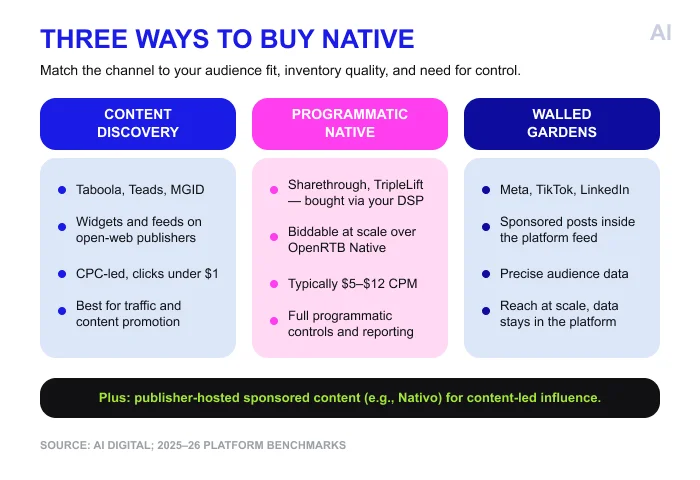
Choosing where to buy matters as much as what you buy. Native delivery lives in three main channels: open-web content discovery networks, programmatic native exchanges/SSPs, and the social walled gardens. The right mix depends on your audience fit, inventory quality, measurement and brand-safety controls, and the level of support you need.
What they are
Native advertising platforms help brands buy and deliver ads that match a site or app's look and behavior.
On the open web, you'll see two big categories: content recommendation networks (widgets and in-feed units across large publisher networks) and programmatic native exchanges/SSPs (biddable native inventory rendered to each publisher's template via OpenRTB Native).
Many publishers also run sponsored/branded content through specialized platforms, and of course the social "walled gardens" (Meta, TikTok, X, LinkedIn, Pinterest, Snapchat) are themselves large native environments.
Top digital advertising platforms to try
Below is a practical, starting list:
- Taboola (content discovery/open web). Powers native widgets and feeds across major publishers and now runs Yahoo's native ad inventory under an exclusive 30-year deal, giving buyers consolidated access to Yahoo properties via Taboola's stack. Recent investor disclosures cite ~600 million daily active users across its network. Useful for performance content, commerce pages, and broad reach. Its self-serve platform now operates under the Realize name.
- Teads (formerly Outbrain — content discovery, premium video/open web). Outbrain completed its roughly $900 million acquisition of Teads in February 2025, and by June 2025 the combined company had rebranded entirely under the Teads name — the Outbrain advertiser product, dashboard, and brand were retired. The merger pairs Outbrain's recommendation and performance technology with Teads' premium video and CTV inventory; company materials reference 1B+ monthly users. Lean on it for brand-safe premium placements and video-led native.
- Sharethrough (programmatic native exchange/SSP). A large native-heavy exchange with sustainability and attention features; the company highlights significant daily ad volume and publisher breadth, and the platform supports native, display, and video in one workflow. Good when you want biddable native at scale through your DSP.
- TripleLift (creative SSP/programmatic native). Known for pioneering programmatic native and templated, publisher-matched formats; also active in CTV and retail media. Recent updates include support for Amazon Ads' Native Responsive eCommerce (REC) on third-party supply and statements of 1T+ monthly ad transactions across formats — useful for omnichannel creative consistency.
- Nativo (publisher-hosted sponsored content/native articles). Specializes in hosting branded articles and stories on publisher sites, then promoting them through native placements; recent releases focus on mid-funnel measurement (e.g., Brand Rank) and expanded app inventory access. A fit when your strategy centers on content-led influence with premium publishers.
- Dianomi (finance/business native marketplace). A finance- and business-focused native network with partnerships across premium publishers and claims of hundreds of millions of reachable devices globally — useful for wealth, fintech, B2B, and corporate campaigns that value contextual alignment.
- MGID and Revcontent (open-web native networks). Both offer large open-web reach with content recommendation and in-feed units; good for scale testing outside the walled gardens. Evaluate inventory quality, brand safety controls, and optimization tooling for your category before committing spend.
⚡ Tip: For video-first plans, line up native video inventory alongside CTV and out-stream so your creative and measurement frameworks stay consistent.
💡 For a broader streaming context, see Best OTT Platforms in 2025: What's Trending in Streaming and Advertising.
How to measure native ad success
Start by mapping metrics to intent, then choose instruments that validate quality, not just volume.
💡 For a deeper philosophy on metric selection, see Why your marketing metrics are lying about growth.
Key KPIs (CTR, engagement, scroll depth, etc.)
Tie primary KPIs to the campaign goal, then add diagnostics that explain why performance moved.
- Awareness: viewable impressions and in-view time. A viewable impression follows the MRC standard — ≥50% of pixels for ≥1s (display) or ≥2s (video) — which is the baseline before attention quality is assessed.
- Consideration: CTR and post-click engagement. Track scroll depth, engaged time, pages per session, and video quartiles/completions. GA4's enhanced measurement and Tag Manager's Scroll Depth trigger make this straightforward to implement.
- Conversion: CVR, CPA/CPL, and assisted conversions (including view-throughs with a clearly stated window).
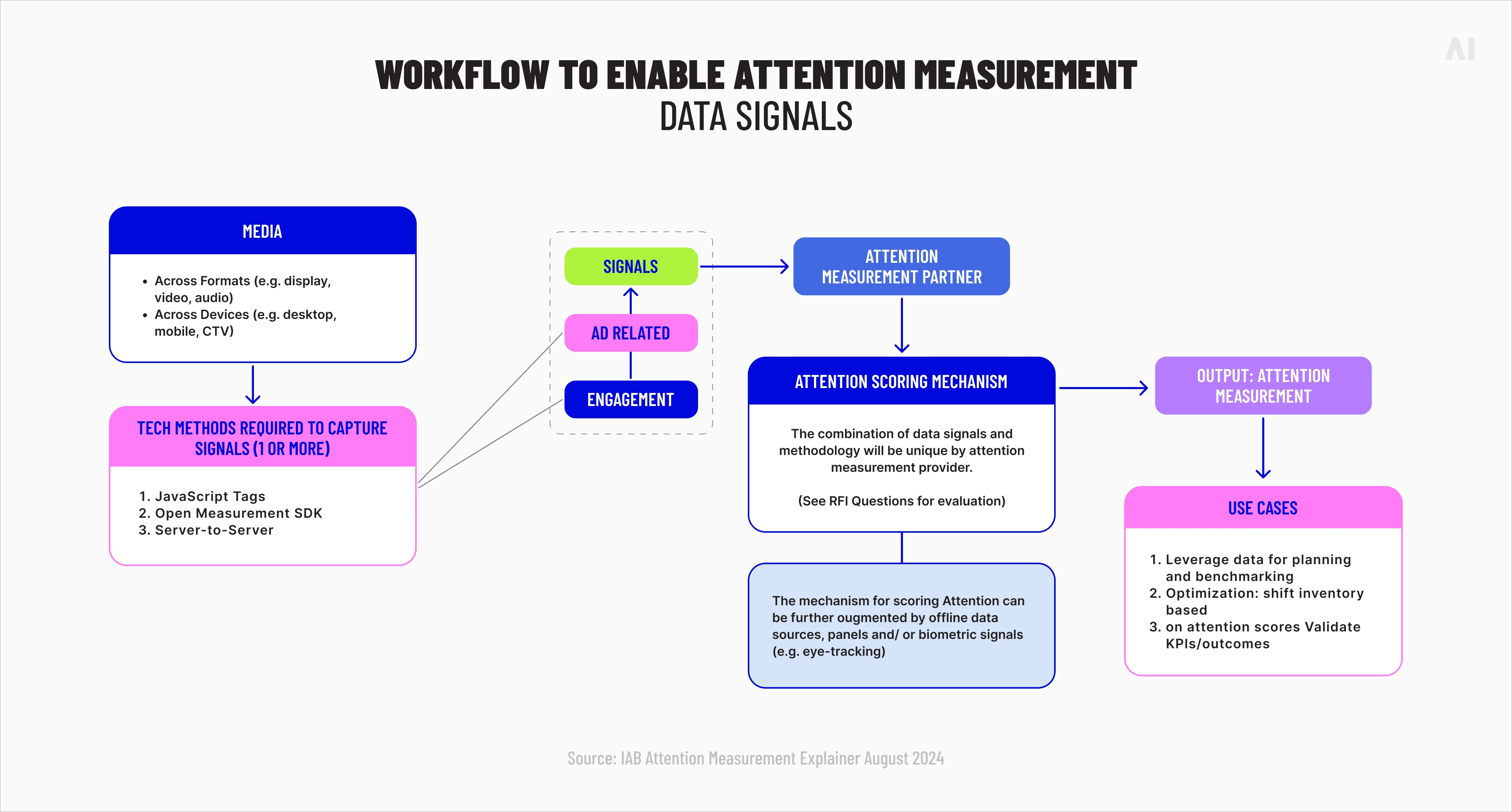
- Attention (quality signals): go beyond viewability with in-view time, interaction rate, and attention quality indices from verification providers such as IAS, DoubleVerify, and Lumen. These quantify exposure time and interaction — useful for optimizing native units that behave like content.
💡 For a complete metric menu and thresholds, see 15 Digital Marketing Metrics & KPIs to Measure Performance.
Brand lift & perception metrics
Native often aims to change what people think and feel, so run brand-lift tests when budgets allow.
- What to measure: unaided/aided awareness, ad recall, favorability, consideration, and purchase intent via control vs. exposed surveys. Providers like Nielsen and Kantar offer standardized methodologies and dashboards.
- Why it matters: Nielsen research reinforces the link between brand-building and commercial outcomes. Nielsen reports that sustained upper-funnel activity contributes to brand equity, can reduce customer-acquisition costs and may generate long-term effects that double the immediate impact of media spend. In 2026, Nielsen also introduced Predictive Sales Lift, which connects campaign exposure with estimated incremental sales and revenue. That supports using native to build demand across the funnel rather than judging it only by last-click conversions

Attribution challenges
Attributing sales to native is hard because journeys span devices and platforms, and privacy changes limit user-level tracking.
- Signal loss and policy changes: Apple's AppTrackingTransparency requires explicit user permission to track across apps/sites; without consent, IDFA is inaccessible.
- Cookies and the web: Google's Privacy Sandbox has shifted the Chrome roadmap toward more user choice and privacy-preserving APIs rather than a hard, fixed deprecation date; plan for less deterministic cross-site tracking and more aggregate measurement.
Practical fixes: use view-throughs with conservative windows, apply geo/incrementality tests where feasible, adopt multi-touch or data-driven attribution for on-site behavior, and complement with brand-lift to capture upper-funnel impact. IAB's State of Data reporting and Tech Lab guidance provide additional direction on ID alternatives and privacy-safe signals.
⚡ Awareness → viewability and attention. Consideration → CTR and on-page engagement. Conversion → CPA/CPL and assisted paths. Verify with third-party tags.

Tools to use (Moat, IAS, GA4, platform-native)
Use a layered toolkit: third-party verification to confirm viewability, attention, and invalid traffic; analytics to track post-click behavior and conversions; and platform-native studies to quantify lift. The tools below play different roles — use them together for a complete read on performance.
- DoubleVerify for attention diagnostics: exposure, engagement, and attention quality signals across screens. Oracle closed its advertising business — Moat included — at the end of September 2024, and its verification clients have largely moved to the market's two established providers, DoubleVerify and IAS — so treat any measurement plan still specifying Moat as out of date.
- Integral Ad Science (IAS) for viewability, brand safety, and attention scoring; IAS research (2023) shows up to 130% higher conversion rates from high-attention vs. low-attention impressions, making attention a credible optimization target.
- GA4 (and Tag Manager) for engagement and outcomes: scroll depth, engaged-session time, events/goals, and conversion paths.
- Platform-native measurement for lift and diagnostics at scale (e.g., Meta or YouTube brand-lift studies), supplemented by third-party verification for consistency.
⚡ If you use AI Digital's Elevate, you can centralize planning, forecasting, and cross-channel analytics in one intelligence layer across 12+ DSPs — and use its reporting and MMM to steer optimization wherever your campaigns run.
Conclusion on digital native advertising
Native advertising isn't a replacement for banners or pre-roll. It's a complementary format that fits the surrounding content and earns attention by feeling natural to the experience. Results depend on the basics: set a clear objective, ship high-quality creative, and target with intent. Do those three well, and native can carry its weight from awareness to action.
Looking ahead, expect more native — especially in feed-based environments and publisher integrations — as brands prioritize credible, content-led ways to build trust in a crowded ad economy.
Advances in planning and measurement will help connect native to broader video and TV strategies; if that's on your roadmap, see The rise of AI in TV advertising.
Need a hand? AI Digital can plan, execute, and measure native as part of a full programmatic mix:
- Open Garden (DSP-agnostic, transparent, cross-platform): unify performance across channels while keeping control of where budgets go and how supply is optimized.
- Managed service (end-to-end execution): strategy, buying, and optimization across CTV/OTT, display, social, search, native, and audio.
- Smart Supply (premium, brand-safe inventory + SPO): selected SSP access, fraud filtering, and clear reporting.
- Elevate (planning, optimization, and cross-channel insights): predictive planning, real-time optimization, and holistic analytics to keep campaigns aligned with business KPIs.
If you want a pragmatic plan — formats, platforms, KPIs, and tests — we're ready to help.
.webp)