Retail Media Networks: what they are, how they work, and why they matter in 2026


Retail media now sits where intent is highest—closer to the basket than almost any channel—and it finally links exposure to sales with closed-loop attribution. Retailers package their digital and physical touchpoints as premium ad inventory and activate first-party data that reflects actual purchases. In a privacy-first environment, that's a compliant, durable way to reach real buyers.
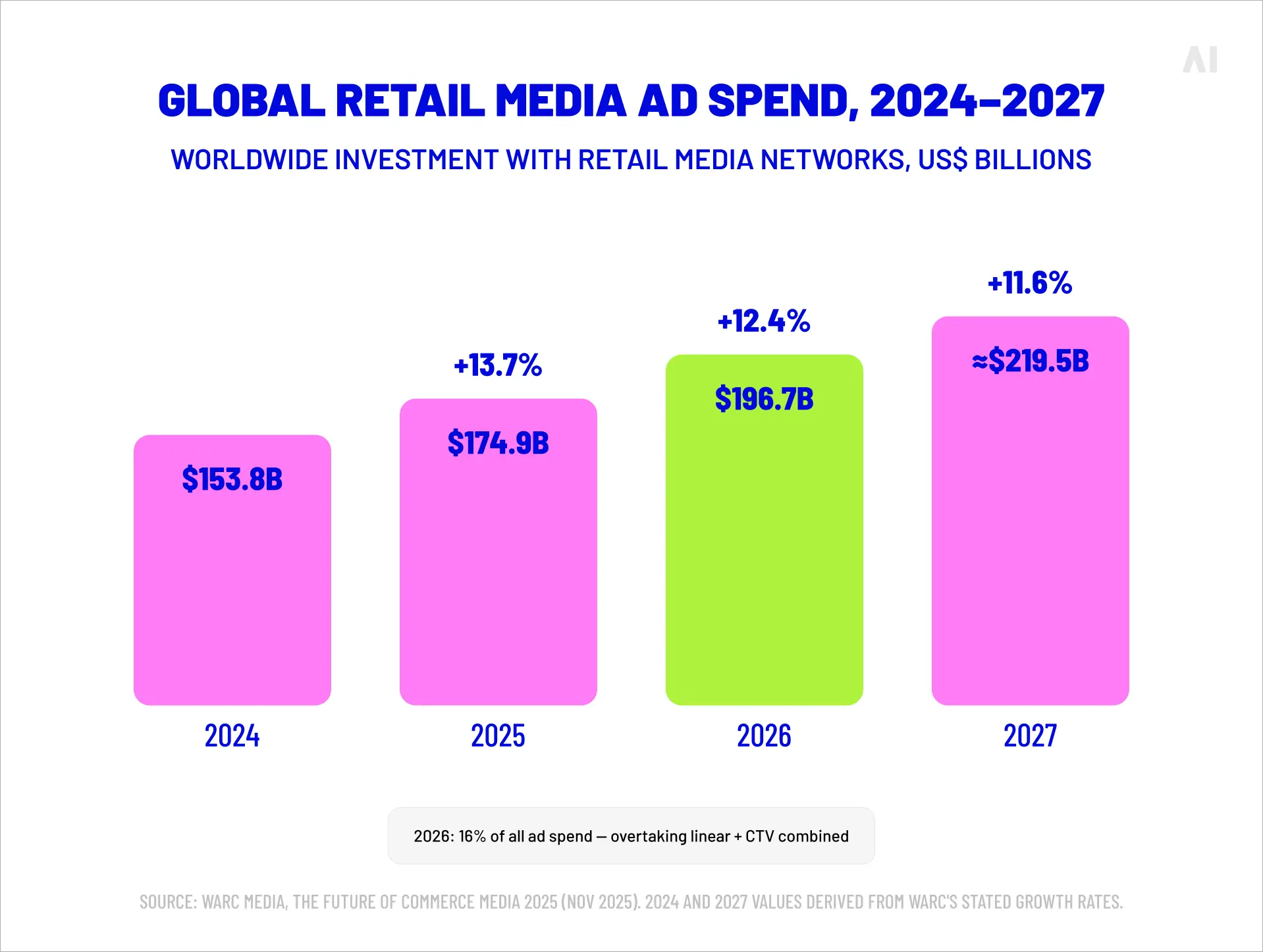
Momentum isn't just hype. More than half of advertisers (52%) are actively reallocating display budgets from open-web DSPs into retail media DSPs—and the economics are compelling for retailers themselves, with profit margins commonly in the 50–70% range for mature platforms, well above core merchandising. Growth is maturing, though: WARC expects topline growth to ease from 13.7% in 2025 to 12.4% in 2026 and 11.6% in 2027, which makes network selection and measurement discipline matter more.
This guide lays out the RMN landscape, how placements and data flows actually work, which networks lead—with a side-by-side comparison of the top eight—where measurement breaks, and what to fix.
You'll get a clear view of the trends that will define the next two years, from CTV convergence and off-site scale to agentic commerce.
TL;DR
- A retail media network (RMN) is an advertising platform run by a retailer that uses its first-party shopper data and owned inventory to let brands reach customers at the moment of purchase.
- Retail media is a $196.7 billion global channel in 2026—16% of all ad spend—overtaking linear and connected TV combined for the first time, per WARC.
- Amazon Ads, Walmart Connect and Target Roundel lead the field. See the full comparison table of eight networks below.
What is a retail media network?
A retail media network is an advertising platform operated by a retailer that leverages the retailer's first-party shopper data and owned media inventory to enable third-party brands to advertise directly to the retailer's customers.
Unlike traditional advertising networks, retail media platforms sit at the intersection of commerce and media, allowing brands to reach consumers at the exact moment they're making purchase decisions.
The power of a retail network lies in its unique position. Retailers possess data that reveals what customers actually buy, not just what they browse or click. This purchase data, combined with loyalty program information, browsing behavior, and demographic insights, creates highly accurate customer segments. When a brand advertises through a retailer's platform, it gains access to this valuable first-party data while the retailer maintains full control over customer information.
Retail media networks monetize three primary asset types:
- digital properties like websites and mobile apps,
- physical locations including in-store displays and screens, and
- customer data that enables precise targeting both on and off the retailer's owned channels.
This tri-faceted approach allows retailers to become media companies without abandoning their core business.
💡 The relationship between advertising technology and marketing technology plays a crucial role in how these networks operate. For a deeper understanding of how these systems work together, explore our guide on Adtech vs. Martech: Understanding the differences and synergy.
⚡ Retail media networks are making retailers into media owners with serious commercial influence, fundamentally changing the relationship between brands and the stores that sell their products.
How retail media networks work
Look under the hood of retail media and the appeal becomes clear. Through five core steps, these platforms connect what advertisers want with what shoppers do, then tie it all back to outcomes at the till.
Step 1: Inventory and data aggregation
Retailers compile their available advertising inventory across all channels. This includes:
- sponsored product placements on e-commerce sites,
- display banner positions on category pages,
- search result slots,
- mobile app advertising positions,
- email newsletter placements,
- in-store digital screens, and
- partner network opportunities.
Simultaneously, retailers organize their first-party data, which encompasses purchase histories, loyalty program information, browsing patterns, and demographic details.
This data foundation enables the precise targeting that makes retail media so effective.
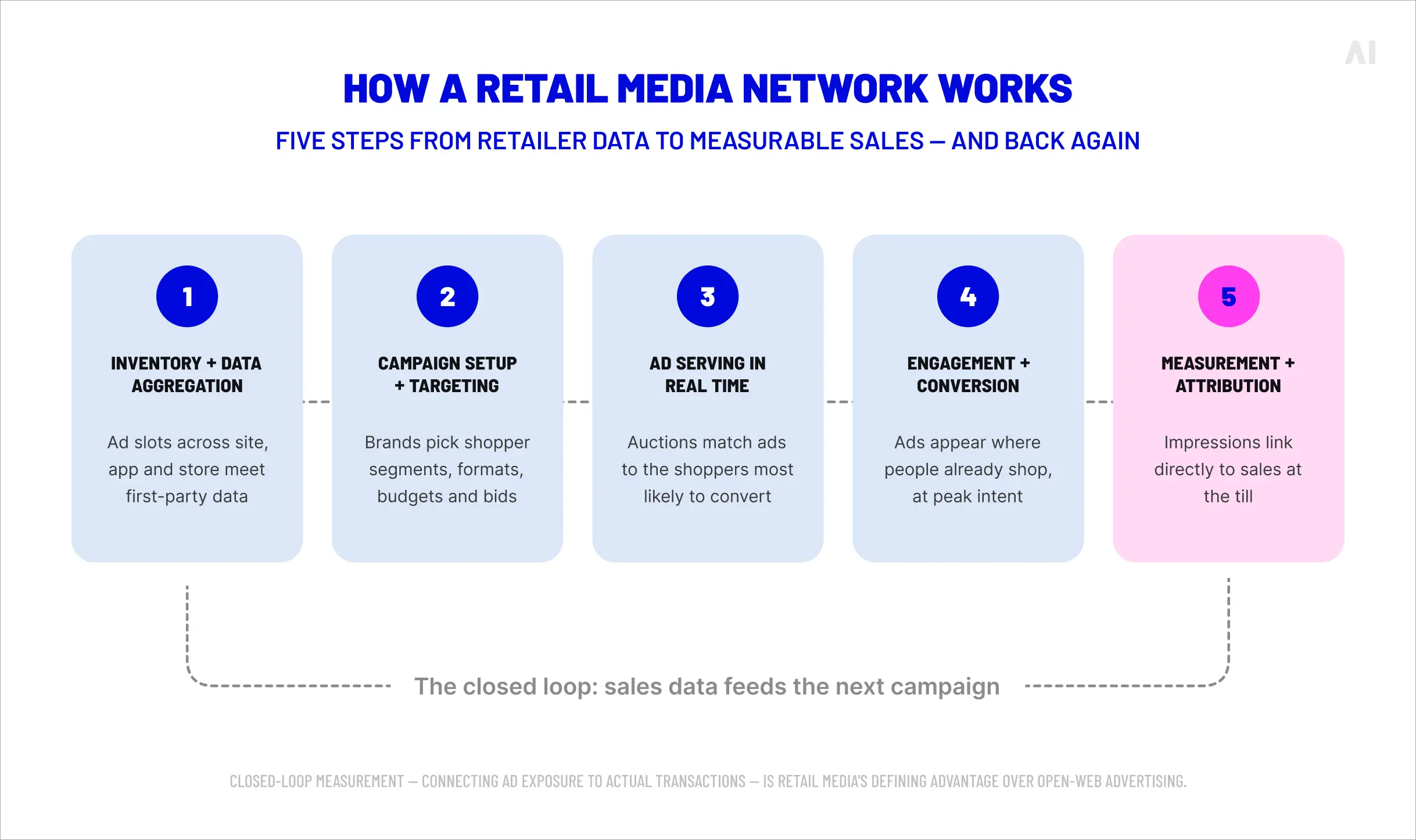
Step 2: Campaign setup and targeting
Brands access the retail media platform to define their campaign parameters. They:
- select target audience segments based on the retailer's shopper data,
- choose ad formats that align with campaign goals,
- set budgets and bidding strategies, and
- determine campaign timing.
Some retailers offer self-serve platforms where brands can manage campaigns independently, while others provide managed service options.
Increasingly, retailers integrate with demand-side platforms to allow programmatic access to their inventory, making campaign setup more efficient for advertisers managing multiple retail networks.
Step 3: Ad serving and real-time targeting
Once campaigns launch, automated systems match ads to the right shoppers at optimal moments. The retail media technology uses auction mechanisms to allocate impressions, applying the retailer's proprietary data to ensure ads reach users most likely to convert.
For example, someone searching for coffee on a grocery retailer's site might see sponsored listings from premium coffee brands, while a shopper with a purchase history in baby products could receive targeted ads for infant care items across various site pages.
Step 4: Customer engagement and conversion
Shoppers encounter these ads during their normal shopping journey, whether browsing online, using a mobile app, or walking through physical store aisles.
Because retail media ads appear exactly where customers are already shopping, they align with high purchase intent. When customers click on an ad and make a purchase, the retailer typically earns a percentage of the advertising spend or a commission based on sales generated.
Step 5: Measurement and attribution
The defining advantage of retail media is closed-loop measurement. Retailers can directly connect ad impressions to actual transactions using their customer data, providing brands with concrete metrics like
- return on ad spend,
- sales lift,
- conversion rates, and
- incremental revenue attributable to specific campaigns.
⚡ Closed-loop attribution is now the channel's chief pull factor: 57% of advertisers shifting display budgets into retail media DSPs cite it as their reason—something open-web programmatic can't match.
This attribution capability, which ties advertising directly to sales outcomes, represents a major advancement over traditional digital advertising metrics.
{{rmn-1}}
Types of retail media
Retail media advertising manifests across three distinct channel types, each offering unique advantages for reaching shoppers at different stages of their journey.
Onsite ads
Onsite advertising appears directly on the retailer's owned digital properties, including e-commerce websites, mobile applications, and other branded channels. These placements capture shoppers actively browsing or searching for products on that specific retailer's platform.
Common onsite formats include
- sponsored product listings that appear at the top of search results or category pages,
- display banners positioned on homepages and product detail pages,
- native advertising that blends with organic product content, and
- video ads featured on product pages or within app experiences.
On platforms like Amazon.com or Walmart.com, brands bid for premium placement when customers search relevant keywords, ensuring their products appear prominently during high-intent moments.
The strength of onsite retail media lies in reaching shoppers at the digital shelf when purchase intent peaks. These ads feel less intrusive because they integrate naturally into the shopping experience, often appearing indistinguishable from organic search results. For brands, onsite placement means competing directly at the point of decision.
Offsite ads
Offsite retail media extends the retailer's advertising capabilities beyond their owned properties by using first-party shopper data to target customers across external channels. Retailers partner with third-party publishers, social media platforms, streaming services, and programmatic ad exchanges to deliver targeted advertising while maintaining data privacy.
For instance, Kroger can use its shopper data to help brands target those same customers with ads on streaming TV services, news websites, or social media feeds. The customer never leaves their preferred content platform, but the ad targeting benefits from Kroger's knowledge of actual grocery purchase behavior.
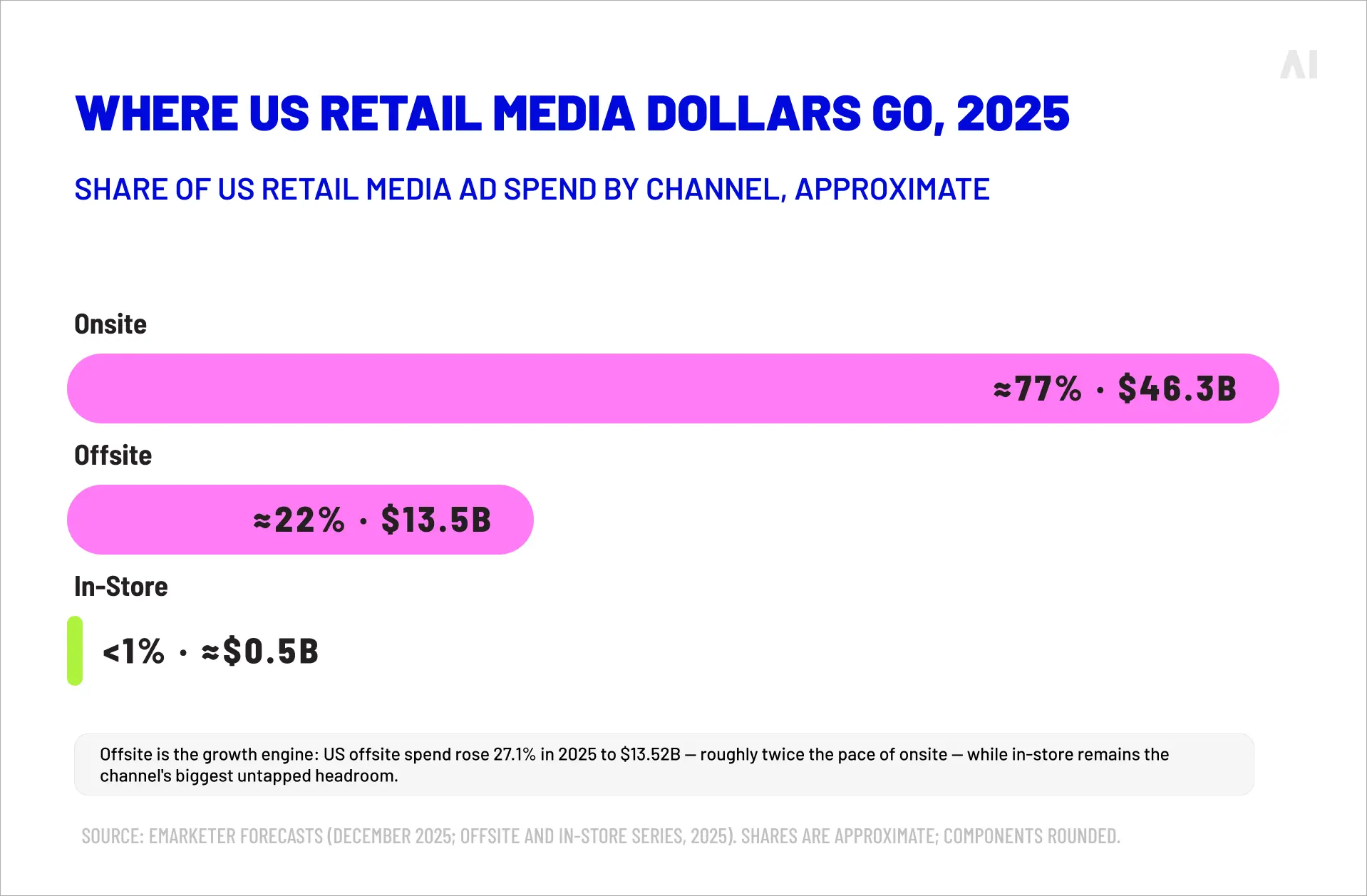
This approach dramatically expands reach beyond the limitations of owned properties. Off-site retail media ad spend is growing roughly twice as fast as on-site spend through 2026, as retailers push past the constraints of their own traffic. US off-site spend jumped 27.1% in 2025 to $13.52 billion, up from $10.64 billion the year before, per eMarketer—and every scaled network is now building off-site muscle, from Walmart's Vizio-powered CTV to Roundel's programmatic partnerships.
In-store retail media
Physical retail locations are becoming sophisticated advertising channels through digital screens, audio systems, interactive kiosks, and even smart shopping carts. Retailers are treating brick-and-mortar stores as the next major mass-media channel by deploying technology that delivers targeted messaging at the literal point of sale.
In-store formats include
- digital endcap displays and aisle screens showing product videos and promotions,
- electronic shelf labels that display dynamic pricing and offers,
- in-store audio announcements with sponsored messages, and
- checkout screen advertising that captures attention during the payment process.
Some retailers even place ads on screens in parking lots or at fuel pumps in their gas stations.
While still a small slice of total retail media spend, in-store advertising is accelerating. US in-store retail media ad spend is on track to pass $1 billion by 2028, per eMarketer—yet it still accounts for under 1% of the channel, even though the majority of retail sales happen in physical stores. eMarketer's 2026 forecast calls in-store "underdeveloped", which is precisely why retailers from Walmart to Best Buy are investing in screens, smart carts and digital shelf labels now: the gap between where people buy and where retail media money goes is the channel's clearest headroom.
{{rmn-2}}
Top retail media networks in 2026
A handful of heavyweight retailers anchor retail media, each with distinct data, formats, and reach. Knowing their strengths helps brands put budgets where they'll work hardest. The market is also concentrating: eMarketer estimates that around 89% of the incremental US retail media dollars added in 2026 will flow to just two players—Amazon and Walmart—which makes deliberate network selection the single most consequential planning decision in the channel.
Here's how the top eight networks compare.
{{rmn-3}}
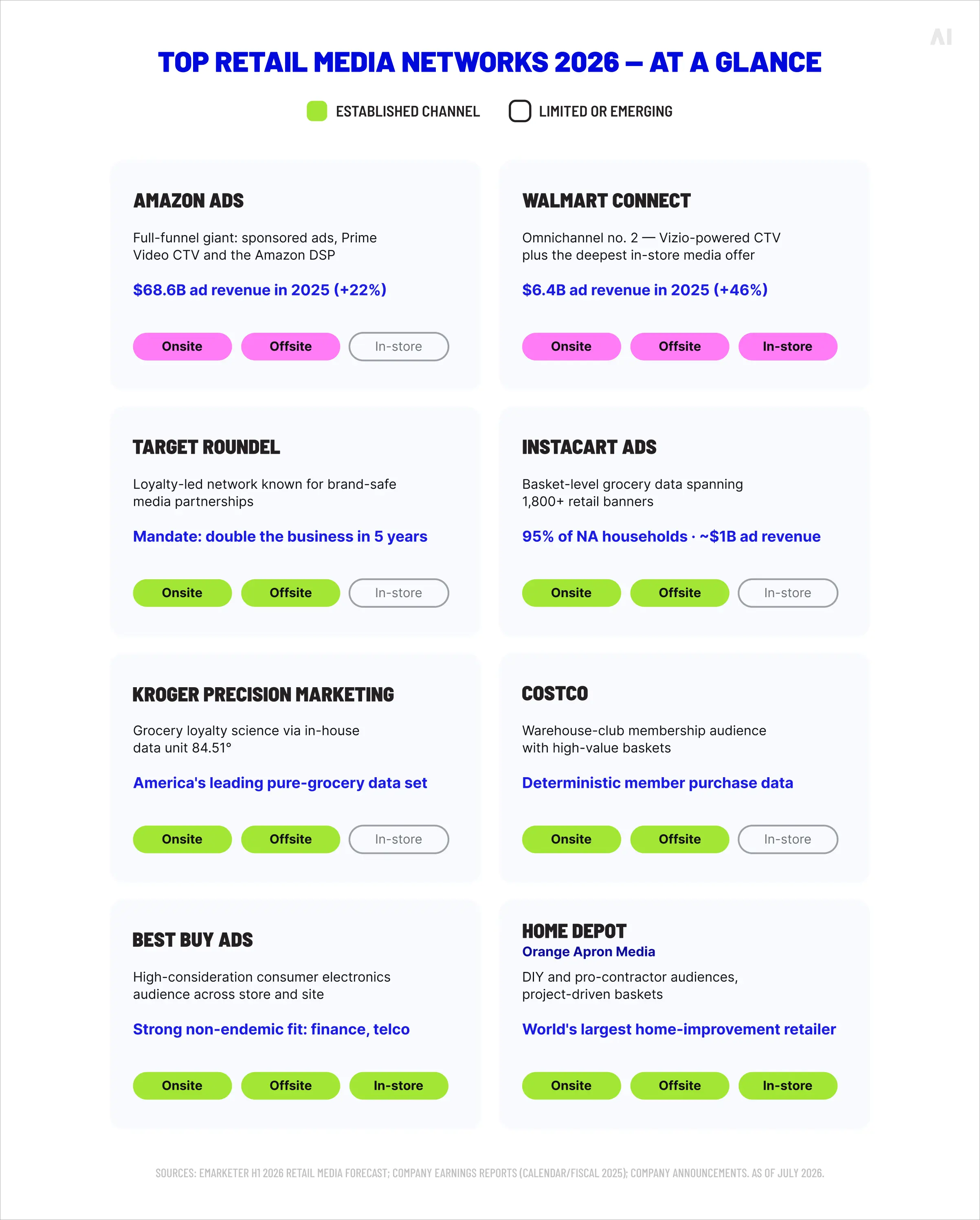
Beyond these major networks, numerous other retailers operate significant media businesses, including:
- Macy's Media Network,
- Albertsons Media Collective,
- CVS Media Exchange and
- DoorDash Ads.
Even non-retail companies in travel and finance are launching commerce media networks, with Marriott and Expedia offering ad placements using their customer data. The retail media arena continues expanding as any company with consumer data and touchpoints considers becoming an ad publisher.
💡 For a comparison of different advertising formats and when to deploy them across retail media channels, see Native ads vs. display ads and when to use each.
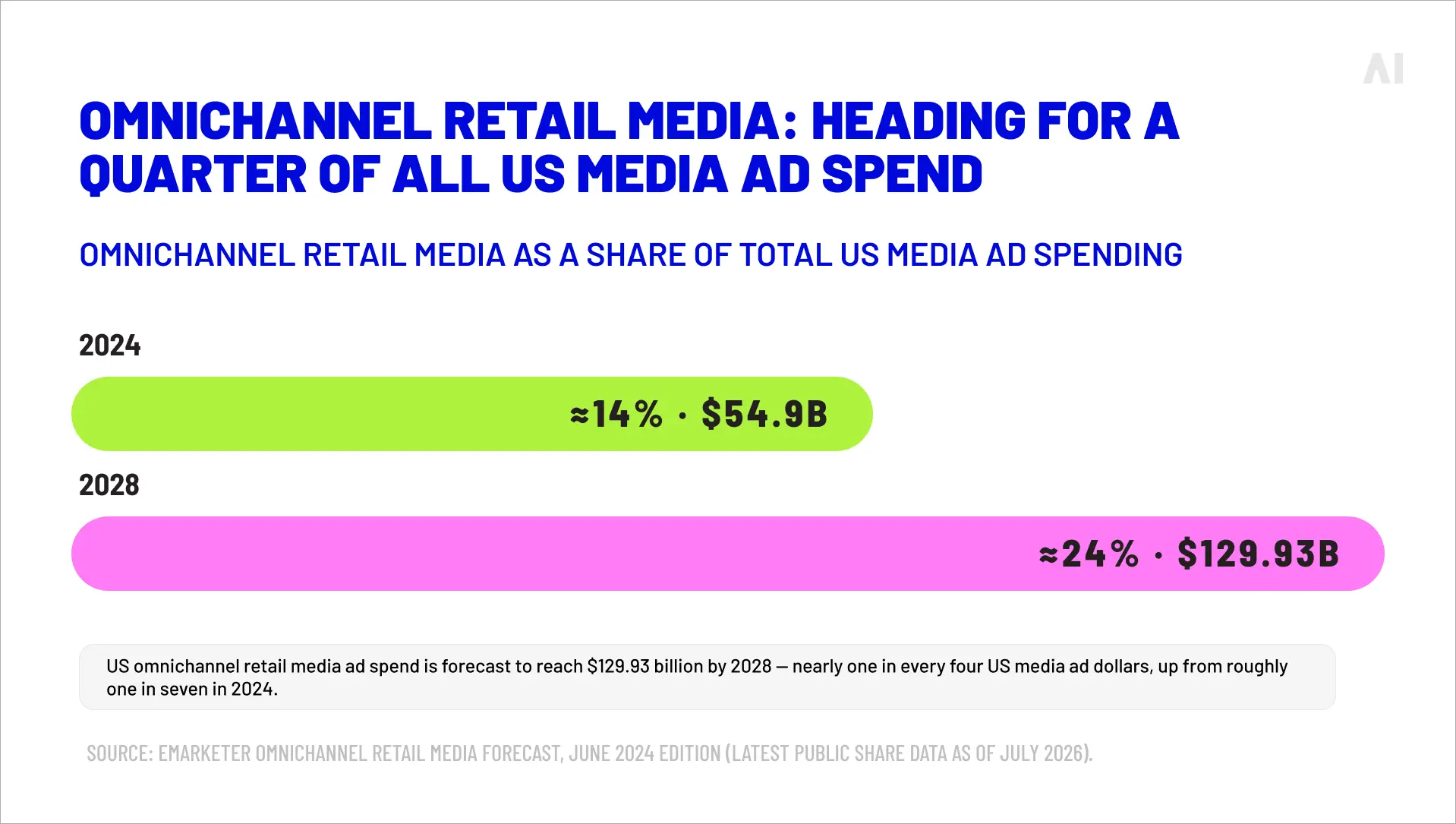
Benefits of retail media networks
Retail media platforms deliver compelling advantages for both advertisers seeking better campaign performance and retailers looking to diversify revenue. These benefits explain the channel's explosive growth.
Access to first-party data
Retail media networks provide advertisers with privacy-compliant access to retailers' first-party customer data, including purchase history, demographics, and loyalty membership information. In an era of disappearing third-party cookies, this wealth of shopper data proves incredibly valuable.
Brands can target based on actual purchase behavior rather than inferred interests. A beauty brand might reach "frequent beauty buyers" on a retailer's site using loyalty program data, creating precision impossible with open web advertising.
⚡ Advertisers are voting with their budgets: 52% are reallocating display spend from open-web DSPs to retail media DSPs—a direct bet on the value of retailer first-party data.
This data access enables better ad relevance and personalization, leading to more effective campaigns. Shoppers receive ads aligned with their demonstrated interests, improving both user experience and conversion rates.
Better targeting & personalization
Retailer data allows ads to be finely tuned to individual shopper interests and past behaviors, creating more personalized experiences than broad-based advertising can achieve. For consumers, retail media ads often feel more like helpful product recommendations than intrusive advertising, especially when integrated naturally into e-commerce sites.
A shopper who frequently purchases baby products might see tailored ads for new infant care items, while someone with a history of buying organic foods could receive promotions for premium organic brands.
⚡ Research indicates that 51% of brands and agencies cite data-driven targeting and personalization as a leading opportunity when using connected TV in retail media campaigns.
Closed-loop measurement (link sales directly to ads)
Perhaps the most significant advantage of retail media is the ability to directly measure advertising impact on sales. Retailers tie ad impressions to transactions using customer data, providing brands with granular attribution that other channels struggle to offer.
This closed-loop reporting delivers clear visibility into metrics like sales lift, conversion rate, and incremental revenue from campaigns. Brands can justify ad spend and optimize with real sales data rather than proxy metrics like clicks or impressions. As covered above, it's the single most-cited reason advertisers are moving display budgets into retail media DSPs.
High shopper intent = higher ROI
Retail media ads reach shoppers at the point of sale or discovery, benefiting from exceptionally high purchase intent. Consumers on a retail site or in a store are actively looking to buy, making ads served in these environments more likely to convert.
A sponsored product ad on a retailer's site can directly lead to an instant sale, producing more tangible outcomes than general display ads on random websites. This proximity to purchase typically translates to higher return on ad spend, with brands often seeing strong ROI that justifies shifting budgets from less accountable channels.
Monetization opportunities for retailers
For retailers operating these networks, retail media provides lucrative monetization beyond core retail sales. Essentially, it transforms retailers into media companies while maintaining their primary business.
Advertising revenue carries much higher profit margins than merchandise sales. As mentioned earlier, retailers operating RMNs often see profit margins above 50% on advertising revenue, extremely high compared to typical retail product margins. A grocery chain can generate substantial high-margin income by selling ad space to cereal brands targeting its shoppers.
Additionally, retail media can increase basket size and cross-sell by promoting related items, thereby lifting overall sales per customer. The advertising business strengthens the retailer's bottom line while enhancing the shopper's journey with relevant suggestions.
⚡ The profit margins on retail media often exceed 50%, turning traditional low-margin retail businesses into high-margin media enterprises without abandoning their core commerce operations.
What results look like
Retail media's promise is measurable outcomes, so it's fair to ask what the numbers actually show. Across the platforms Skai tracks, average return on ad spend held at 6.1x for five consecutive quarters through early 2025—remarkable consistency for a channel this young. And in Skai and Stratably's 2026 survey of 166 advertisers, seven in ten brands report meeting or exceeding their retail media goals.
Scale stories keep arriving too. Instacart Ads generates close to $1 billion in annual US ad revenue on the strength of basket-level grocery data. Walmart's ad business reached $6.4 billion globally in 2025, up 46%. And Amazon's advertising arm—$68.6 billion in 2025—now outearns most global media companies outright.
One caution belongs here: dashboard ROAS and incremental ROAS are not the same thing. Networks report last-click results that flatter performance, which is why incrementality testing—covered in the challenges section below—should sit alongside every headline number.
How to choose and get started with a retail media network
With brands already juggling six networks on average—and expecting that to reach eleven by the end of 2026—the question isn't whether to use retail media but which networks earn a place on the plan. Four filters do most of the work:
- Where your product actually sells. Closed-loop attribution only works where the transaction happens. A grocery brand belongs on Kroger, Instacart and Walmart before anywhere else; a power-tool brand starts with Home Depot and Amazon.
- Whose data answers your question. Loyalty-driven networks (Kroger, Target) excel at frequency and household penetration; membership models (Costco) offer deterministic purchase mapping; Amazon offers unmatched breadth. Match the data asset to the campaign objective, not the other way round.
- Which formats fit the funnel stage. Sponsored search converts demand that already exists. Offsite display, social and CTV build the demand—and are where the fastest growth is. If awareness is the goal, weight networks with strong offsite and CTV capability.
- What you can measure across all of them. Before adding a network, decide how you'll compare it with the ones you already run. Only 15% of brands report strong confidence in their retail media measurement—the brands that scale successfully build a cross-network measurement framework first and add networks second.
Getting started is straightforward on the major networks: most offer self-serve platforms with modest minimums for sponsored products, which makes a test-and-learn entry cheap.
- Start with one or two networks where your sales concentrate,
- establish baseline ROAS and incrementality, then
- expand deliberately—not because a network exists, but because it answers a question your current mix can't.
Retail media vs commerce media
You'll increasingly hear "commerce media" used alongside—or instead of—retail media.
The distinction is scope. Retail media is advertising sold by retailers using retailer data. Commerce media widens the definition to any company that monetizes transaction-based audiences: travel brands like Marriott and Expedia, payment players like Klarna, delivery platforms like Uber and DoorDash.
The industry is following the money—WPP Media now includes travel and financial-services networks in its forecasts, and on that wider definition commerce media reached roughly $178.2 billion in 2025, about 15.6% of all ad revenue and above total TV for the first time, with a projected 17.2% share by 2030.
For advertisers—the playbook you build for retail media (first-party data, closed-loop measurement, network selection discipline) will soon apply to a much wider set of sellers.
Challenges in retail media networks
Despite rapid growth and enthusiasm, retail media platforms face significant obstacles that both retailers and advertisers must address.
Walled gardens & fragmentation
Each retailer's media network operates largely as a walled garden where data stays contained and campaigns run in isolated platforms. Advertisers wanting to reach across multiple retailers must manage numerous separate RMNs, each with distinct systems and reporting.
⚡ As mentioned, brands now run six retail media networks on average and expect that to reach eleven by the end of 2026—yet the operational and measurement capabilities needed to manage that expansion aren't keeping pace. Fragmentation is capping the channel's growth.
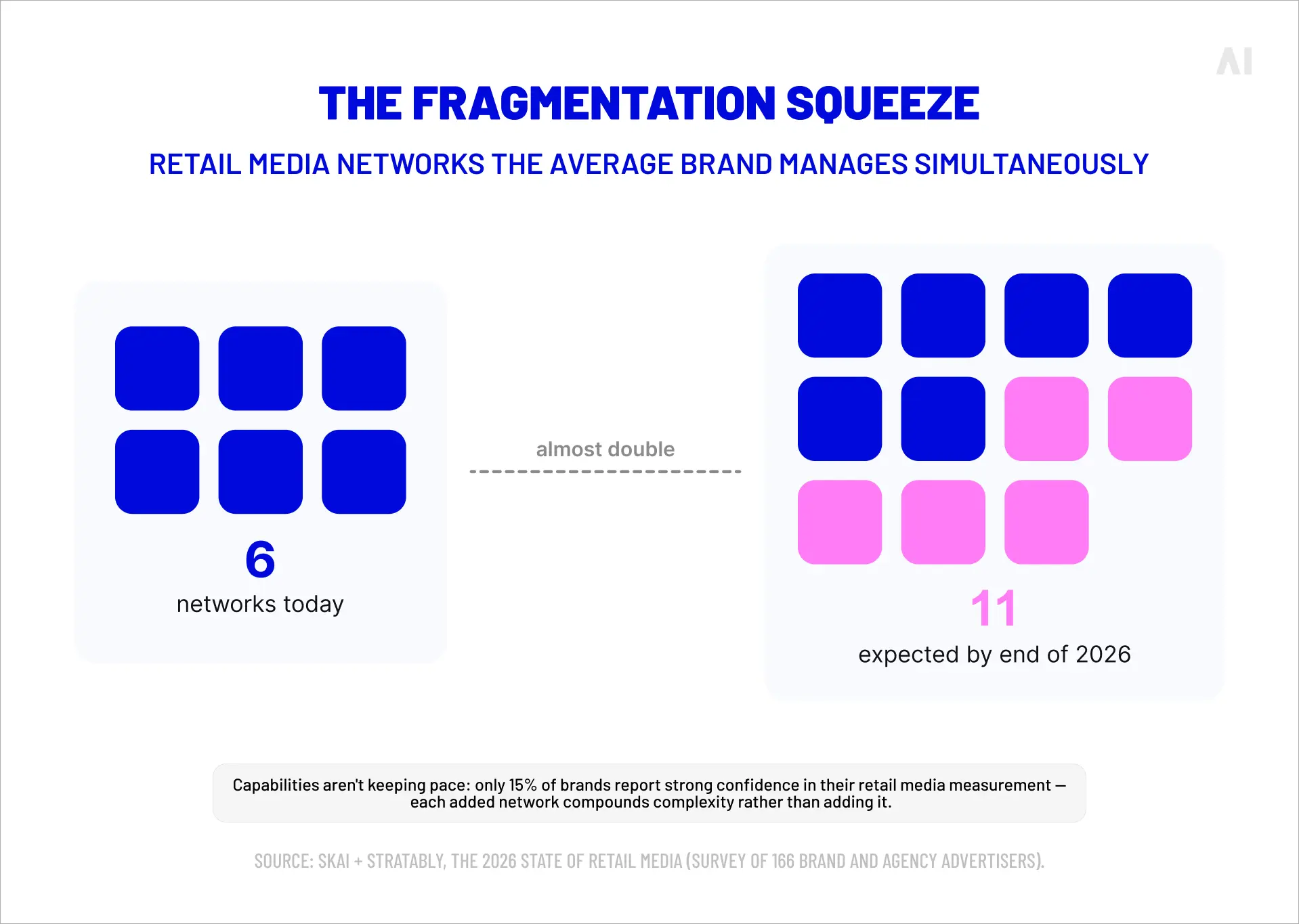
Each additional network means more contracts, more formats, more reporting and more internal confusion—complexity that compounds rather than adds. The walled-garden nature also prevents unified cross-platform frequency management and coordinated messaging across retailers.
High costs & competition
The most popular retail media networks have become highly competitive marketplaces where ad inventory can be expensive, especially for premium placements. Larger brands with substantial budgets often outbid smaller ones, squeezing out small and mid-sized businesses.
A major CPG can lock up top-of-search placements, squeezing the room for challengers. The math is unforgiving: on Amazon, page-one results capture at least 80% of clicks, and the first three listings soak up at least 60% of those. In auctions where prime positions cost more, incumbents with deeper budgets command the lion's share of shopper attention, leaving smaller brands to compete over lower-visibility inventory. And the concentration is intensifying: around 89% of the incremental US retail media dollars added in 2026 flow to Amazon and Walmart alone, per eMarketer.
Additionally, retailers often impose strict rules and fees, including minimum spend requirements and specific creative specifications, creating barriers for smaller advertisers. High entry costs mean smaller brands risk being left behind as big brands consolidate dominance on retail media platforms.
Limited standardization in measurement
Metrics and reporting standards vary widely across different retail media networks, making apples-to-apples evaluation difficult. One network might calculate return on ad spend one way while another uses different attribution windows or defines impressions differently.
The Interactive Advertising Bureau has noted that inconsistent measurement and lack of transparency around attribution windows and viewability hinder advertisers' ability to compare performance. The confidence gap is stark: only 15% of brands report strong confidence in their retail media measurement. Most networks still provide data post-campaign rather than in-flight, hampering optimization—and the leaders are pulling away precisely because they've built in-flight, data-driven decision-making.
Advertisers are calling for industry-wide standards and better third-party verification. The retail media space remains in flux on measurement practices, forcing marketers to piece together insights from each platform.
Balancing user experience with ad load
An inherent tension exists between monetizing every available space with ads and maintaining quality shopping experiences. If a retailer's site or app becomes cluttered with advertising, it frustrates customers and deters shopping.
Many retailers exercise caution with ad load, limiting the number of sponsored results on the first page or ensuring on-site ads don't slow page performance. Research across the US and Europe found brands complaining about on-site ad space limitations, as retailers can only show so many ads without harming the experience.
If too few ad slots are available to preserve user experience, that drives up competition and cost for those slots. Additionally, if ads are irrelevant or poorly integrated, they can hinder the shopping experience, turning consumers away. Retailers must carefully vet ad content and format while maintaining shopper trust and satisfaction.
💡 For broader context on retail marketing strategies that balance customer experience with commercial objectives, see Retail digital marketing strategies for 2026: driving growth in a digital-first world.
Retail media trends in 2026
Looking ahead, retail media is positioned for continued rapid evolution. Several key trends will shape the landscape through 2026 based on recent data and expert analysis.
Expansion into CTV & streaming platforms
Retail media networks are increasingly partnering with connected TV and streaming platforms to extend reach into living rooms. This convergence allows brands to use retailer data to target and measure ads on TV content, effectively combining high-intent shopper data with big-screen viewing.
Walmart's partnership with Disney—letting advertisers use Walmart's audience segments to buy ads on Disney's streaming services, with sales impact measured via clean rooms—has moved from experiment to established practice, and Walmart's acquisition of Vizio has since given it an owned CTV operating system. Roundel and Instacart have both expanded streaming partnerships too: the CTV convergence is now infrastructure, not a pilot.
Shoppable CTV ads, where viewers can see a product ad and easily purchase it via their phone or TV, are rising.
⚡ Data shows that 46% of consumers have made a purchase through shoppable media, with advertisers ramping up spend on these formats.
Expect more retail media-driven ads on streaming networks, interactive TV ads tied to retailer inventories, and possibly retailers launching their own streaming content.
AI-driven targeting, personalization—and agentic commerce
The use of artificial intelligence and machine learning in retail media will deepen significantly. AI can optimize ad placements, bidding, and creative personalization in real-time.
⚡ Only 41% of brands currently use AI for campaign activation—yet 59% of CPG executives expect AI agents to own the consumer relationship within five years. The gap between adoption and expectation is where the next advantage lies.
Retailers are deploying AI to better predict shopper behavior and serve ultra-tailored ads. Dynamic creative might change messaging based on a shopper's profile or current cart contents. Generative AI can automatically create ad variations or customize on-site content for each user.
The frontier beyond optimization is agentic commerce: AI assistants that research, compare and buy on shoppers' behalf. WARC puts the total addressable market at $136 billion in 2025, with a potential $1.7 trillion by 2030. For retail media, the implication is profound—when an AI curates the shopping journey, brands must win the algorithm's recommendation, not just the shopper's click. Expect networks to launch agent-facing formats and APIs through 2026–27.
💡 To explore how AI capabilities are being integrated into advertising platforms, learn about Smart Supply—an AI-powered curation tool that uses machine learning and historical data to neutralize platform inventory bias and optimize programmatic supply paths against your specific KPIs.
Retail media + programmatic integration
The integration of retail media networks with the broader programmatic advertising ecosystem is accelerating. Rather than remaining isolated platforms, RMNs are opening up via APIs and partnerships so advertisers can buy retail media inventory through familiar programmatic channels while using retailer data for targeting.
Walmart's DSP built with The Trade Desk allows programmatic access to Walmart audiences off-site, and partnerships between retailers and ad tech firms, DSPs, and social/CTV platforms keep extending these networks. Media buyers increasingly pursue full-funnel strategies across programmatic, CTV, and social using retail data.
Expect more retailers to integrate their data with open ad exchanges or preferred DSPs, enabling brands to plan retail media alongside other channels. This means more real-time bidding on retailer ad space and unified dashboards managing campaigns across multiple retail sites.
Retailers as publishers (content + commerce)
A notable trend involves retailers increasingly acting like media publishers, blending content and commerce to attract both consumers and ad dollars. Retailers are launching content platforms from editorial content and product guides to live shopping streams and retail-centric media productions, creating more advertising opportunities and engaging shoppers beyond transactional visits.
Some large retailers operate online magazines or recipe hubs that carry advertising, while others partner with media companies to produce shoppable content.
Expect more non-traditional players joining and traditional retailers producing richer content to keep consumers on their sites longer. A home improvement retailer might run a DIY content portal or YouTube channel with sponsored tutorials, integrating product ads within that content. Retail media networks are making retailers into media owners with serious commercial influence, blurring the lines between retailer and publisher.
Clean rooms & privacy-first measurement
As data privacy remains paramount, secure data collaboration methods like data clean rooms are becoming standard in retail media. Clean rooms allow retailers and advertisers to share and match data in a privacy-compliant way, attributing ad exposures to purchases without leaking personal information.
⚡ Roughly two-thirds (66%) of organizations now use data clean rooms in some form—yet fewer than half (48%) of US retail media networks offer clean-room capabilities. That gap is a differentiation opportunity for networks and a due-diligence checkpoint for brands.
The focus now shifts to making clean room integration seamless, embedding it into campaign workflows for always-on measurement and audience insights.
Retail media networks will increasingly offer built-in clean room solutions for advertisers, allowing brands to upload customer data to compare with retailer data and find overlaps without violating privacy. This improves multi-touch attribution, answering questions like whether a TV ad plus an on-site ad both contributed to a sale. Clean rooms will support advanced targeting such as creating custom audience segments combining brand and retailer insights.
Expect clean rooms to be a norm in retail media deals, enabling privacy-first measurement and data partnerships. This ensures that even as third-party signals disappear, retailers and brands can still collaborate on data safely.
⚡ Privacy-enhancing technologies like data clean rooms are not optional add-ons but foundational infrastructure for retail media's next phase, enabling measurement and collaboration without compromising consumer trust.
Conclusion: Why retail media is the future of advertising
Retail media networks have established themselves as an essential channel for modern advertisers, combining the targeting precision of first-party data with the attribution certainty of closed-loop measurement. For brands, the opportunity is clear: reach high-intent shoppers at the moment of purchase decision and prove exactly how advertising drives sales.
- Brands should invest in RMNs now because the channel is still maturing—but the window is narrowing. With growth settling into low double digits per WARC, the land-grab phase is closing. Early movers gain experience optimizing campaigns, build relationships with retail media sales teams, and secure inventory before competition intensifies further. Waiting means entering a more crowded, expensive marketplace.
- When deciding between onsite, offsite, and in-store retail media, consider your campaign objectives. Onsite placements excel at direct response and conversion when shoppers are actively browsing products. Offsite retail media works for awareness and consideration, reaching customers across their digital lives with retailer data precision. In-store media captures attention at the physical point of sale, particularly valuable for impulse categories and experiential campaigns.
- How RMNs fit into omnichannel campaigns depends on coordinating messaging across touchpoints. A customer might see a brand's offsite retail media ad on streaming TV, search for that product on the retailer's website and see an onsite sponsored listing, then encounter an in-store display while shopping. This coordinated approach, powered by the same retailer data, creates consistent experiences that drive results.
- AI and CTV will reshape the retail media landscape by making targeting more precise and extending retail media's reach into premium video inventory. AI-driven optimization will help brands manage the complexity of multiple retail networks while maximizing return on investment. CTV integration brings retail media to the biggest screen in the home, combining the impact of television with the accountability of digital advertising.
The retailers winning in this space will balance monetization with user experience, invest in technology infrastructure that makes campaigns easy to execute, and prioritize transparency in measurement. For brands, success requires treating retail media as a distinct channel with unique characteristics, not simply another place to run display ads.
If you'd like to turn these insights into a plan that fits your budget, reach out to AI Digital; we'll design the channel mix, set the right tests, and build a measurement framework you can rely on.