Black Box AI in Marketing: Risks and Limitations

A peculiar inversion has taken hold inside most marketing organizations over the past two years. Budgets, bid strategies, audience definitions, creative selection, and attribution credit are being assigned by AI systems running on data the marketer cannot see, against logic the platform will not disclose, optimized toward objectives the model interprets in its own way.
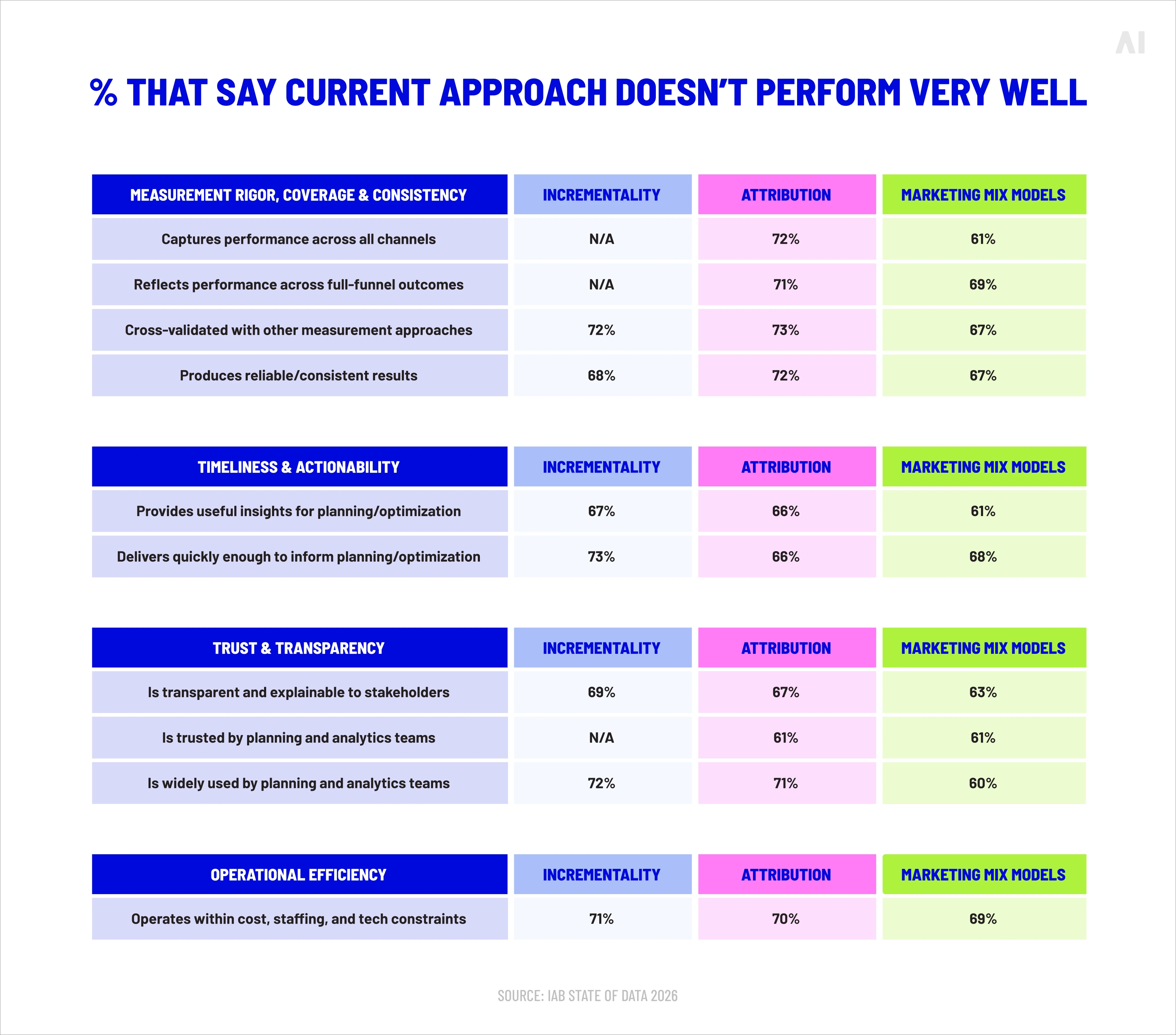
When campaigns perform well, this rarely registers as a problem. When budgets get misallocated or performance dips, the absence of explanation becomes acute. Teams find themselves reacting to outputs without the ability to interrogate inputs, and the gap between what AI is doing and what marketers can verify has become the single most consequential blind spot in digital advertising. The Interactive Advertising Bureau's State of Data 2026 report found that 60–75% of buy-side users of advanced measurement say current systems fall short on rigour, timeliness, trust, and efficiency — figures that hold even as AI adoption inside those same systems accelerates.
The point worth making early is that the problem is not AI itself. AI has produced real, measurable improvements in efficiency, scale, and personalisation. The problem is the kind of AI that arrives without a window into its own reasoning—what's known as black box AI—and the speed at which marketers have come to depend on it. The disadvantages of AI in digital marketing show up most clearly when something goes wrong and no one can say why.
This piece sets out where AI is making decisions that affect performance and revenue, why opacity in those decisions is a structural rather than tactical issue, and what marketing teams can do to rebuild visibility, validate outputs, and align AI with business outcomes rather than platform metrics.
What is black box AI in digital marketing?
Black box AI describes any system that produces decisions or recommendations without revealing how those decisions were reached. The system takes inputs, runs them through layers of statistical and machine-learning models, and returns outputs—bids, audiences, creative selections, attribution credit—but the internal logic is either hidden by design or genuinely too complex for human interpretation, even by the engineers who built it. From the marketer's perspective, the practical effect is the same: a confident output, no auditable reasoning behind it.
The black box exists for understandable commercial and technical reasons. Platforms protect proprietary algorithms because those algorithms are the product. Modern deep-learning architectures, including the neural networks behind most predictive bidding and audience modelling, achieve their accuracy precisely because they identify patterns no human-readable rule set could capture, which makes those patterns difficult to translate into plain-language explanations. Add the speed at which decisions are made—millions of bid auctions per second, audience refreshes in near real time—and explanation becomes computationally and commercially expensive in ways that platforms have little incentive to absorb.
What this produces, at scale, is a marketing function increasingly dependent on systems whose outputs it can observe but whose decisions it cannot validate.
Where black box AI is making decisions
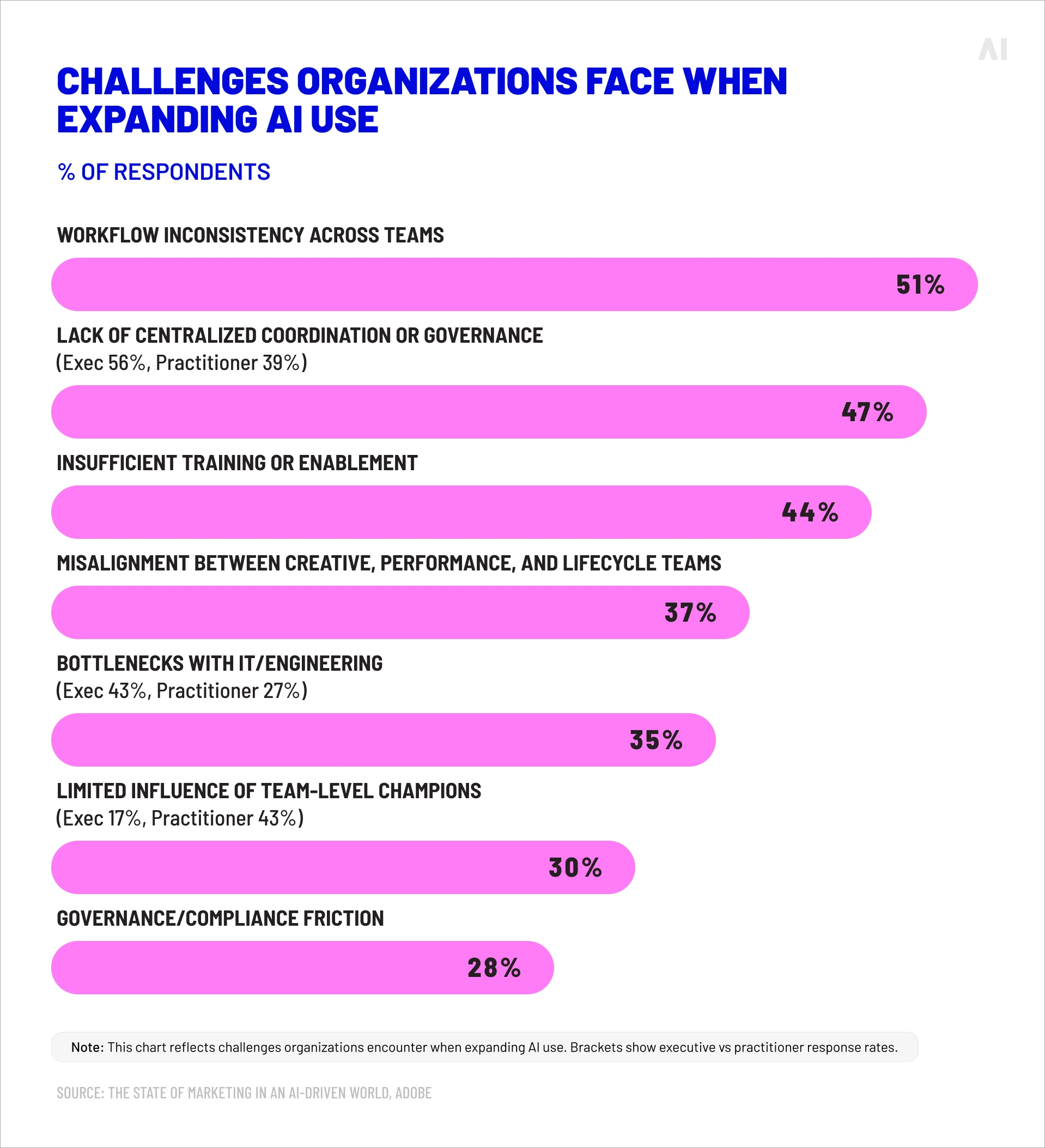
Black box AI is no longer confined to experimental tools or specialist functions. It is embedded in the day-to-day mechanics of media buying, audience definition, creative delivery, and performance measurement—the four areas where most marketing budgets are actually allocated. Each one operates with a different kind of opacity, but the underlying issue is the same: decisions that materially affect outcomes are being made without visibility into the logic behind them.
The four domains below cover where the practical impact is largest. Each warrants a closer look because the failure modes differ.
⚡ The black box describes the cumulative effect of automated decisions made faster than any team can audit them—rarely a single piece of technology.
Media buying and budget allocation
Inside any modern programmatic stack, AI models decide which impressions are worth bidding on, how much to bid, and how to redistribute budget between channels in flight. The efficiency case is real—algorithmic media buying processes far more signal than human teams could evaluate—but the visibility case has eroded sharply. When a DSP shifts spend from one publisher cluster to another mid-flight, the marketer typically learns about the shift through a performance report rather than through any prior signal of intent. The reasoning behind the move, the alternatives the system considered, and the confidence level of its decision are not generally exposed to the buyer.
The consequence is that budget is being optimized against the platform's objective function, which may or may not reflect the advertiser's commercial priorities. Where the two diverge—and they often do, particularly when platform metrics like impressions or click-through favour the platform's own inventory or revenue-share economics—the misalignment is invisible until results are reconciled against business KPIs weeks later.
Audience targeting and lookalike modeling
AI builds audiences the way no manual segmentation ever could: by ingesting behavioural, contextual, transactional, and interest signals across millions of profiles and identifying clusters that resemble high-value users. Lookalike modelling, predictive segmentation, and propensity scoring all rely on these inferences, and they account for a substantial share of how reach is now defined inside walled gardens and DSPs.
The problem sits in two places.
- The first is composition: marketers cannot generally see which signals the model weighted most heavily when defining a segment, which means they cannot tell whether the audience reflects their intended target or a statistical proxy that happens to correlate with conversion in the training data.
- The second is adjustment: once segments are deployed, they evolve. Models retrain on new data, drop or add features, and reshape audiences in ways the buyer is rarely notified about. Bias enters through data gaps—under-represented groups, atypical purchase paths, geographies with thinner signal—and propagates downstream into AI-targeted advertising decisions that were never explicitly authorised.
💡 Related reads: Transparency in advertising
Creative optimization and personalization
Dynamic creative optimization systems test, swap, and personalize creative at a scale that human teams cannot match—different headlines, images, calls to action, and offers served to different audience clusters and refreshed against live performance data. The performance case for automated creative is well established. The control case has weakened in step.
Three issues recur.
- Brand consistency suffers when creative variants are generated, ranked, and rotated outside the visibility of brand teams, with the AI selecting on engagement metrics that may reward attention-grabbing combinations the brand would not otherwise approve.
- Differentiation suffers because most platforms train on similar engagement signals, which tends to converge creative output toward a recognisable house style across competing advertisers.
- And learning suffers, because the marketer rarely receives a clear account of which creative elements actually drove performance—only that one variant outperformed another, with the explanation reduced to a confidence interval.
The trade-off between AI-driven personalization and creative governance has become one of the more contested arguments inside agency–brand relationships.
Attribution and performance measurement
Attribution is where black box AI does the most damage to decision-making, because the output of an attribution model determines how every other AI system gets evaluated. Multi-touch attribution, data-driven attribution inside ad platforms, and AI-assisted marketing mix modelling all produce confidence-rated credit assignments to channels and touchpoints—but the model assumptions, lookback windows, deduplication logic, and weighting decisions sit largely inside the platform that runs them.
The result is that the same campaign, evaluated against the same conversions, can produce dramatically different attribution outcomes depending on which model runs the calculation. The IAB found that none of its surveyed buy-side decision-makers believe all paid channels are well-represented in current marketing mix models—a quiet admission that the systems generating performance signals are not capturing the activity they claim to be capturing.
Decisions about where to scale, where to cut, and how to rebalance budget are being made on attribution outputs whose underlying logic the marketer cannot inspect, validate, or independently reproduce.
The core disadvantage of AI in marketing: no visibility
The practical core of the problem is that black box systems produce confident outputs without explaining the logic behind them, which forces marketing teams into a reactive posture they were not designed for. The team can observe what happened—spend shifted, audience expanded, conversion credit moved—but cannot answer the question that matters most after the fact: why.

The downstream effects are predictable.
- Optimization slows because teams cannot test hypotheses against the system's behaviour.
- Decision cycles lengthen because every meaningful change requires reconciling outputs from multiple platforms, each with its own opaque logic.
- Budget allocation drifts toward whichever channel reports most aggressively against a metric the marketer has not validated, because in the absence of independent visibility, platform-reported performance tends to win the argument by default.
Visibility, in this context, is not a transparency-for-its-own-sake concern. It is the precondition for control. Without it, marketing teams become administrators of decisions they did not authorise and cannot meaningfully influence—and the disadvantages of AI in marketing show up not as catastrophic failures but as cumulative drift away from business priorities, accumulating one unexplained optimization at a time.
Risks and limitations of black box AI in marketing
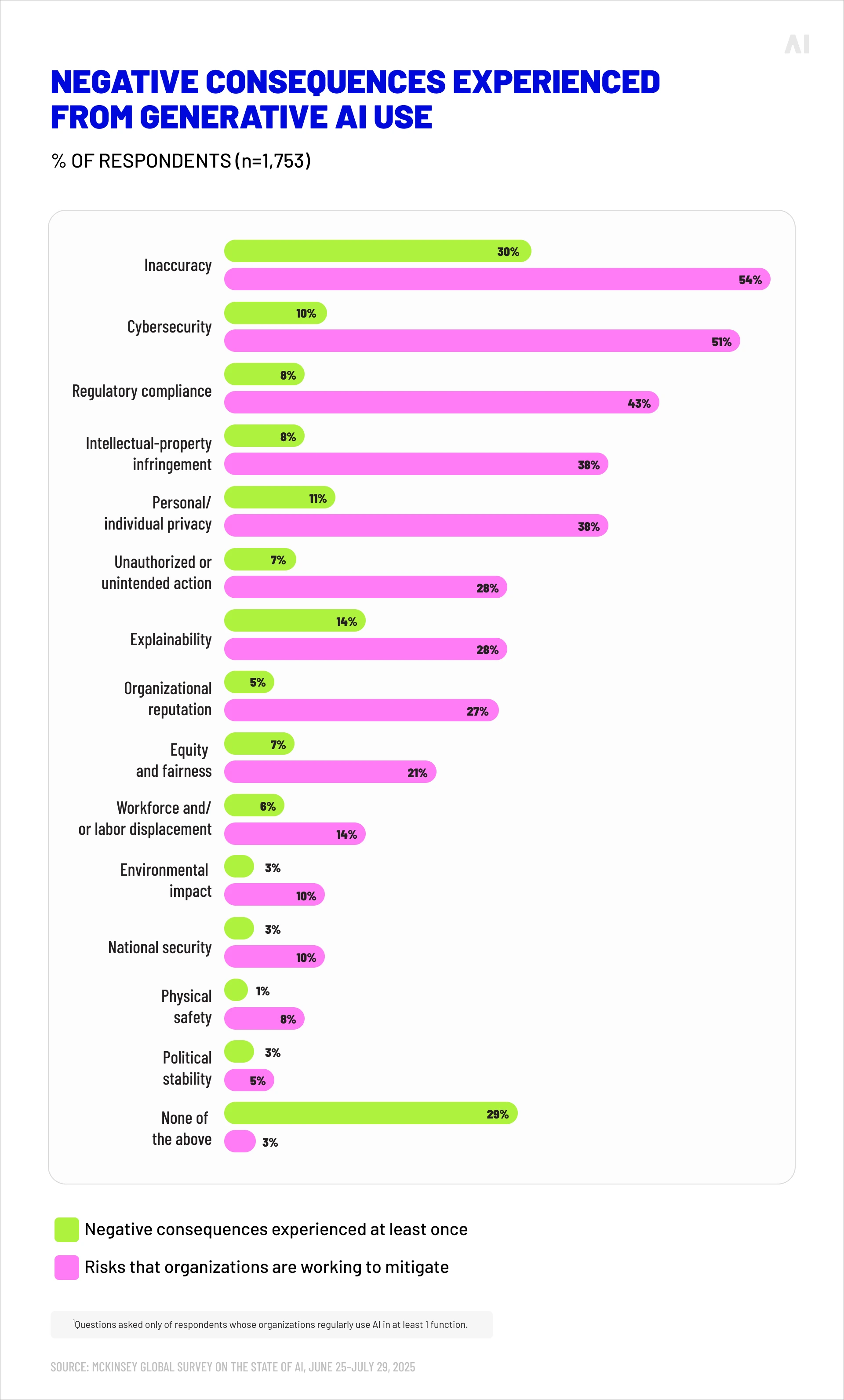
The risks of opaque AI in marketing fall across six broad categories, each one tied to a specific failure mode in how decisions are made or validated. They show up at different stages of the campaign cycle, but they share a common origin: the gap between what the system does and what the marketer can see.
Decisions without explainable logic
The first and most foundational risk is that AI outputs arrive without justification. A bid lands, a segment expands, an attribution model assigns credit—and the explanation stops at the result. For high-stakes decisions, this is a structural problem rather than an inconvenience, because it forces teams to accept outcomes they cannot verify or correct. Gartner has predicted that more than 40% of agentic AI projects will fail by 2027, citing inadequate guardrails and weak transparency as primary causes—a forward indicator of where unexplainable automation tends to break.
Misaligned optimization
AI systems optimize toward whatever objective they're given, and inside most ad platforms that objective is a media metric — clicks, viewable impressions, completed views, attributed conversions.
The misalignment with business outcomes is not theoretical. A campaign optimized toward CPM efficiency can deliver outstanding cost-per-thousand and underwhelming revenue. A model rewarded for click-through can consistently shift budget toward placements that produce traffic without conversion.
Without a separate measurement layer aligned to revenue or margin, the team learns about the misalignment through the quarterly numbers rather than in time to correct it.
Data bias and skewed targeting
AI models inherit the biases in their training data, and in advertising those biases tend to be systematic rather than random.
- Under-represented groups are reached less often because the model has weaker signal for them.
- Atypical purchase paths get under-weighted because the model treats them as noise.
- Categories with thinner first-party data are served by proxies whose accuracy degrades silently over time.
The downstream cost is not only reduced reach quality and wasted spend; it is also exposure to brand and regulatory risk when targeting decisions look discriminatory in retrospect, even when no bias was intentionally encoded.
AI, market disruption, and cross-functional demands are expanding the CMO's remit, but not their resources. To stay relevant, CMOs must stop prioritising execution and instead lead through strategic insight. — Sharon Cantor Ceurvorst, VP, Research, Gartner Marketing Practice (Gartner, November 2025)
Over-reliance on platform algorithms
A specific kind of black-box risk emerges when an entire performance function runs inside a single platform's AI. Walled gardens tend to combine the buying interface, the targeting model, the optimization algorithm, and the measurement system in one closed loop, and that consolidation makes independent validation almost structurally impossible. Decisions about creative, audience, and bid get made inside the platform; the performance numbers that justify those decisions get reported by the same platform. The advertiser is left validating the system against itself.
The risk is not that any given platform is inaccurate. The risk is that the dependency removes the buyer's ability to make objective comparisons across platforms, evaluate alternatives, or build a measurement view independent of any single algorithm's account of itself.
💡 Related reads: Alternatives to Walled Garden Reporting: Building Independent Cross-Channel Visibility
Inaccurate predictions and measurement gaps
Predictive models perform best on data that resembles their training set, and they degrade—quietly and without warning—when conditions change.
Privacy-driven signal loss, third-party cookie deprecation, and the migration of audiences across platforms have all shifted the underlying data environment in ways that historical models were not built to handle.
Attribution outputs that look authoritative on a dashboard may be running on incomplete inputs, with assumptions baked in that no longer match the channel mix actually being measured.
The IAB estimates that better-modernized measurement could unlock $26.3 billion in media investment plus $6.2 billion in productivity value over the next one to two years—a figure that quietly indicates the scale of what current systems are getting wrong.
💡 Related reads: Marketing Attribution Challenges: Why Traditional Attribution Models Don't Work Anymore | Attribution Is Broken: Why Traditional Models No Longer Work
Privacy, compliance, and data risk
AI models in marketing process personal and behavioural data at scale, often through inference and combination steps that are themselves opaque. Where the data flow into and out of a model cannot be cleanly traced, regulatory exposure accumulates—under the EU AI Act, GDPR, the various US state privacy laws, and the disclosure obligations associated with automated decision-making in advertising.
Gartner reports that 76% of enterprises now cite data privacy and security as their top AI risk, and the share is rising as enforcement actions catch up with the speed of deployment.
💡 Related reads: Navigating AI Marketing Compliance: Our Partnership with GetGenAI | The Problem with Platform-Reported Data: Why You Can't Trust the Numbers
Why traditional dashboards don't solve the problem
Dashboards are easy to mistake for visibility. They aggregate, visualize, and summarize—but what they show is the output of decisions already made, not the logic that produced them. A team can spend an entire quarter watching its dashboards refresh in real time without ever moving closer to understanding why budget moved between channels, why an audience expanded or contracted, or why a creative variant outperformed another. The interface is informative; the underlying system remains opaque.
The deeper problem with dashboards in an AI-driven environment is that they tend to reinforce the dependency they're meant to mitigate. Teams build their decision rituals around the metrics the platform exposes, which means the questions they ask are constrained to the answers the platform is willing to report. Anything outside that frame—the trade-offs the model considered, the alternatives it dismissed, the assumptions it ran on—is structurally absent from the conversation.
The result is a kind of measured drift: confidence in the numbers grows over time precisely because the numbers are visible, even as the system producing those numbers becomes harder to interrogate.
4 Steps to reduce AI black box risk in marketing
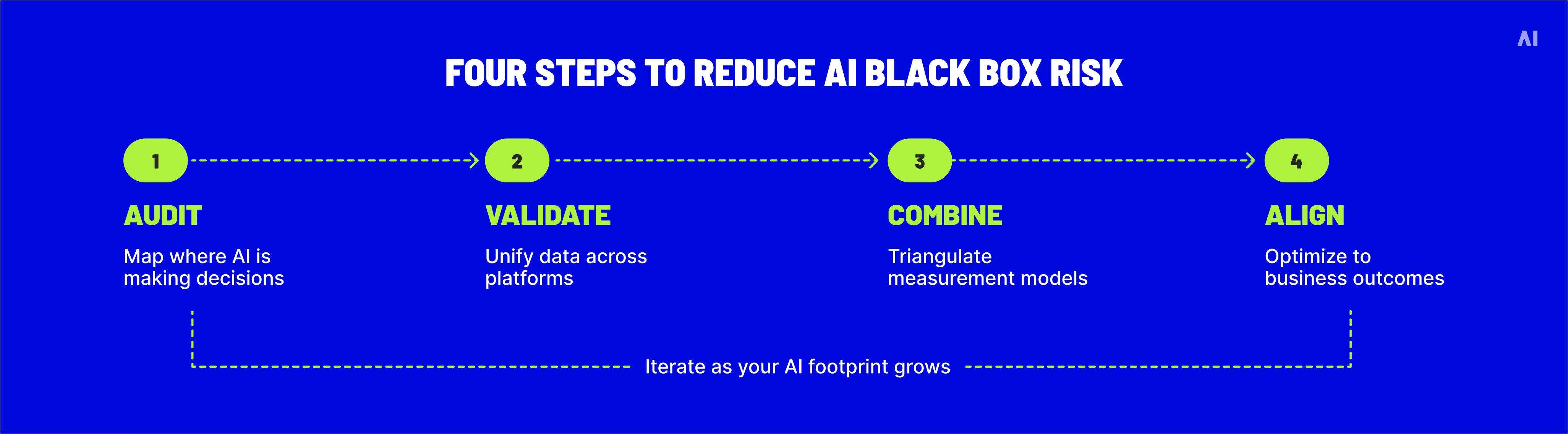
There is no single technology choice that resolves opacity in AI-driven marketing. What works in practice is a set of disciplined moves that re-establish visibility at the points where decisions matter most—and that compound, over time, into a more controllable operating model. The four steps below are sequential but iterative; most organizations cycle through them more than once as their AI footprint grows.
💡 Related reads: Creating a Data-Driven Marketing Strategy | Marketing Measurement Strategy: How to Measure and Optimize Performance Across Channels
1. Audit where AI is making decisions
The first move is the simplest and the one most often skipped. Map every place inside the marketing operation where an AI model is making or materially influencing a decision—not just the obvious ones (bid pricing, lookalikes, attribution) but the second-order ones (creative ranking, send-time optimization, churn scoring, send-list curation, generative content selection).
The point of the audit is not to remove AI from those decisions but to know they are being made, by which system, against which objective, with which inputs.
Prioritize the audit by financial exposure: where would a wrong decision cost the most? Most teams find that media buying and attribution top the list, with audience modelling close behind. Those are the systems whose outputs deserve the strictest validation regime.
2. Validate and unify your data
AI is only as reliable as the data it runs on, and data quality issues are amplified rather than corrected by sophisticated models. Inconsistent audience definitions across platforms, conflicting conversion taxonomies, and unsynchronised attribution windows all produce AI outputs that look authoritative but rest on incoherent inputs.
The work here is unglamorous and material in equal measure: aligning definitions, reconciling identifiers, validating event tracking, and establishing a single source of truth for the metrics that decisions are made against.
Effective cross-platform measurement governance is what separates AI that improves over time from AI that confidently compounds the same underlying errors.
💡 Related reads: Unified marketing measurement: What It Is and Why It Matters
3. Combine measurement models
No single measurement approach captures the full picture of AI-driven performance, and relying on one is a faster route to misallocation than most teams recognise.
- Multi-touch attribution shows touchpoint contribution but mis-credits channels with weaker tracking.
- Marketing mix modelling captures top-funnel and offline impact but operates at lower temporal resolution.
- Incrementality testing isolates causation but is expensive to run continuously.
Combining the three — and using each to triangulate against the others—is what produces a measurement view robust enough to challenge any single AI system's reporting. Mixed media modelling is one component of that triangulation; the broader principle is that different models should disagree productively rather than be forced into false consensus.
💡 Related reads: Media Mix Optimization: How to Use MMM for Budget Allocation | Best Attribution Models for B2B and Long Sales Cycles
4. Align optimization with business outcomes
The single most consequential move for reducing black box risk is also the one most consistently neglected: aligning AI optimization against business outcomes rather than platform metrics. Most ad platforms default to optimizing for impressions, clicks, viewable rate, or attributed conversions because those are the metrics they can measure inside their own systems. The metrics that actually matter to the business—revenue, margin, customer lifetime value, retention—generally sit outside the platform and require deliberate effort to feed back into the optimization loop.
The discipline involves two components.
- First, define a small set of business-aligned digital marketing KPIs that genuinely reflect commercial priorities.
- Second, invest in the data plumbing required to flow those KPIs back into the platforms where AI is making decisions, so the systems are optimizing against the right objective in the first place.
Without that loop, even excellent AI will efficiently pursue the wrong target.
💡 Related reads: Display Ad KPIs That Actually Drive Performance (Not Just Reports)
⚡ Visibility lives in the system underneath the dashboard, and rebuilding it is the precondition for AI that earns its trust rather than asks for it.
From black box AI to marketing intelligence with AI Digital
The shift that matters here is not from AI to no-AI, and it is not from automation to manual control. It is from AI that operates as a black box to AI that operates as an intelligence layer—one where decisions are connected to verifiable inputs, where the reasoning behind outputs is exposed rather than hidden, and where optimization runs against objectives the business has explicitly chosen rather than ones the platform has assumed.
This is the operating model AI Digital has built across three connected components: Elevate, Smart Supply, and the Open Garden Framework. Each addresses a different vector of black-box risk identified earlier in this article, and together they form an integrated marketing intelligence approach rather than a stack of tools.
Gartner's research on AI trust, risk, and security management (AI TRiSM) found that organizations operationalising AI transparency, trust, and security can see a 50% improvement in adoption, business goals, and user acceptance—a useful indication of what visibility actually returns when it's engineered into the system rather than bolted on afterwards.

💡 Related reads: From Data to Decisions: How Marketing Intelligence Transforms Performance Strategy | Integrated Marketing Systems: How to Connect Data, Channels, and Performance
Enabling transparent decision-making
Elevate is AI Digital's marketing intelligence platform, and its operating premise inverts the usual platform relationship: rather than gating clients out of the system that makes decisions on their behalf, it places them inside it.
Research, planning, optimization, and reporting run as a single intelligence layer connected across the digital ecosystem, with 150 billion data points refreshed monthly and over 10,000 audience attributes available for inspection rather than abstraction.
The platform's modules—AI Audience Segments, Audience Personas, Competitive Analysis, Advanced Planning, Path to Conversion, MMM—are designed so that the rationale behind each AI recommendation is visible to the team using it, not absorbed into a closed model.
The practical effect is that decision drivers become legible. Why an audience was constructed a particular way, what the AI-Assisted Media Planner considered when shaping a scenario, which signals are weighted in a forecast, where MMM credit is being assigned and why—these stop being trade secrets and become inputs to a working conversation between the platform and the team relying on it.
Improving control and efficiency in media buying
Smart Supply addresses the supply-side half of the black-box problem, where opaque routing, hidden intermediary fees, and unverified inventory quality eat into working media without showing up cleanly in performance reports. By selecting and optimizing supply paths against KPI performance rather than against any one SSP or DSP's commercial preferences, Smart Supply restores visibility into where media spend is actually landing—and removes the unnecessary auction hops that inflate costs while degrading impression quality.
The unbiased orientation matters because supply selection is one of the few places where opacity has a direct, measurable cost: every dollar spent on a supply path the buyer cannot inspect is a dollar partially controlled by the seller.
Reducing platform dependency
The Open Garden Framework is AI Digital's structural answer to the dependency risk created by single-platform algorithms. Working DSP-agnostically across more than fifteen demand-side platforms, it allows performance data, audience signals, and optimization logic to flow across the boundary between walled gardens and the open internet rather than getting trapped inside any one ecosystem.
The framework makes cross-channel decision-making genuinely possible, because the data underneath those decisions is not hostage to a single platform's account of itself.
⚡ Opacity is not a price worth paying for performance, because in practice it stops being performance the moment the team responsible for it cannot validate the result. Marketing intelligence — visible, vendor-agnostic, and built around business outcomes—is what makes AI accountable rather than merely impressive.
💡 Walled gardens vs. the open internet and the Open Garden Framework explainer cover the structural argument in more detail.
Conclusion: from black box AI to smarter marketing decisions
Black box AI is not going away. The performance gains are too real and the operating economics too favourable for marketers to abandon it, and few would want to. What has to change is the assumption that opacity is the price of those gains. It isn't. Teams that have rebuilt visibility into their AI decision-making—by auditing where it operates, validating the data it runs on, combining measurement models to triangulate its outputs, and aligning optimization against business KPIs rather than platform metrics—are not getting less performance from AI. They're getting more, because they can correct misalignment before it compounds.
The shift this article has been describing is not a rejection of automation. It's a maturation of it: from AI as a tool that makes decisions on the marketer's behalf to AI as an intelligence layer the marketer operates inside, with the reasoning behind each decision available for inspection and adjustment. Marketing teams that make that shift—through their own processes, through better data discipline, or through partners and platforms built around transparency—get the efficiency without the dependency, and the scale without the loss of control.
If your team is rethinking how AI is shaping decisions inside your marketing operation, AI Digital combines a marketing intelligence platform (Elevate), supply path discipline (Smart Supply), and a vendor-agnostic execution framework (Open Garden) to put visibility back inside the system. We'd welcome the conversation — reach out here.