AI Marketing Platforms vs Marketing Automation Platforms: What’s the Difference?

The conversation about marketing technology has shifted in a way most CMOs felt before they could name. For two decades, marketing automation was the answer. Build the workflow, set the triggers, schedule the sends, watch the leads move through. The machinery worked, more or less, when channels were few, customer journeys were linear, and the data fit on one screen. None of those conditions still hold.
Today's marketing leader oversees a stack that, by ChiefMartec's count, sits inside an industry of more than 15,000 commercial tools—most of them running their own logic, optimizing their own metrics, and giving conflicting answers to the same question. Customers move across paid, owned, and earned touchpoints in patterns no rule-based system was designed to anticipate. Privacy regulation has thinned the signal. Budgets are flatter than they were. And the question every senior marketer is being asked has changed shape: not "did the campaign run?" but "did the spend produce measurable business outcomes?"
That shift is what's exposing the difference between marketing automation platforms and AI marketing platforms, and it's the difference between execution and decision-making. Marketing automation platforms execute predefined workflows. AI marketing platforms make and optimize the decisions those workflows are trying to act on. The two are not the same category, and treating them as substitutes is part of why so many martech investments quietly fail to pay back.
The point of this piece is practical: not to argue that AI replaces automation, but to map where each belongs, where AI marketing platforms outperform, and how senior teams are restructuring their stacks to capture both. The honest answer is that most companies will end up using both, but only if they understand which is doing what.
What is a marketing automation platform?
A marketing automation platform is a system designed to execute predefined workflows across channels — email, CRM, lifecycle campaigns, web personalization, lead scoring—without manual intervention at each step. Think Marketo, HubSpot, Salesforce Marketing Cloud, Pardot, Eloqua: tools that streamline repetitive tasks, route customer interactions through pre-built logic, and reduce the operational burden of running campaigns at scale.
The category emerged to solve a real problem. Before automation, marketing meant manual list pulls, hand-coded emails, and one-off send schedules. Automation made it possible to nurture leads, score behavior, and run lifecycle sequences at volumes a human team could not maintain. The premise—and it remains valid—was that operational efficiency was the bottleneck, and that scripting it away would free marketers to focus on strategy.
That premise still holds, partially. The platforms still streamline work that nobody should be doing by hand. What's changed is what counts as the bottleneck. With customer journeys fragmented across dozens of channels and the need for real-time decisioning becoming the norm rather than the exception, "what to send" has overtaken "how to send it" as the harder problem to solve. Marketing automation platforms were built for the second question.
How marketing automation platforms work
Most marketing automation platforms run on the same underlying logic: predefined rules, triggered by events, applied to segmented audiences. A user fills out a form, a workflow fires. A behavior threshold is crossed, a sequence advances. A list is updated, a send is queued.
The actions are scheduled, branched, and conditional—sophisticated, in their way—but they are still rules. The platform does what it was told to do, when it was told to do it. The intelligence sits in the configuration, not in the system. Whoever built the workflow decided in advance what the right action was for each combination of input and context. The platform's job is to execute that decision faithfully and at scale.
This is automation in the strict sense: speed, repeatability, and reliability applied to tasks whose answers are already known. It is excellent for what it does. The trouble starts when the questions stop having known answers.
Key limitations
The limitations of marketing automation platforms are not bugs; they are direct consequences of the design. The system runs the rules it has been given. It does not learn which rules were wrong, propose better ones, or adapt when conditions change.
Three structural limits show up everywhere.
- First, adaptability: rule-based systems cannot optimize dynamically across channels because they have no model of cross-channel performance to optimize against.
- Second, single-channel myopia: most automation platforms are built around one channel—email, primarily—and bolt on others in ways that rarely produce coherent cross-channel logic.
- Third, manual maintenance: every new behavior, segment, or scenario requires a human to map the rule. The cost of staying current scales linearly with complexity, while the complexity itself scales exponentially.
The Duke CMO Survey's spring 2026 edition, conducted in January 2026 with 308 marketing leaders at U.S. for-profit companies, found that the most cited capability shortfall reported by marketing leaders was a lack of resources—people, time, and budget—to make existing capabilities effective, particularly in areas tied to AI, analytics, and marketing technology. The point is not that the tools are too few. It's that the human and organizational layer that makes the tools intelligent has not kept up.
💡 Related reads: Why fragmented martech stacks kill marketing performance
What is an AI marketing platform?
An AI marketing platform is a system that unifies cross-channel data, applies machine learning to detect patterns and predict outcomes, and continuously optimizes the decisions a marketing organization is making—about audience, budget, channel mix, message, and timing. Where automation executes, AI marketing platforms decide.
That distinction is doing more work than it might first appear. An AI marketing platform is not simply automation with a faster engine, or automation with generative AI bolted on for content production. It is a different layer of the stack—one that sits above execution and tells it where to point. The question it is engineered to answer is not "how do I send this?" but "what should I send, to whom, on which channel, with which budget, right now?"
The category has matured quickly. McKinsey's State of AI 2025, surveying 1,993 respondents across 105 countries, found 88% of organizations now use AI in at least one business function—up from 78% the year before, with marketing and sales the function most consistently reporting revenue increases attributable to AI use. The shift from experimental pilots to operational deployment has happened. The next question, which the same research makes uncomfortably clear, is whether organizations have built the infrastructure to capture value from what they've already adopted.

💡 Related reads: AI in marketing automation | What is an AI marketing platform? Definition, features, and how it works
How AI marketing platforms work
The mechanics are easier to describe than to engineer. AI marketing platforms ingest cross-channel data—campaign performance, audience behavior, conversion signals, supply-side metrics, external context—at volumes that would defeat manual analysis. Machine learning models identify patterns: which segments are converting where, which channels are saturated, which budget shifts would compound, which creatives are decaying. Predictive models forecast outcomes for proposed actions. The system then either recommends or directly executes the optimization, watches what happens, and updates its priors.
The crucial property is continuous learning. Every campaign, every conversion, every shift in audience behavior becomes signal that improves the next decision. Where a marketing automation platform is essentially static—it runs the rules it was given until someone changes them—an AI marketing platform is adaptive by construction. The Duke CMO Survey reports that AI and machine learning now power 17.2% of all marketing efforts, a 100% increase since 2022, with marketing leaders projecting 157% growth over the next three years to reach 44.2% of all activities. That trajectory is not a forecast. It is what's already happening.
💡 Related reads: How AI transforms performance marketing: from data to optimization
Business impact on marketing operations
The business impact lands in three places.
- Manual optimization shrinks, because the system is doing the work that media planners and analysts used to do by hand.
- Decision speed accelerates, because the cycle between observation, analysis, and action collapses from weeks to minutes.
- And continuous performance management replaces periodic review, because the campaign is being actively managed by the system between the dashboards a CMO actually looks at.
This is what people mean when they say AI changes the rhythm of marketing. The work isn't faster automation. It's a different operating model—one in which strategy and creative remain human, but the optimization layer sitting underneath them runs continuously, on data the team would not otherwise see in time to act on.
Business benefits of artificial intelligence marketing platforms
The benefits of AI marketing platforms cluster around four outcomes that senior marketers are now expected to defend in front of finance: higher ROI, less wasted spend, faster decisions, and the ability to scale without proportionally scaling headcount. Each connects directly to a question CMOs are being asked, and each illustrates where AI marketing platforms produce value that automation alone cannot.
Higher marketing ROI
AI marketing platforms drive higher return on marketing investment by continuously optimizing the variables that determine performance—audience targeting, channel mix, budget allocation, creative selection—against the business outcomes that actually matter. Where rule-based optimization stops at the boundary of what was anticipated, AI platforms keep going.
The mechanism is straightforward:
- The system runs thousands of micro-decisions per day, each informed by what it has just learned.
- Budget gets reallocated mid-flight from underperforming channels to ones that are converting.
- Creative variants get rotated based on engagement decay.
- Audience segments get refined as behavioral patterns emerge.
None of this is genuinely possible inside a marketing automation platform, because the platform doesn't have the model to reason about it. It is the natural mode of an AI platform.
💡 Related reads: AI targeted advertising
Reduced wasted spend
In 2025, the Association of National Advertisers found only 41% of programmatic ad spend resulted in quality impressions—viewable, valid, non-fraudulent—meaning roughly 60% of the dollars going into the open programmatic market produced nothing the brand could meaningfully count. The waste is structural. It comes from underperforming inventory, supply paths bloated with intermediaries, and targeting that optimizes to the platform's metric rather than the brand's.
AI marketing platforms address this by operating at the layer where the waste is generated. They identify which channels are underperforming on the brand's actual KPIs, which supply paths produce real engagement versus which produce billable impressions, and where budget is being absorbed without proportional return. No optimization rule, however clever, solves a problem the system cannot see. The fix is visibility.
💡 Related reads: From fragmented to sustainable: rethinking the programmatic supply path
Faster decision-making
The decision speed argument is sometimes made in cartoonish terms—"AI makes decisions in milliseconds!"—that obscure what's actually changing. The shift is not that decisions are faster. It is that the gap between observation and action has closed. McKinsey's research finds that AI high performers are 2.8 times more likely than their peers to have fundamentally redesigned workflows around AI—which is, when you read it carefully, a statement about decision architecture, not technology adoption.
In practical terms: the system spots performance shifts faster than a human team could; it surfaces those shifts as recommendations or executes them within guardrails; the team approves, intervenes, or strategizes from a position of knowing rather than guessing. The decision does not get easier. It gets earlier.
Scalable cross-channel growth
Scaling without breaking is the unglamorous prize. Most marketing teams hit a complexity ceiling somewhere around five active channels, beyond which coordination overhead consumes the gains. AI marketing platforms remove that ceiling by treating cross-channel optimization as a single problem rather than a stack of single-channel problems.
The cross-channel measurement gap is documented and stubborn. Nielsen's 2025 Annual Marketing Report found that only 32% of marketers globally measure their media spending holistically across digital and traditional channels . That figure dropped to 23% in Europe. When teams cannot measure across channels, they cannot optimize across them either. AI platforms close that gap from both directions: ingesting unified data and outputting decisions that respect the cross-channel system, not the channel silo.
AI marketing platforms vs Marketing automation platforms: Key differences
The AI vs marketing automation comparison is best understood as a difference in what each system is for, not what it does. Both manage marketing activity. Only one of them was built to make the activity better at scale. The table below summarizes the contrast at a feature level; the sub-sections below it walk through the implications.
{{26-AI-Marketing-Platforms-vs-Marketing-Automation-Platforms-1="/tables"}}
💡 Related reads: AI marketing platform vs traditional martech stack
Execution vs decision-making
Marketing automation does what it is told. An AI marketing platform works out what to do. That statement is straightforward, and it captures the AI vs automation distinction more honestly than most longer ones.
- Automation answers the question of how an instruction is carried out.
- AI platforms answer the question of what the instruction should be in the first place.
Conflating the two is the most common reason organizations buy AI tools and find themselves disappointed: they have replaced a hammer with a more expensive hammer, when what they needed was a different shop.
Rule-based workflows vs adaptive systems
The rule-based model assumes the future resembles the past closely enough that a human can describe it in advance. The adaptive model assumes it doesn't. In a stable environment, rules win on speed and predictability. In a volatile one—which is to say, in any current marketing environment—adaptive systems win because rules degrade, and degrading rules generate worse outcomes the longer they run.
Channel-level vs cross-channel optimization
Most automation platforms optimize within a channel. They make email better, or social better, or display better. AI marketing platforms optimize across channels—moving budget between them, sequencing them, recognizing that a customer who saw a CTV ad and clicked a search result is a single customer rather than two attribution events. The difference compounds as channels multiply.
Static campaigns vs real-time optimization
A static campaign runs as configured. A real-time-optimized campaign adjusts targeting, message, and budget allocation based on live performance signals, often within the same flight. The static campaign is a bet placed before the race. The optimized campaign is a position adjusted while the race is being run.
Manual control vs autonomous intelligence
Manual control is the model in which the platform does what the operator says, and the operator's expertise determines the ceiling. Autonomous intelligence is the model in which the system makes the routine decisions itself, escalating exceptions for human judgment. The trade-off is real: organizations have to give up some of the granular control they used to have over each individual lever. What they gain, in return, is the ability to act on insight at a speed and scale no team can match.
💡 Related reads: Advertising intelligence
How artificial intelligence enhances automation
Artificial intelligence and automation are most usefully understood not as competitors but as layers.
⚡ Marketing automation is the execution layer; AI is the decision layer.
Each is doing a different job, and the most sophisticated marketing organizations are now using both—explicitly and deliberately, with clear lines about which is responsible for what.

In this architecture, the AI marketing platform analyzes cross-channel data, identifies what should happen next, and instructs the automation platform to do it. The automation platform—the existing email engine, the CRM workflow, the campaign management system—receives the instruction and executes faithfully. Neither replaces the other. The point is to stop asking the automation platform to do work it was never designed for, and to give it intelligent instructions instead.
This is not theoretical. It's what the better-resourced marketing teams are quietly already doing: keeping the automation infrastructure they've spent years building, layering AI-driven decisioning on top, and using the combination to turn the existing stack into something more responsive than the sum of its parts. The integration is the lift, not the rebuild.
⚡ The most sophisticated marketing organizations have stopped treating AI and automation as competing investments. They've started treating them as different layers of the same system—and the gains have been disproportionate to either alone.
💡 Related reads: Integrated marketing systems: how to connect data, channels, and performance
From automation to agentic AI: beyond workflows
If automation is execution and AI marketing platforms are decisioning, agentic AI is the next stage—systems that don't just decide, but plan, act, and adapt across multi-step workflows with minimal human input. The distinction is that agents can hold goals across a sequence of actions, maintain context, use tools, and re-plan when conditions change. They are, in the strict sense, autonomous.
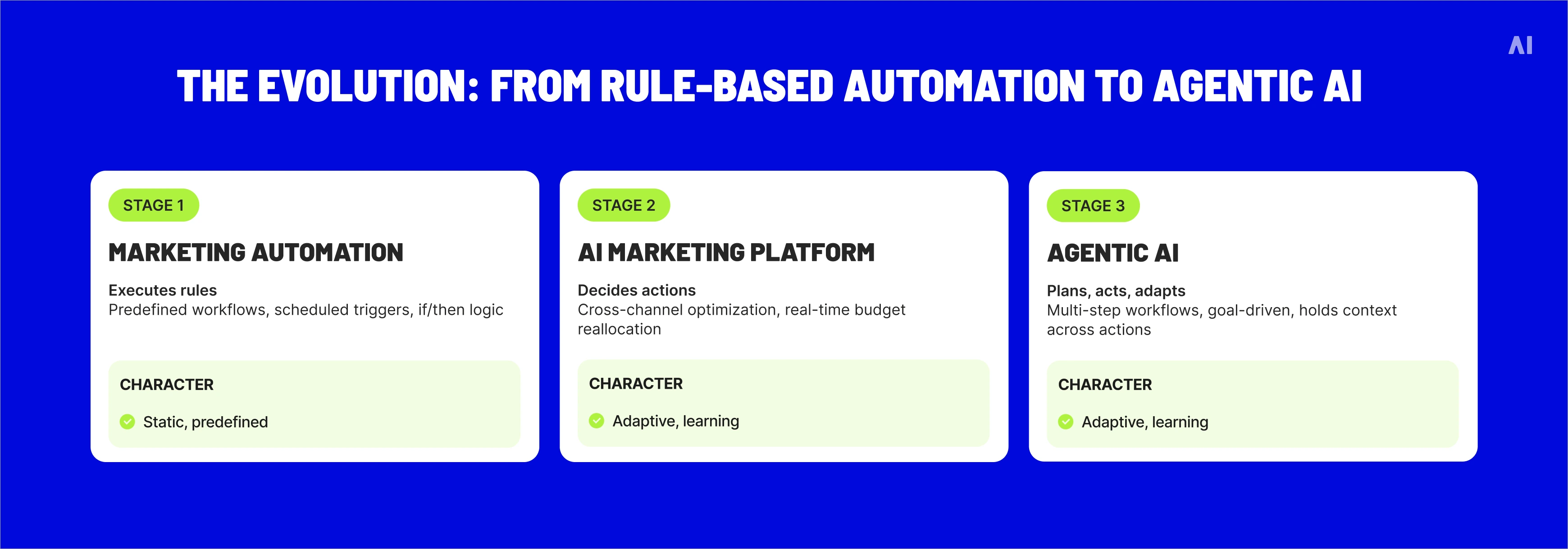
The pace of adoption is faster than most CMOs are tracking. Gartner predicts that 40% of enterprise applications will feature task-specific AI agents by the end of 2026, up from less than 5% in 2025. Looking further out, Gartner forecasts that 60% of brands will use agentic AI to deliver streamlined one-to-one interactions by 2028.
"This marks the end of channel-based marketing as we know it. "— Senior Principal Researcher Emily Weiss (Gartner)
The honest counterweight is that the technology is not yet delivering on the marketing promises being made for it. Gartner's October 2025 survey of martech leaders found that 45% of those with AI agents in pilots or production say the vendor-offered capabilities don't meet expected business performance. Half cite a lack of technical and data-stack readiness; half cite a shortage of technical talent. Agentic AI is real, and it's coming, but the organizations capturing value from it now are doing the underlying work—data infrastructure, governance, workflow redesign—that vendor demos rarely show.
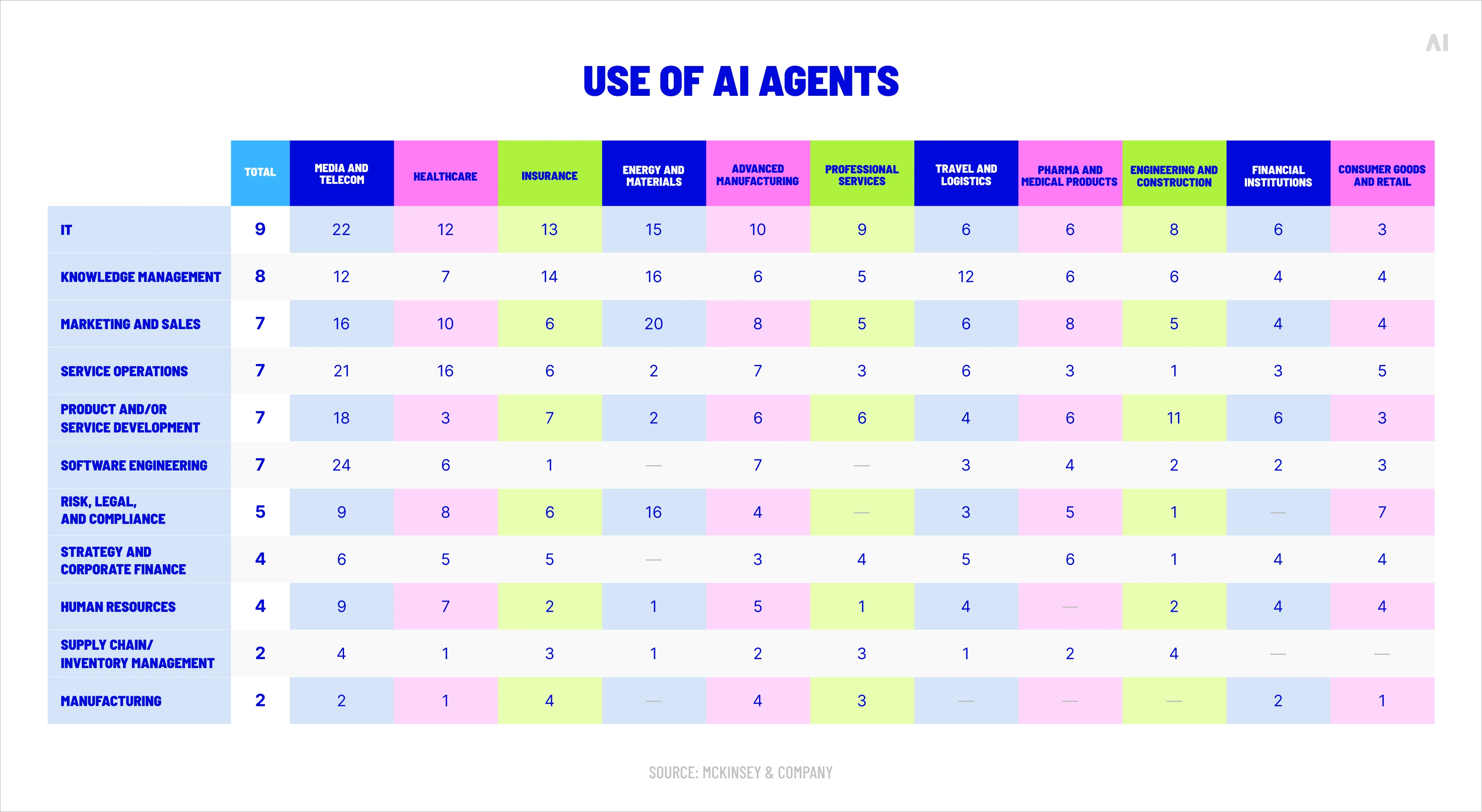
Where AI marketing platforms outperform automation
There are scenarios in which marketing automation does the job and AI marketing platforms would be overkill—modest channel mixes, small audiences, predictable lifecycles. There are also scenarios in which automation is structurally insufficient and the gap between what it can do and what the business needs widens by the quarter. The four below are the most common.
{{26-AI-Marketing-Platforms-vs-Marketing-Automation-Platforms-2="/tables"}}
Budget allocation and campaign optimization
Static budget allocation is the default in most automation-only stacks: a quarterly plan, locked in advance, adjusted manually when something visibly breaks. AI marketing platforms move budget continuously, based on what is actually working. The shift from periodic to continuous optimization is what produces the efficiency gains finance asks about—and increasingly, what funds the case for further investment. EMARKETER's July 2025 research found that 46.9% of US brand and agency marketers plan to invest more in marketing mix modeling over the next year, in large part because manual planning has stopped being defensible against AI-driven measurement that actually quantifies channel contribution.

💡 Related reads: Media Mix Optimization: How to Use MMM for Budget Allocation
Cross-channel journey orchestration
A customer who clicks a search ad, opens an email, watches a CTV spot, and converts via retargeting is a single journey that a single-channel automation platform sees as four unrelated events. AI marketing platforms reassemble the journey, optimize across the touchpoints rather than within each one, and produce orchestration that automation, on its own, cannot. The improvement isn't a marginal lift; it is the difference between coordinated marketing and a coincidence of marketing activities.
Personalization at scale
Personalization in automation platforms means rule-based content swaps tied to predefined segments. Personalization in AI marketing platforms means real-time, behavior-driven decisions about what content, offer, or message to serve to which person, calculated on the fly from the signals that just arrived. The bar customers have set for relevance—and the speed at which their context changes—has moved past what segment-based logic can deliver.
Media buying and supply optimization
Media efficiency is where AI marketing platforms produce the cleanest economic case, because the waste is documented and the optimization is mechanical. Solutions like supply-side curation—applying AI to filter inventory before it reaches the buy side, optimizing supply paths to remove unnecessary intermediaries, prioritizing brand-safe placements—produce measurable reductions in wasted spend. AI Digital's Smart Supply is one example of this category: a curation layer that applies AI-driven path optimization and direct SSP relationships to keep budget closer to working media. The outcome that matters isn't methodology. It's what reaches the buy side, and what doesn't.
💡 Related reads: Media planning and buying | Marketing Planning Software: How to Connect Planning, Optimization, and Reporting in One System
How to choose the right marketing platform approach
The choice between automation, AI marketing platforms, or both is not theoretical for any business spending real money on marketing. It comes down to scale, complexity, and the business outcomes the marketing function is being held to. The framework below maps the three.
{{26-AI-Marketing-Platforms-vs-Marketing-Automation-Platforms-3="/tables"}}
💡 Related reads: What is AI marketing intelligence platform? Definition, features, and how it works
When automation platforms are sufficient
Automation alone is enough when the marketing operation is small enough, channel-narrow enough, and predictable enough that the rules a competent operator writes will hold for long enough to pay back. Email-led nurture programs, single-product lifecycles, and B2B businesses with stable funnels often fit. The signal that automation is enough is that nobody is asking the team to optimize across channels in real time, and nobody is being asked to defend cross-channel ROI to the CFO. Where that's true, the more sophisticated platforms are buying capability that won't be used.
When AI marketing platforms become critical
AI marketing platforms become critical when channel complexity, data volume, or the pace of change has outstripped what manual optimization can keep up with. The triggers are recognizable: cross-channel measurement starts feeling like guesswork; budget reallocation always lags performance; the team is hiring analysts to keep up rather than to drive growth; the senior leadership conversation has shifted from "did the campaign run?" to "what did the spend produce?" When more than one of those is true, decisioning has become the constraint, and the constraint is the right place to invest.
💡 Related reads: How AI platforms improve cross-channel marketing
When to combine both platforms
The combination is the configuration most large marketing organizations end up at. AI handles the decisioning layer—what to send, where, when, to whom, with how much budget. Automation handles the execution—actually sending the email, queuing the campaign, advancing the sequence. The integration is the work, and it is the work that produces the gains.
💡 Related reads: Why AI alone can't fix marketing performance
From automation to AI marketing: how to make the shift
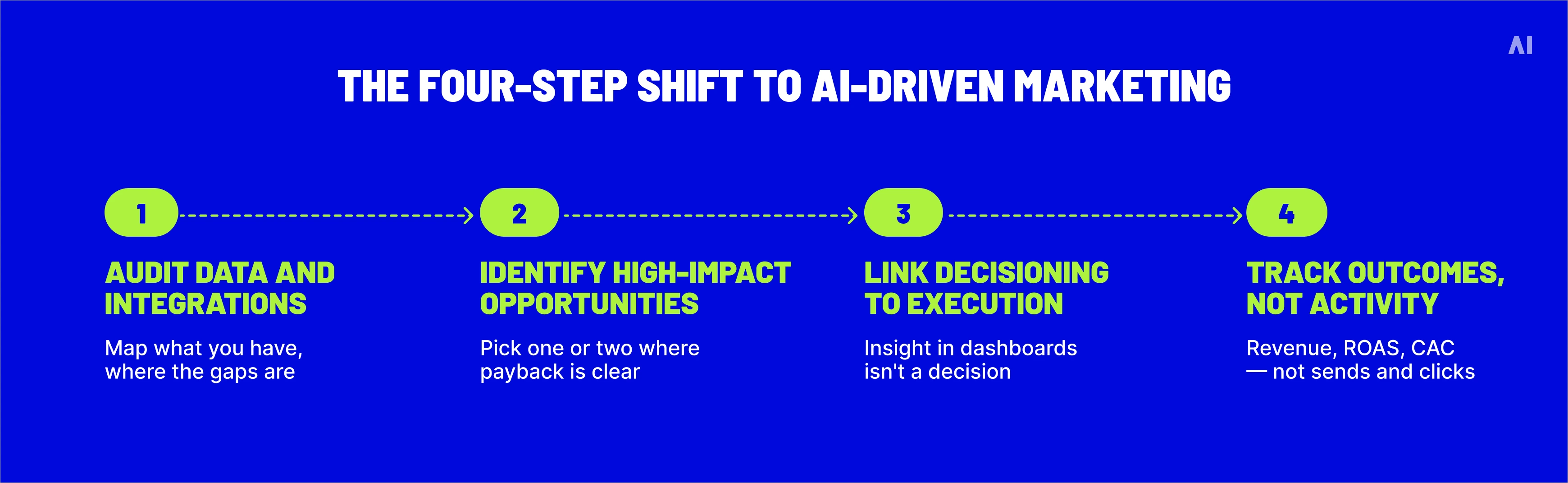
Moving from a marketing automation–led stack to one that includes AI-driven decisioning is less a technology project than an operating-model shift. The shift fails most often not because the AI doesn't work, but because the organization wasn't structured to act on what the AI produced. The four steps below are the order in which the teams capturing real value tend to do it.
💡 Related reads: Creating a data-driven marketing strategy
1. Audit your data and set up
AI is only as useful as the data it is reasoning over. Before introducing decisioning capability, audit the data you have, the tracking that produces it, and the integrations that move it between systems. Most organizations find at this stage that the data is fragmented, the tracking has gaps, and the integrations are partial. That's normal. Fix it before adding intelligence on top, or the intelligence will optimize against incomplete signal.
2. Identify high-impact opportunities
Not every problem benefits equally from AI-driven decisioning. The opportunities with the highest payback are usually budget optimization, cross-channel performance, and personalization at scale—places where the manual cost of getting it right is high and the marginal value of getting it slightly more right is large. Pick one or two. Resist the temptation to deploy AI everywhere at once.
💡 Related reads: AI-driven personalization
3. Link decisioning to execution
The most common failure mode is producing AI-driven insight that nobody acts on. Insight that lives in a dashboard is a report, not a decision. The integration that matters is the one between the AI marketing platform and the execution systems already in the stack—the automation platform, the campaign management tools, the bidding systems. The shorter the path from insight to action, the more value the AI captures.
4. Track outcomes, not activity
Marketing has too many metrics that measure activity rather than outcomes—sends, clicks, impressions. The teams that get the most out of AI marketing platforms reorient their KPI hierarchy around the outcomes the business is trying to produce: revenue, ROAS, customer acquisition cost, lifetime value. The shift is uncomfortable because it makes some long-protected programs look worse. That's the point. The teams that do it earliest are the ones that defend their budgets best when the conversation gets sharper.
How AI Digital enables AI-driven marketing
A coherent stack for the conversation above has three components: a decision layer, an execution layer, and a media-quality layer. The decision layer is where intelligence lives. The execution layer is where it acts. The media-quality layer is where it doesn't waste itself on supply that won't repay it. AI Digital is built around exactly this architecture, and the three products that compose it map directly to the three layers.
Elevate: decision intelligence layer
Elevate is AI Digital's marketing intelligence platform—the decision layer. It unifies research, planning, optimization, and reporting in a single workspace, applying AI to the full digital landscape rather than to programmatic alone.
In practice, that means an AI-Assisted Media Planner that translates campaign objectives into structured plans across DSPs; AI Audience Segments that map a target description into channel-ready segments; cookieless targeting that runs alongside standard segmentation; and Marketing Mix Modeling and Path-to-Conversion analysis that quantify what is actually driving outcomes versus what is simply present in the journey.
The point of the platform is to compress the gap between observation and action, and to do it on data the team would not otherwise see in time to act.
Smart Supply: media efficiency and quality
Smart Supply is the media-quality layer. It curates premium inventory, optimizes supply paths to remove unnecessary intermediaries, and uses AI-driven filtering to ensure budget reaches working media rather than getting absorbed in the gaps between SSPs.
The structural argument for the layer is the one the ANA's data has been making for two years: too much programmatic spend produces nothing the brand can count, and the most efficient way to fix that is to act before the impression is bought, not after. Smart Supply is the operationalization of that argument.
Open Garden Framework: ecosystem integration
The Open Garden Framework is the integration logic that makes the other two layers work as a system rather than as isolated tools. Where walled gardens—Google, Meta, Amazon—restrict cross-platform data and force advertisers to optimize within their proprietary environments, Open Garden treats the ecosystem as a single playing field. Data flows where it needs to. DSPs are chosen on performance, not allegiance. The advertiser's KPIs sit above the platform's, not below them. It is the framework version of an architectural commitment: the brand's outcomes are the optimization target.
💡 Related reads: The Open Garden Framework: a new operating model for programmatic advertising
Business outcomes delivered by AI Digital
The combination is what produces the business outcomes—improved marketing efficiency, scalable cross-channel growth, and the kind of decision speed senior teams ask for when they say they want to "be more data-driven" without quite knowing what that should look like operationally. Decisioning happens in Elevate. Execution happens through the existing automation and campaign infrastructure. Media efficiency is enforced by Smart Supply. The architecture connects, and that's the part that ends up mattering most.
💡 Related reads: What we do
Conclusion on AI vs marketing automation: Improve marketing efficiency with the right platform choice
The argument behind every section of this piece is the same one. Marketing automation platforms remain valuable; they execute reliably, at scale, the work that nobody should be doing by hand. AI marketing platforms are the layer above them—the part of the stack that decides what the execution should be doing in the first place. The two are not substitutes. The choice of which to deploy is determined by whether the binding constraint is operational efficiency or decision quality, and for most large marketing organizations the answer is increasingly both.
Key takeaways:
- Marketing automation platforms streamline execution, but they don't optimize performance on their own.
- AI marketing platforms improve efficiency by driving real-time decisions, dynamic budget allocation, and cross-channel optimization.
- The highest impact comes from combining AI decisioning with automation execution—layered, not substituted.
- Choosing the right platform depends on data scale, channel complexity, and the business outcomes the team is being measured against.
For organizations rebuilding their stack around the difference between execution and decisioning, the question worth asking before the next vendor demo is the one most easily skipped: what decision is the system actually making, and against what objective? AI Digital's combination of Elevate, Smart Supply, and the Open Garden Framework is built around a specific answer to that question—decisioning that respects the brand's outcomes, execution that respects the brand's existing stack, and media efficiency that respects what the budget can actually return. To explore where that fits with your own operation, get in touch.