Why Fragmented Data Is Breaking Cross-Platform Performance

Advertisers have never had more data at their disposal, more platforms to activate against, or more measurement signals to evaluate. And yet, data fragmentation in advertising remains one of the most persistent barriers to performance. The volume of data has grown exponentially, but the infrastructure to unify, align, and interpret that data across platforms has not kept pace. Each channel operates its own reporting logic, defines its own metrics, and attributes conversions according to its own models. The result is a landscape where every platform tells a different story about the same campaign — and none of those stories are complete.
This article examines why fragmented marketing data is not just an inconvenience but a structural problem that actively undermines cross-platform decision-making, inflates costs, and prevents marketers from understanding what actually drives results. It also outlines what a unified approach to data and measurement makes possible.
💡 Related reads: Programmatic advertising | Digital Advertising Ecosystem: How It Actually Works in a Fragmented, Platform-Driven World
The illusion of “data-driven” advertising
Most marketing organizations describe themselves as data-driven. Dashboards are checked daily. Reports are circulated weekly. Performance reviews happen monthly. On the surface, everything looks rigorous.
The problem is that nearly all of those decisions happen inside platform silos. A media buyer optimizes Meta campaigns using Meta's reporting. A search marketer evaluates Google Ads performance using Google's attribution. A CTV buyer reviews completion rates inside the DSP's interface. Each decision appears informed, but each one is also confined to a single environment with no ability to compare results on equal terms.
This creates a false sense of visibility. Marketers see data — plenty of it — but they are looking at fragments rather than a whole picture. The metrics are real; the conclusions drawn from them are often misleading because they lack the cross-platform context needed to evaluate true performance.
Platform dashboards are designed to present the platform in the most favourable light. That is not a conspiracy; it is a product design choice. When every platform optimizes its own reporting to demonstrate value, the advertiser receives multiple competing narratives, each internally consistent but externally contradictory. Spending more time inside those dashboards does not solve the problem. It reinforces it.
💡 Related reads: Digital advertising transparency: why it matters in a fragmented ecosystem
What fragmented data actually looks like
Fragmentation is often discussed in abstract terms. In practice, it shows up in specific, recognisable patterns that marketing teams navigate every day.
Disconnected reporting environments
A typical multi-channel campaign might involve Google Ads, Meta, a programmatic DSP, a CTV platform, and a social channel like TikTok or LinkedIn. Each of these environments generates its own reports, uses its own dashboard, and presents performance in its own format. None of them communicate with each other natively.
The marketer is left to manually export, normalize, and compare data across environments—a process that is time-consuming, error-prone, and fundamentally limited by the fact that each platform's data was never designed to be combined with another's. According to Forrester, disconnected data sources, inconsistent quality, and limited internal resources are among the most common barriers preventing marketers from making effective use of measurement and analytics.
Inconsistent metrics and definitions
The word "conversion" travels across platforms but changes meaning at every stop. Meta may credit a view-through conversion within a one-day window. Google may demand a direct click inside seven days. A DSP may count any post-impression site visit over 30 days. Far from minor technicalities, these differences alter the shape of performance data at a foundational level.
The same inconsistency applies to reach, engagement, impressions, and viewability. When each platform defines these terms differently, any attempt at cross-channel comparison is built on mismatched foundations. Budgets shift based on metrics that are not measuring the same thing.
Misaligned attribution models
Attribution is where fragmentation becomes most damaging. Each platform applies its own attribution logic—last-click, view-through, fractional, or proprietary algorithmic models—and each one assigns credit in a way that favours its own channel.
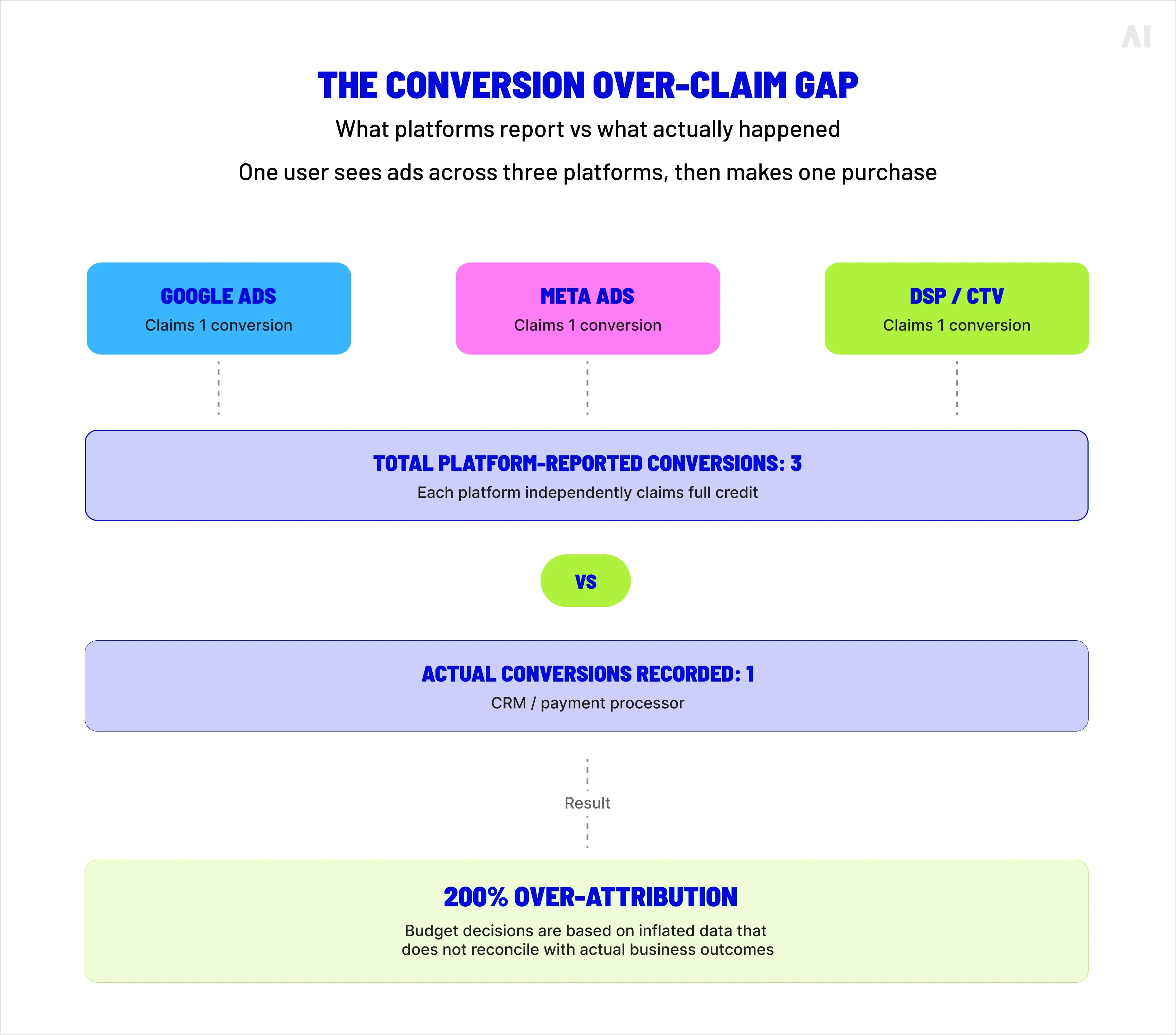
The result is that three platforms can claim credit for the same conversion. The marketer's ad platforms might collectively report 120 conversions, while the payment processor records 45 actual transactions. This is not a data error; it is a structural consequence of each platform measuring independently without any shared framework for deduplication.
No shared user identity
Without cross-platform identity resolution, platforms cannot recognise the same person across channels. A user who sees a display ad on mobile, researches the product on desktop, and converts via a tablet app appears as three separate individuals in three separate reports.
This breaks frequency management, audience suppression, and sequential messaging. It also means that every audience insight generated by a single platform is, by definition, incomplete. The user is fragmented just as the data is.
Why platforms cannot provide a unified view
It would be convenient if platforms simply agreed to share data and align their measurement. They will not, and the reasons are structural rather than incidental.
Major advertising platforms operate as walled gardens, environments where data, audiences, inventory, and measurement all remain inside the platform's perimeter. According to Statista, the world's largest walled gardens—including Alphabet, Meta, Amazon, Apple, TikTok, and Microsoft—accounted for approximately 78% of global digital advertising revenue in 2022, with that share projected to reach 83% by 2027. The IAB/PwC report confirmed that in 2024, the top ten companies alone controlled 80.8% of U.S. digital ad revenue.
{{26-Fragmented-Data-Cross-Platform-1="/tables"}}
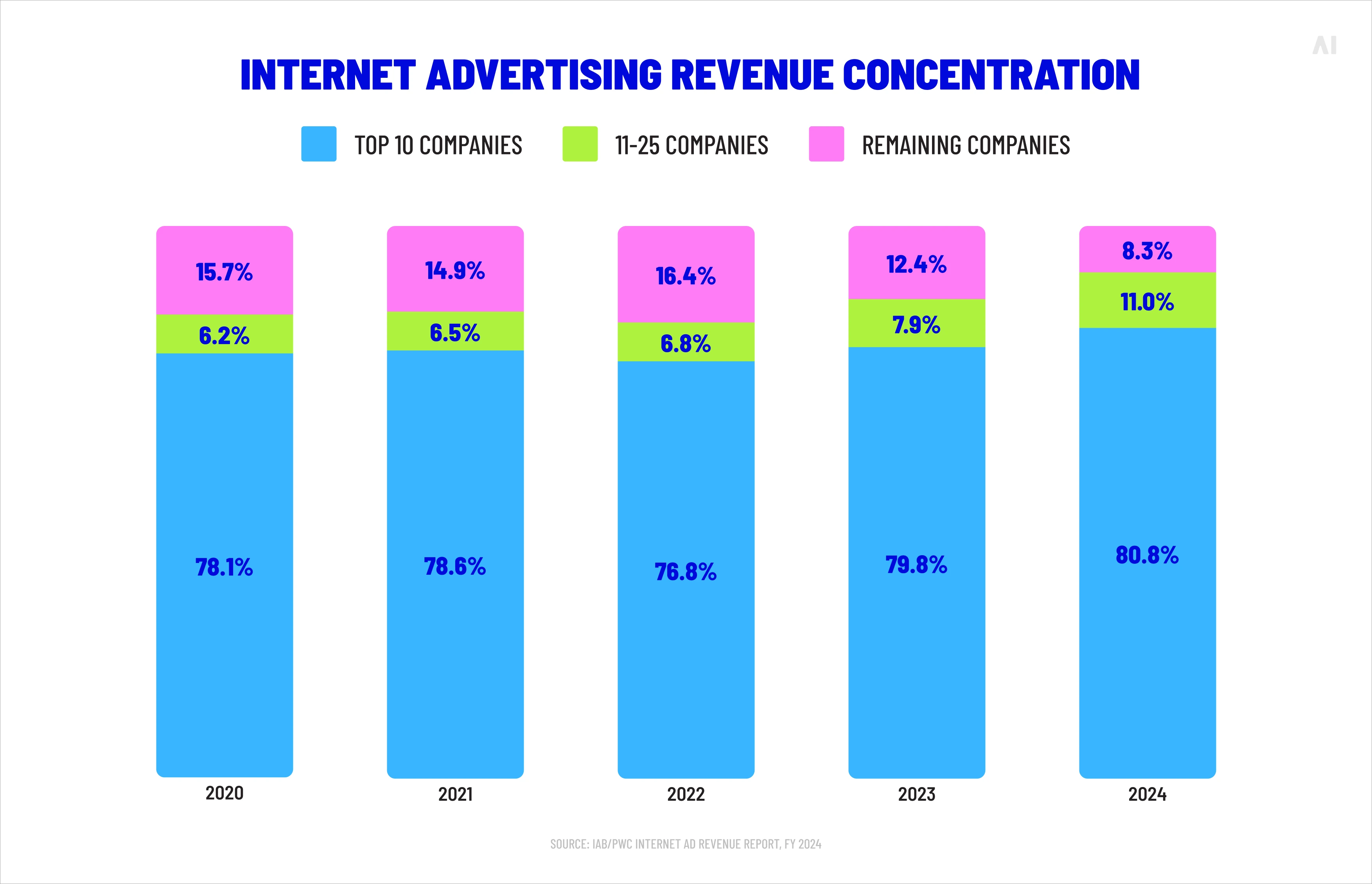
These platforms have a commercial incentive to keep advertisers within their ecosystems. Sharing granular performance data with competitors or enabling true cross-platform comparison would undermine their ability to claim disproportionate credit for conversions and justify premium pricing. Fragmentation is not a bug in the system. It is a feature of how the system is designed to operate.
{{26-Fragmented-Data-Cross-Platform-2="/tables"}}
As Tom Burke, VP of Growth at AI Digital, wrote: "The more tightly a media strategy is built around one platform, one path, or one way of activating inventory, the harder it becomes to adjust when the market moves. That can affect pricing, negotiating power, data flexibility, inventory access, and the ability to compare performance across environments with confidence."
💡 Related reads: Walled gardens
The core problem: performance cannot be compared
When data is fragmented and metrics are inconsistent, the most fundamental requirement of media optimization—the ability to compare performance across channels—becomes impossible. This has consequences that cascade through every budget decision.
No consistent measurement baseline
Without standardized measurement, a marketer cannot objectively answer the question: which channel is delivering the most value per dollar spent? CTV might report strong completion rates. Paid social might report high engagement. Search might report strong click-through. But these metrics are not equivalent, and comparing them is like evaluating athletes across different sports using different scoring systems. Each one looks impressive in isolation, yet none can be ranked against the others with any confidence.
Platform bias distorts decision-making
Self-attributed reporting is inherently biased. Every platform has a financial incentive to present its own performance favourably, and the attribution models they use reflect that incentive. This leads to systematic over-investment in platforms that claim the most credit and under-investment in channels whose contribution is harder to measure—often upper-funnel and awareness-stage channels that initiate demand but do not close it.
Optimization becomes guesswork
When budget allocation decisions rely on incompatible data, optimization becomes reactive rather than strategic. Marketers shift spend toward whichever dashboard looks strongest, rather than toward the channel that genuinely drives incremental outcomes. This is not optimization. It is pattern-matching based on incomplete information.
💡 Related reads: Why cross-platform measurement is still broken in a walled garden world.
Attribution breaks across channels
Attribution models are supposed to answer the question of what drove a conversion. When data is fragmented, they cannot.
Platforms over-claim conversions
Each platform independently tracks user interactions and independently assigns credit for conversions. When a user is exposed to ads across three platforms before converting, all three may claim that conversion. The ANA's Q2 2025 Programmatic Transparency Benchmark estimated that $26.8 billion in global programmatic media value is lost each year to supply chain inefficiencies — and over-attribution is a core contributor to that waste, because it distorts the data marketers use to determine where that spend should go.
Cross-channel impact is invisible
In most multi-channel campaigns, individual channels influence each other. A display ad may create awareness that makes a search ad more effective. A social ad may drive consideration that leads to a direct site visit. These cross-channel dynamics are invisible when each platform only reports its own data. The marketer sees individual channel performance but cannot see how channels work together—or against each other.
Multi-touch models fail without unified data
Multi-touch attribution is designed to distribute credit across touchpoints proportionally. In theory, it solves the over-claiming problem. In practice, it requires a unified data set that connects user-level interactions across all channels, devices, and sessions. When underlying data is fragmented—different identifiers, different conversion definitions, different attribution windows—multi-touch models produce outputs that appear precise but rest on inconsistent inputs.
⚡ Fragmented data does not just reduce visibility. It actively misleads, creating a version of performance that looks coherent on each platform's dashboard but falls apart the moment you try to reconcile it with actual business results.
Frequency, reach, and audience overlap are invisible
Frequency management is one of the most direct casualties of cross-platform data silos. Without shared identity and aligned data, advertisers cannot see how many times the same person has been exposed to their message across channels—only how many times that person was reached within each individual platform.
The World Federation of Advertisers (WFA) reported that 80% of advertisers agree poor frequency control results in "advertising switch-off," where consumers tune out entirely. The same research found that campaigns now feature an average of nine different touchpoints, making cross-platform frequency management not just desirable but essential.
Without unified frequency data, the consequences are predictable. Some audience segments are saturated to the point of diminishing returns, while others remain underexposed. Reach figures are inflated because the same individual is counted separately in each platform's reporting. Audience suppression—removing recent converters from active targeting—fails because platforms cannot share conversion signals. The advertiser pays for impressions that either annoy existing customers or duplicate effort that has already been completed elsewhere.
The hidden cost of fragmented data
The economic impact of reporting fragmentation extends well beyond wasted impressions. It affects how budgets are structured, how campaigns are evaluated, and how acquisition costs are calculated.
The ANA's Q4 2025 Programmatic Transparency Benchmark provided the starkest illustration: advertisers enforcing disciplined quality governance converted 56.7% of their programmatic spend into benchmark-qualified impressions, while lower-performing advertisers converted just 37.5%. That 19-point gap is not explained by creative quality or audience strategy alone. It reflects the operational advantage of having unified, transparent data that enables informed decision-making at the impression level.
{{26-Fragmented-Data-Cross-Platform-3="/tables"}}
When data is fragmented, budgets are allocated based on which platform makes the strongest case for itself, not based on which channel genuinely contributes the most to business outcomes. Over time, this compounds into significant cost inflation. Customer acquisition costs rise because spend is being duplicated across channels that are reaching the same people. Campaign evaluation becomes unreliable because the metrics being compared are not comparable. And strategic planning is impaired because the organization lacks a coherent view of what is actually working.
Why more tools don’t fix the problem
A common response to data fragmentation is to add more technology — a customer data platform (CDP), a data management platform (DMP), a business intelligence layer, or an analytics suite that promises to unify everything.
These tools can help, but they do not solve the underlying problem if the data feeding into them remains structurally disconnected. A CDP that ingests data from five platforms with five different attribution models, five different conversion definitions, and five different identity systems will produce outputs that inherit all of those inconsistencies. The dashboard may look unified, but the data underneath is not.
The issue is not a shortage of tools. It is a shortage of alignment. As the ANA's benchmark programme has consistently shown, the marketers who achieve the strongest efficiency gains are not those with the most sophisticated tech stacks — they are those with the most disciplined approach to data governance, supply path transparency, and measurement standardisation. Technology enables that discipline. It does not replace it.
💡 Related reads: What is an ad tech stack—components, structure & strategic role
What unified data should actually enable
Before introducing any specific framework, it is worth being precise about what marketers actually need from their data infrastructure. The requirements are straightforward, even if achieving them is not.
- Consistent measurement across channels. Every platform's contribution should be evaluated using the same definitions, the same attribution windows, and the same conversion criteria. Without this baseline, comparison is impossible.
- Cross-platform visibility. Marketers need a single view of campaign performance that spans all active channels, not a collection of separate reports that must be manually reconciled.
- Aligned attribution. Credit for conversions should be assigned based on actual contribution across the full user journey, not based on each platform's self-serving model. This requires deduplication and a unified data layer that connects touchpoints across environments.
- Audience-level insight. Reach, frequency, and overlap should be measured at the audience level across platforms, not within each silo independently. This is the only way to manage exposure, suppress converters, and avoid duplication.
- Decision-making based on comparable data. Budget allocation, creative rotation, and channel mix decisions should be grounded in data that has been normalized and aligned—not in platform-specific dashboards that each present their own version of reality.
{{26-Fragmented-Data-Cross-Platform-4="/tables"}}
How Open Garden solves this
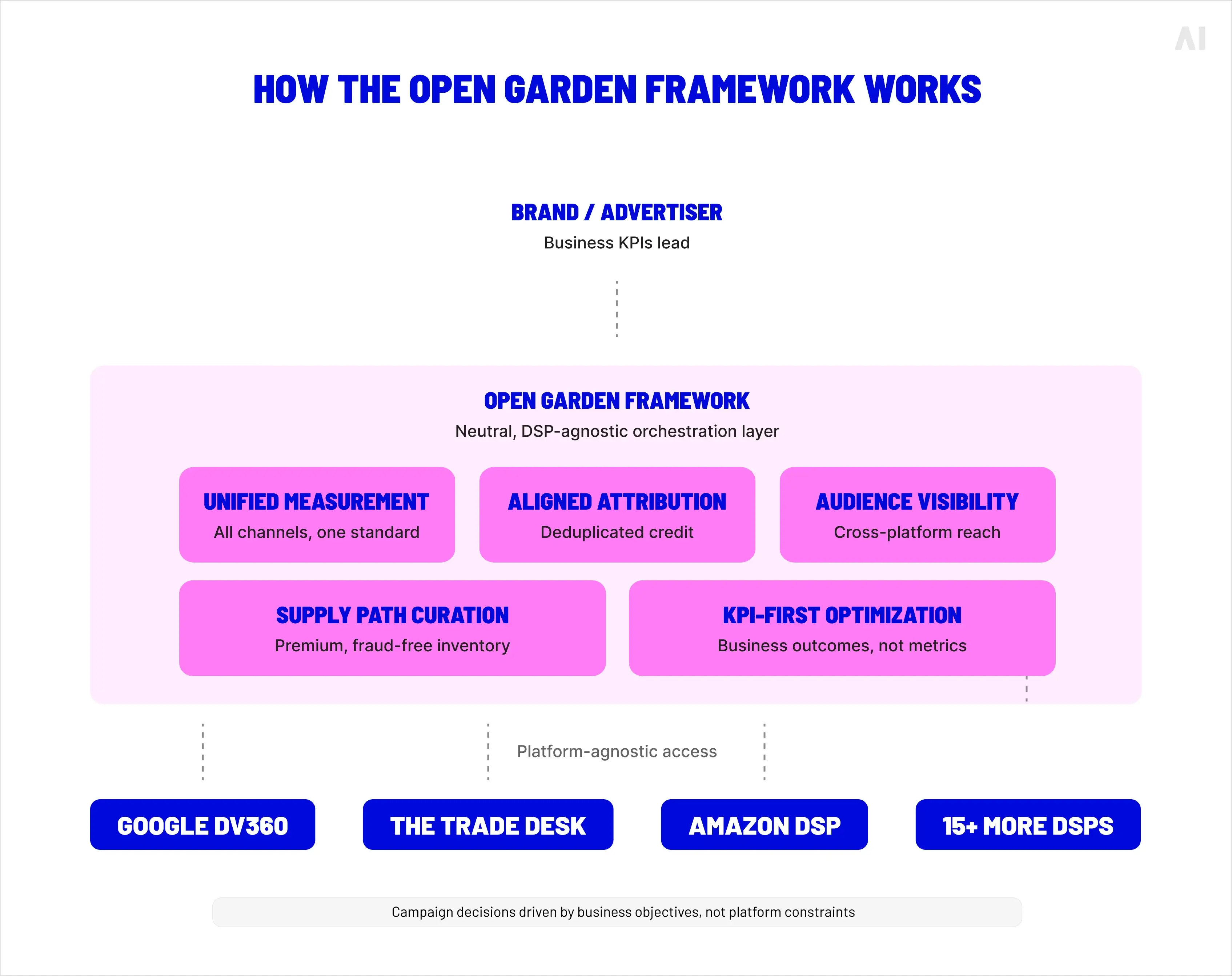
AI Digital's Open Garden framework was built to address fragmentation at its root. Rather than adding another tool on top of disconnected data, Open Garden operates as a neutral, DSP-agnostic layer that aligns data, measurement, and execution across platforms.
The framework is structured around a simple principle: campaign decisions should be driven by the advertiser's business objectives, not by the constraints or commercial incentives of any individual platform. In practice, this means advertisers can evaluate and compare supply paths, attribution models, and audience strategies across environments using consistent criteria — something walled gardens are structurally unwilling to enable.
Open Garden is not a DSP and not a proprietary technology stack. It is an operating philosophy that restores choice, transparency, and competitive accountability to media buying. Advertisers working within the framework can access inventory across 15+ DSPs, evaluate performance using standardized measurement, and make allocation decisions based on what is genuinely driving outcomes rather than on which platform claims the most credit.
As Stephen Magli, CEO and Founder of AI Digital, wrote in AdExchanger: "The industry has fundamentally changed—the old way of buying media no longer reflects where consumers spend their time or how platforms actually operate. When your media strategy is engineered around your KPIs instead of a platform's commercial incentives, the performance gap becomes undeniable."
According to AI Digital's proprietary data, advertisers leveraging predictive analytics across open ecosystems are seeing 2.9x higher performance compared to single-platform approaches, while teams optimising in real time are generating 26% higher ROI and making decisions 73% faster than those operating within closed environments.
What changes when data is unified
When measurement, identity, and attribution are aligned across platforms, the operational improvements are immediate and measurable.
- Budget allocation becomes evidence-based. Instead of distributing spend according to platform-level reporting, marketers can evaluate each channel's contribution using the same yardstick. Underperforming channels are identified faster. High-performing channels receive investment that reflects their actual impact.
- Waste is reduced. Unified frequency data prevents oversaturation. Audience deduplication eliminates redundant reach. Conversion deduplication stops multiple platforms from inflating their reported results. The ANA's Q3 2025 Benchmark illustrated this trajectory: marketers participating in structured transparency programmes reclaimed $13.6 billion in working media value as the share of ad spend reaching publishers rose to 47.1%, up 11 points since 2023.
- Decision speed increases. When all performance data feeds into a single, normalized view, the time required to identify problems, evaluate options, and execute changes compresses significantly. Teams spend less time reconciling dashboards and more time acting on insights.
- Strategic confidence grows. Marketers can defend budget decisions with data that holds up to scrutiny—not because the numbers are large, but because they are consistent, comparable, and grounded in a shared framework. That shift changes the dynamic between marketing teams and the executive stakeholders who fund them.
Conclusion: Data is only valuable if it works together
Programmatic channels are becoming the default for media buying across virtually every format. The volume of data generated by these systems is staggering, and it continues to grow.
None of that data delivers value if it cannot be unified, compared, and acted upon consistently. Data fragmentation in advertising is not a legacy problem that will resolve itself as technology improves. It is a structural feature of an ecosystem designed around walled gardens, self-serving attribution, and platform-level incentives that discourage transparency.
Transparency that stops at the demand layer is incomplete. If the industry is serious about accountability, supply deserves a far more central role in the conversation. — Britany Scott, AI Digital (POV)
The marketers who are gaining ground are the ones who have stopped treating fragmentation as an operational irritation and started treating it as a strategic problem that requires a structural solution. Unified data is not a luxury. It is the foundation on which effective cross-platform performance is built.
If fragmented data is limiting your ability to measure, compare, and optimize across channels, AI Digital can help. Through the Open Garden framework, managed services, and Elevate — our planning, optimization, and measurement platform — we help brands and agencies build media strategies around their business objectives, not around platform constraints. Get in touch!
💡 Related reads: From fragmented to sustainable: rethinking the programmatic supply path.