Digital Marketing Measurement Across Channels: Why Modern Attribution Is No Longer Enough

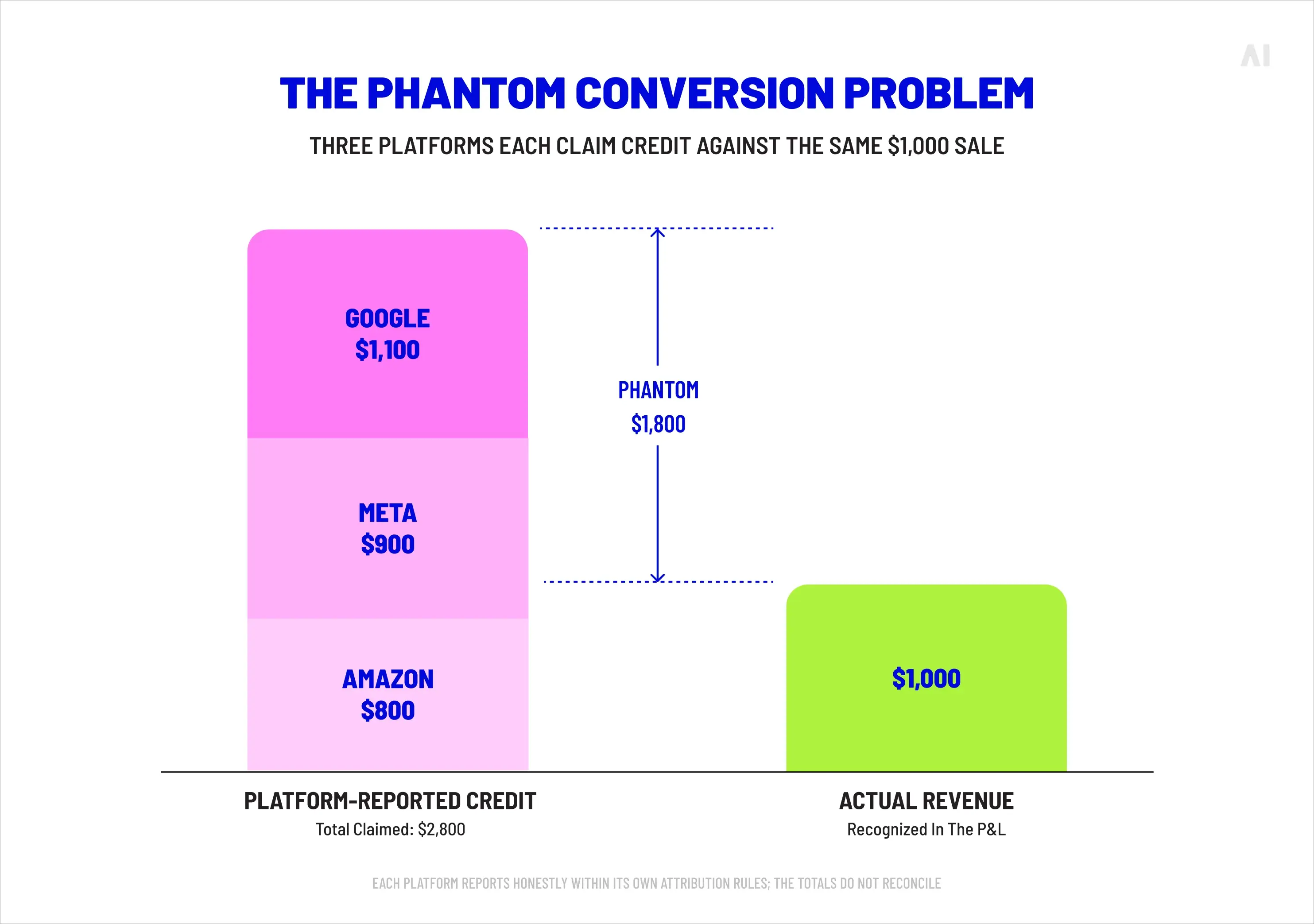
Add up the conversions Google, Meta and Amazon each take credit for in the same multi-channel campaign, and the total will routinely exceed the brand's actual revenue for the period. Each platform is reporting honestly within its own attribution rules. What has gone wrong is the arithmetic, and with it the budget decisions that ride on the answer.
That gap, between platform-reported credit and the revenue the company actually banked, is the operational reality of digital marketing measurement in 2026. A discipline built on click paths and last-touch attribution is being asked to account for customer journeys that now span more platforms than any single analytics system was designed to see, AI-generated answer surfaces that produce no click at all, connected TV impressions delivered into devices that cannot be deterministically linked to a buyer, and offline conversions that arrive weeks after the campaign window has closed. The data the methods were designed for has, in significant part, stopped existing. The methods themselves continue producing numbers anyway — confident, granular numbers that contradict one another and, with increasing regularity, contradict the company's P&L.
That contradiction is now a board-level problem rather than an analytics one. Finance teams have stopped accepting aggregated dashboard ROAS as evidence that marketing is working; they want incremental contribution, cross-channel allocation logic that holds together, and measurement frameworks that connect spend to revenue at a level of granularity their auditors will recognize. Measuring digital marketing performance — and being able to demonstrate digital marketing effectiveness in terms the CFO is willing to underwrite — has become the difference between defending next year's marketing budget and watching it get cut.
How to measure the effectiveness of a digital marketing campaign in this environment is the work of building a measurement architecture that finance trusts, channels respect, and that connects spend to outcomes at the level of granularity the business actually needs.
What digital marketing measurement means
Digital marketing measurement is the practice of evaluating how campaigns, channels, and customer journeys contribute to business outcomes — revenue growth, customer acquisition, retention, and profitability — and then using those evaluations to allocate budgets and optimize future investments.
At a technical level, it sits between data collection and decision-making: the tracking layer captures interactions, the measurement layer turns those interactions into insight about contribution, and the strategic layer translates insight into budget decisions and creative direction.
For most of the 2010s, digital marketing measurement was synonymous with campaign reporting: click-through rates, conversion rates, cost-per-acquisition, and platform-reported ROAS, presented inside the dashboards of whichever DSP or ad network bought the media. That model produced a great deal of activity-level data but a comparatively poor account of whether marketing was paying back at the level of the business.
Modern measurement extends beyond reporting in three ways:
- It is forecast-oriented, projecting how budget changes will affect downstream business outcomes rather than describing what has already happened.
- It is cross-channel, treating campaigns as components of a single ecosystem rather than as standalone units.
- And it is finance-credible, expressed in revenue, profit, and customer-value terms that a CFO can underwrite.
This widening of scope has changed the type of marketer who owns measurement. What used to sit with the digital analytics team now spans planning, finance, and data science. Done well, it produces the kind of evidence that lets a CMO defend marketing spend in a budget review without resorting to anecdote. Done poorly, it produces conflicting numbers nobody trusts.
💡 Related reads: The digital advertising ecosystem | Marketing Measurement Is Broken — Here’s Why Most Data Can’t Be Trusted.
Why measuring marketing effectiveness is more complex
Three structural changes have made measuring marketing effectiveness materially harder than it was five years ago, and the underlying causes are not converging:
- Privacy regulation has reduced user-level tracking.
- Channel proliferation has fragmented customer journeys across more surfaces than any single analytics platform can see.
- And the platforms themselves have closed off cross-channel visibility, leaving marketers to reconcile reports that frequently double-count the same conversion.
Each of these problems has been written about extensively; what is less commonly acknowledged is that they compound. A measurement system that handles one of them adequately can still produce misleading insight if it doesn't address the other two.
The most direct consequence has been a loss of measurement confidence. The IAB's State of Data 2026 report, based on a survey of 400-plus senior planning and analytics decision-makers at US brands and agencies, found that three in four marketers say their existing measurement approaches — attribution, incrementality testing, and marketing mix modeling — are not delivering the speed, accuracy, or trust they need to make confident decisions. The issue is not methodology. The issue is infrastructure. The methods themselves are well understood. What has eroded is the data layer underneath them.
Privacy and tracking limits
The third-party cookie did not die on the schedule the industry expected, but it has decisively stopped functioning as the backbone of digital measurement.
- Safari and Firefox have blocked cross-site tracking by default for years.
- Google's eventual decision in April 2025 was to retain third-party cookies in Chrome but route their use through a user-choice mechanism, with most users opting out when given a clear reject option.
The practical reality for advertisers is a hybrid environment in which the proportion of users carrying a usable third-party identifier is a small and shrinking fraction of any addressable audience.
That signal loss does not stop conversions from happening. It stops marketers from seeing the upper- and mid-funnel touchpoints that led to them. The downstream effects are familiar to anyone who has watched their reported CPA inflate without any change in underlying performance: retargeting audiences shrink, view-through conversions collapse, and attribution models that assumed continuous cross-device tracking begin to misallocate credit by default.
Server-side tracking, first-party identity graphs, consent-aware measurement, and modeled conversions are now the only viable replacements for what cookies used to do — and adopting them is a meaningful infrastructure project rather than a switch to flip.
💡 Related reads: Why fragmented martech stacks kill marketing performance.
Fragmented customer journeys and attribution gaps
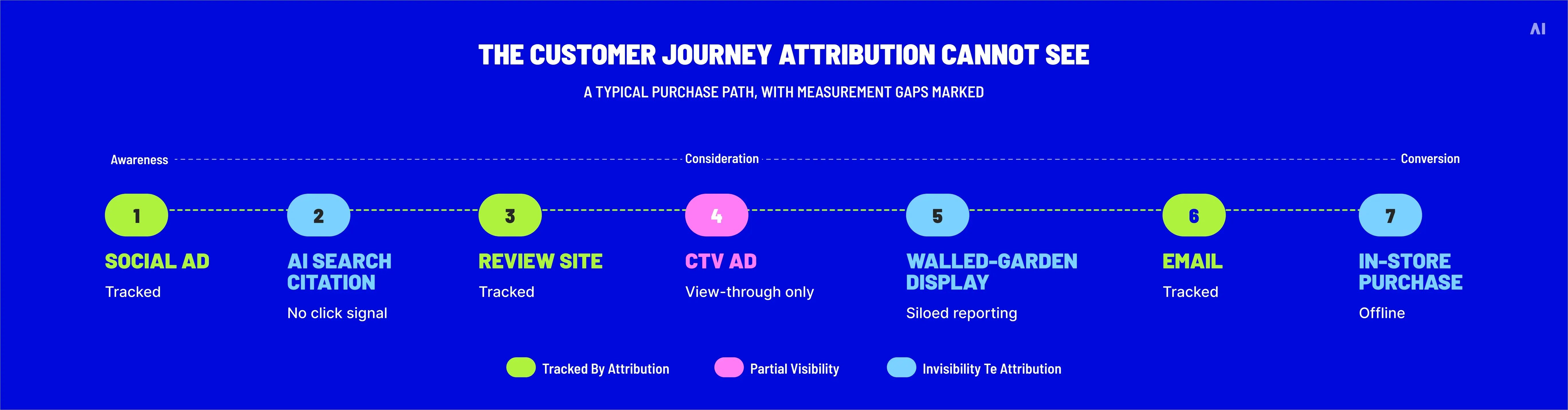
The buyer side of the equation has fragmented at the same rate as the supply side. McKinsey's most recent B2B Pulse research finds that buyers now use an average of 10 interaction channels across a purchase decision, double the five they used in 2016. B2C journeys exhibit similar patterns, with discovery on social, research on review sites and AI search summaries, comparison on desktop, and conversion on mobile or in-store.
Attribution models built for the linear funnel — last-click, first-click, even rules-based multi-touch — assume that the relevant touchpoints sit inside a single tracking domain and can be ordered cleanly.
Modern journeys break both assumptions. Touchpoints occur inside walled gardens that won't share user-level data, on AI-generated answer surfaces that produce no click at all, on devices that can't be deterministically linked to the same customer, and on offline channels that have no digital reporting layer. The attribution model is not wrong; the data it was designed to operate on no longer exists in the form it expects. The credit it assigns is, increasingly, an artifact of what is visible rather than an account of what actually happened.
💡 Related reads: From fragmented to sustainable: rethinking the programmatic supply path | Integrated marketing systems: how to connect data, channels, and performance.
How businesses measure marketing effectiveness across channels
Measuring marketing effectiveness across channels begins with an unglamorous acknowledgement: paid, owned, and earned channels each have their own measurement reality, and pretending otherwise produces conflicting reports more reliably than insight.
The right starting point is to be clear about what is actually measurable in each channel, where the structural attribution gaps sit, and how the channel-specific numbers roll up into a cross-channel picture without losing fidelity.
Paid search
Paid search remains the most measurable digital channel, primarily because the user's intent is encoded in the query itself and the conversion typically occurs inside a relatively short tracking window. Click-through rates, conversion rates, cost per acquisition, and platform-reported revenue are all reliably available, and post-consent gaps have been partially backfilled by enhanced conversions, server-side tagging, and modeled conversion estimates from Google and Microsoft.
The structural attribution problem in paid search lies in incrementality rather than reporting fidelity: how much of the revenue captured by branded search would have arrived anyway, and how much of the volume captured by automated bidding is genuinely incremental rather than demand the brand had already created elsewhere.
The most useful paid-search measurement now treats reported ROAS as a starting input that needs to be tested for incrementality, rather than a finished answer.
Social and programmatic
Social and programmatic display, video and CTV have moved beyond impressions and clicks as primary measurement currencies, though plenty of reporting still leans on them. The harder questions concern view-through attribution, traffic quality, and supply-path transparency.
View-through reporting inflates contribution because every platform that loaded an impression claims credit when a conversion eventually occurs; the aggregated total often exceeds actual sales when summed across providers.
Inventory quality compounds the distortion: when a non-trivial share of impressions land in low-attention environments or non-human traffic, the measured outcomes overstate the underlying media performance.
Brands that take social and programmatic measurement seriously now run incrementality tests against holdout audiences, layer in attention-based metrics from independent vendors, and audit supply paths for direct, fraud-free inventory rather than accepting platform-reported viewability at face value.
💡 Related reads: Programmatic advertising
Content, email, and retention
Content marketing and email rarely sit at the top of an attribution waterfall, because they tend to operate as influencers of behavior over longer time horizons than most reporting windows capture.
Their measurement value is in assisted conversions, repeat purchase patterns, and the contribution they make to customer lifetime value, particularly for retention rather than acquisition. A weekly newsletter that increases reorder frequency by a few percentage points across an installed base will rarely look impressive in a last-click report, but it can be one of the most profitable activities in a portfolio.
The right way to measure these channels is to instrument retention metrics — repeat purchase rate, time between orders, churn — and to evaluate engagement as a leading indicator of long-term value rather than a proxy for short-term revenue.
Partnership and influencer
Partnership, affiliate, and influencer marketing have always been awkward to attribute, because the value sits between earned reach (which has no native tracking layer), promo code redemption (which captures conversion but not influence), and post-purchase recall (which only some buyers are willing to report).
The pragmatic approach has been to combine direct-response signals — unique promo codes, partner-specific landing pages, UTM tracking — with periodic incrementality tests at the market level, where partner activity is concentrated in some geographies and held out in others.
Brand lift studies and post-purchase surveys provide a third layer, capturing the influence partnerships exert on consideration even when they don't generate a directly attributable click.
Omnichannel journey
Omnichannel measurement is the work of stitching the channel-specific views together into a cross-channel account of the customer journey.
- The technical challenge is identity resolution: connecting the same customer across devices, sessions, and offline touchpoints to a single profile that can be analyzed end-to-end.
- The methodological challenge is reconciling channels that report contribution in incompatible terms.
The strongest omnichannel measurement programs treat the stitching layer as infrastructure rather than reporting, building a unified data foundation that the various analytical methods — attribution, MMM, incrementality testing — can all reference. Without that foundation, every model argues with different numbers and the cross-channel view collapses back into channel silos.
💡 Related reads: Integrated marketing vs. omnichannel marketing.
Why attribution alone is not enough
The structural limitation of attribution, whether last-click or multi-touch, is that it measures what happened inside the data the marketer can see. It does not measure causation, it does not capture the influence of activity outside the digital tracking layer, and it cannot tell the difference between a conversion the campaign generated and one it would have happened to capture.
In a world where journeys are short, signals are durable, and the click path is a reliable proxy for influence, those limitations are manageable. In the world digital marketing actually operates in, they are increasingly disqualifying.
⚡ Attribution measures the visible. Incrementality measures the consequential. Marketing mix modeling measures the strategic. Confusing them is the single most expensive analytical mistake in performance marketing.
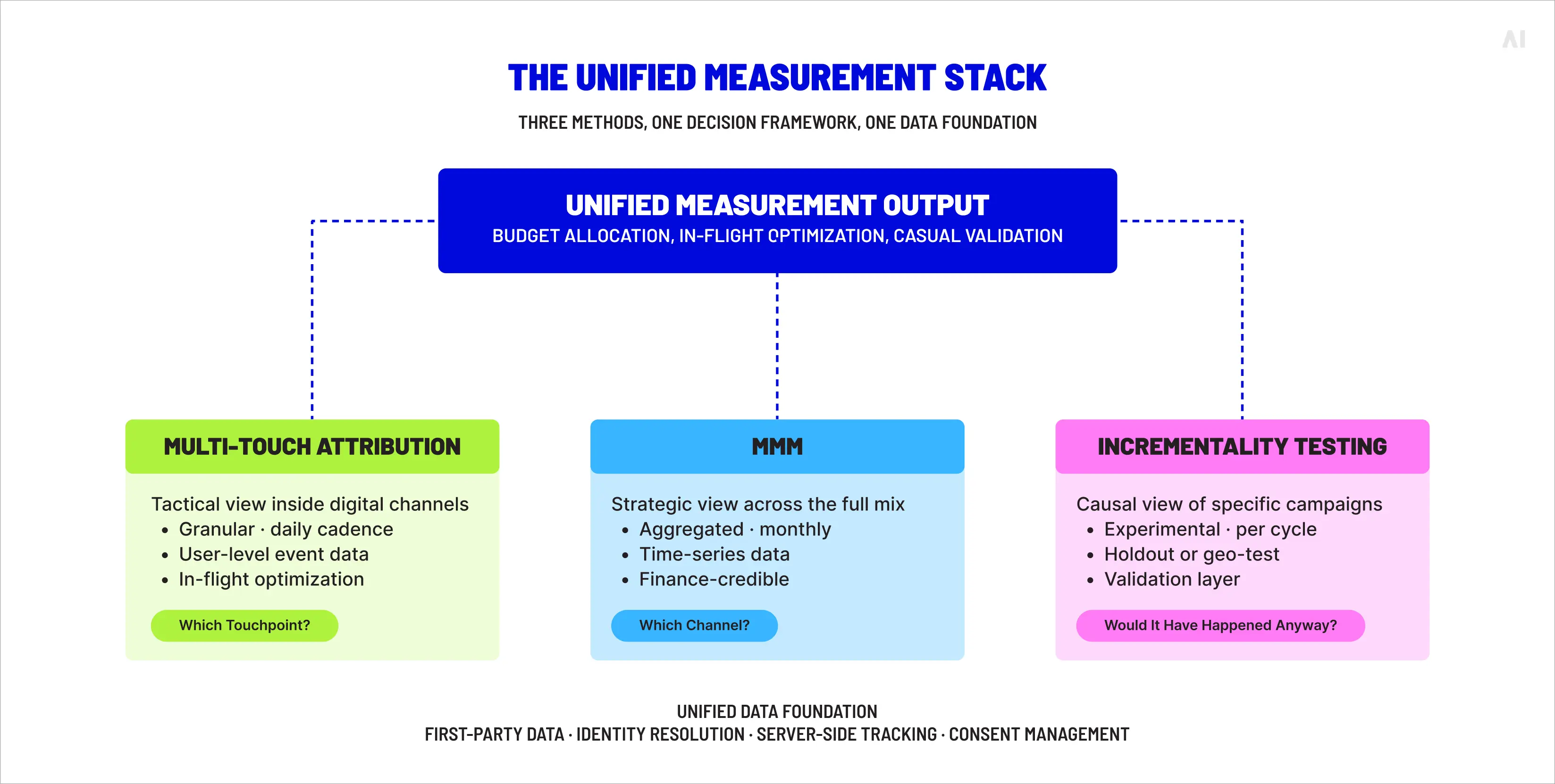
The IAB's 2026 measurement findings are the clearest articulation of where this leaves the discipline. Marketers are not lacking methods. They are running attribution, they are running incrementality, they are commissioning MMM. The trouble is that adoption has outpaced maturity. Each method is good at answering a different question, and most measurement programs are treating them as substitutes when they should be treating them as complements.
- Attribution remains the right tool for tactical, in-flight optimization inside digital channels.
- Incrementality is the right tool for causal validation.
- MMM is the right tool for strategic budget allocation across the full channel mix, including offline.
A measurement program that uses one and ignores the others will systematically misallocate budget; a program that combines all three is doing what the discipline now calls unified measurement.
💡 Related reads: Marketing measurement vs attribution vs MMM: what's the difference.
Modern cross-channel measurement
Modern cross-channel measurement is best understood as an infrastructure problem with an analytical surface. Most of the visible work — the reports, the dashboards, the model outputs — is downstream of decisions about how data is collected, where it is stored, how identity is resolved, and which platforms have visibility into which signals. Get the infrastructure right and the analysis becomes tractable. Get it wrong and no model, however sophisticated, will produce trustworthy results.
The businesses making the most progress on cross-channel measurement are doing three things in parallel: connecting their fragmented marketing data into a unified intelligence layer, demanding transparency from their programmatic supply paths so that what they measure reflects what they bought, and building measurement frameworks that are interoperable across DSPs rather than locked into any single platform's reporting environment.
Connecting fragmented data
Unification is the precondition for everything else. When campaign data, audience data, and measurement data live in separate platforms — each with its own definitions, refresh cadences, and reporting formats — the cross-channel picture has to be assembled by hand every time someone asks for it. Errors compound, definitions drift, and the marketing team spends more time reconciling reports than acting on them.
AI-powered intelligence platforms have emerged as the layer that holds this together. Elevate, AI Digital's vendor-agnostic marketing intelligence platform, brings research, planning, optimization, and reporting into one connected environment, drawing on 150 billion data points monthly and 10,000-plus audience attributes to support cross-channel decisioning. Its MMM and Path to Conversion modules sit alongside the planning and audience layers, so the same data underwrites budget allocation, scenario testing, and post-campaign analysis.
The aim is to give the planning and optimization layer a single, internally consistent reference point for cross-channel performance — without displacing specialist measurement vendors where they are already in place.
Improving transparency in programmatic
Supply-side transparency is where measurement integrity gets won or lost at the inventory layer. Attribution accuracy depends on knowing what was bought; in programmatic environments where supply-path opacity, bid duplication, and made-for-advertising inventory inflate apparent reach, the underlying measurement is corrupted before any model runs against it.
Smart Supply, AI Digital's supply-curation service, works against that distortion by maintaining direct relationships with nine-plus tier-one SSPs, applying supply-path optimization to eliminate unnecessary bid hops, and filtering low-quality, non-brand-safe inventory before it reaches the buyer.
The measurement consequence is straightforward: when the inventory layer is clean and the supply path is direct, the resulting performance data is a more honest input into attribution, incrementality, and MMM alike.
Open measurement frameworks
Interoperability is what stops measurement from inheriting the incentives of any single platform. Walled gardens optimize for their own ecosystems, which means their measurement views privilege the channels and outcomes that benefit the platform. A measurement framework that depends on any one of them inherits those incentives.
AI Digital's Open Garden framework addresses this by operating across 15-plus DSPs and nine-plus SSPs, treating measurement as a cross-platform discipline rather than a per-platform reporting exercise. The framework's three pillars — transparency, customization, and efficiency — translate into a measurement environment where outcomes are evaluated against business KPIs rather than platform-reported metrics, and where the data infrastructure underneath the measurement is owned and auditable rather than rented.
💡 Related reads: Open Garden framework | What is the Open Garden framework | Marketing Measurement Framework: Building a Scalable System for Smarter Decisions.
Tools for cross-channel measurement
Underneath the strategic frameworks sit the technical tools that make cross-channel measurement operational.
- Web analytics platforms — Google Analytics 4 and Adobe Analytics being the most widely deployed — provide the event capture layer.
- CRM systems hold the customer master record.
- Customer data platforms unify behavioral, transactional, and identity data into a single profile that can be activated across channels.
- AI-powered intelligence tools turn the unified data into forecasts and recommendations.
- Server-side tracking restores measurement coverage where browser-based tagging has been blocked.
- Unified reporting environments tie the layers together so that the cross-channel picture can be produced without manual reconciliation every quarter.
None of these on its own constitutes a measurement program. The skill is in combining them to fit the operational reality of the business rather than buying them as an off-the-shelf stack.
Key marketing measurement models
The methodological work of digital marketing measurement is now distributed across a small number of well-defined models, each with its own strengths and structural limitations. Understanding which model answers which question — and which models compensate for which others' blind spots — is the precondition for any unified measurement program.
Multi-touch attribution (MTA)
Multi-touch attribution distributes conversion credit across the digital touchpoints that preceded a sale, using either rules-based weightings (linear, time-decay, position-based) or data-driven algorithms that infer the relative contribution of each interaction from historical conversion patterns. Its strength is granularity: it can tell a media buyer which placements within a campaign appear to be driving conversions, which makes it useful for tactical optimization in-flight.
Its weakness is structural. MTA depends on user-level event data — the same data that has been most affected by privacy regulation and platform restrictions — and it cannot see touchpoints outside the digital tracking layer.
Treating MTA as a complete measurement system is now the most common cause of misallocated budget in performance marketing.
Marketing mix modeling (MMM)
MMM operates at the opposite end of the granularity scale. Rather than tracking individual users, it analyzes aggregated, time-series data — total spend, total impressions, total outcomes — to estimate how each channel has contributed to revenue over time, controlling for seasonality, pricing, competitor activity, and external variables.
Because it works with aggregated data, MMM is unaffected by cookie deprecation, captures offline media and brand activity that digital attribution cannot see, and produces the kind of cross-channel allocation outputs that finance teams will accept as inputs to budgeting decisions.
Its limitation is cadence: traditional MMM is a quarterly or annual exercise, though AI-enhanced versions now produce monthly or near-real-time refreshes that make it usable for in-flight decisioning.
Incrementality testing
Incrementality testing answers the question attribution cannot: would the conversion have happened without the campaign? Through randomized holdout groups, geo-based experiments, or matched-market designs, incrementality isolates the causal lift attributable to a specific marketing investment rather than the credit it captured in a reporting pipeline. Adoption has moved from niche to mainstream, with 52% of US brand and agency marketers using incrementality testing to measure campaigns, and a further 36% planning to increase investment in incrementality over the next twelve months, according to a July 2025 EMARKETER and TransUnion survey.
The growth is driven by two pressures at once: privacy-related tracking loss makes user-level attribution less reliable, and CFO demand for causal evidence has made hypothetical credit harder to defend.
💡 Related reads: Incrementality testing framework: step-by-step.
Attribution and incrementality
The most useful pairing of methods is attribution and incrementality, used together rather than in isolation.
- Attribution provides the granular, daily view useful for tactical decisions.
- Incrementality calibrates the attribution by establishing which of the touchpoints it credits are actually causing outcomes rather than capturing demand.
Running them in combination — attribution as the operational layer, incrementality as the periodic calibration — produces a measurement program that is responsive to daily campaign performance while remaining honest about which of that performance is real.
💡 Related reads: Incrementality vs attribution: what's the difference and why the shift is happening.
Unified marketing measurement approaches
Unified marketing measurement is the practice of combining attribution, MMM, incrementality testing, and AI-powered forecasting into a single decision framework, with each method correcting for the others' blind spots. MMM provides the strategic view; attribution provides the tactical view; incrementality provides the causal validation; AI forecasting projects forward.
The framework only works when the methods reference a common data layer; otherwise each one produces a different answer to the same question, and the unified view collapses back into the methodological argument it was meant to settle.
Digital marketing KPIs that work
Choosing the right digital marketing KPIs is a question of strategic alignment rather than measurement technique. The KPIs that work are the ones tied to the business outcomes the company is actually trying to deliver — revenue growth, profitability, customer retention — and owned by someone with the authority to act on them when they move. KPIs that report activity rather than outcomes, or that no one is accountable for, are decoration.
Acquisition and efficiency KPIs
Acquisition KPIs describe whether marketing investment is producing customers at sustainable economics.
- Customer acquisition cost (CAC) measures the all-in cost of acquiring a paying customer, including media, creative production, and internal cost.
- Return on ad spend (ROAS) measures revenue per dollar of media. Incremental ROAS adjusts the reported figure for causal lift, which produces a more conservative but more defensible number.
- Marketing efficiency ratio (MER) aggregates total revenue against total marketing spend at the business level, which provides a useful cross-check against platform-reported numbers that frequently double-count contribution.
The discipline in using these KPIs is to treat the platform-reported versions as inputs requiring validation rather than as outputs ready for budgeting decisions.
Revenue and growth KPIs
Revenue and growth KPIs measure the connection between marketing activity and the financial outcomes the business is being judged on.
- Customer lifetime value (CLV) projects the total revenue a customer will produce across their relationship with the brand, which converts marketing from a cost into an investment.
- Pipeline contribution captures the value of opportunities marketing has sourced or influenced, particularly in B2B contexts.
- Revenue attribution allocates revenue back to the activities that produced it. Incremental revenue isolates the share of revenue that would not have arrived without the marketing investment.
Together these KPIs let marketing express its value in the same units finance uses to evaluate every other function.
Retention and customer value KPIs
Retention and customer value KPIs are where acquisition economics either pay back or expose themselves as expensive. Retention rate, repeat purchase rate, churn, payback period, and cohort revenue all describe whether the customers marketing has acquired are continuing to produce value over time. They tend to receive less attention than acquisition metrics because they move slowly and their reporting cadence is longer, but they are usually the better predictors of sustainable growth. A high-CAC channel that produces customers with strong retention will outperform a low-CAC channel whose customers churn within ninety days, even when the short-term acquisition metrics suggest the opposite.
Measurement mistakes to avoid
Most measurement failures come from operational decisions rather than analytical mistakes — choices about which numbers to trust, which signals to act on, and which horizons to optimize for that look reasonable in isolation and produce predictable distortions in aggregate. Five recur often enough across enterprise measurement programs to merit naming directly.
💡 Related reads: Why AI alone can't fix marketing performance (and what actually works).
Overtrusting platform attribution
Ad platforms have an incentive to claim credit for conversions they were proximate to, and their default attribution settings reflect that. Aggregated across multiple platforms, the same conversion typically gets claimed two or three times, producing total reported ROAS figures that exceed actual revenue when summed. The fix is to treat platform numbers as inputs requiring external validation rather than abandoning them outright — typically through incrementality testing, MMM, or a unified measurement view that reconciles the platform-level totals against actual business outcomes.
💡 Related reads: Marketing attribution challenges: why traditional attribution models don't work anymore | The problem with platform-reported data: why you can't trust the numbers
Ignoring assisted and offline conversions
Last-touch attribution credits the final touchpoint before conversion and discards every preceding interaction. In short journeys with high-intent traffic, that approximation works. In journeys with longer consideration phases, multiple devices, and offline touchpoints, last-touch credits whichever channel happened to capture the bottom of the funnel and systematically under-values the channels that built awareness, consideration, and intent earlier. Assisted-conversion reporting, view-through measurement, and cross-channel MMM are the standard correctives.
Measuring channels in silos
Channel-by-channel reporting produces channel-by-channel optimization, which is rarely the same thing as cross-channel performance improvement. A retail-media team that optimizes in isolation will reliably under-invest in upper-funnel channels that feed it. A paid-search team that optimizes against last-click will reliably under-credit social and display. The cross-channel question — how the total mix is performing against the business outcomes the company is being judged on — only gets answered when measurement is run at the portfolio level rather than the channel level.
Confusing performance with growth
Strong campaign performance metrics — high CTRs, low CPCs, strong reported ROAS — frequently fail to translate into incremental revenue or profitable growth. A campaign that captures demand which would have arrived anyway will produce excellent platform-reported numbers and contribute nothing to the business. Growth is measured at the level of the business, in incremental revenue, profitability, and customer lifetime value. Performance is measured at the level of the campaign, in activity and conversion metrics. The two are not the same number, and confusing them produces decisions that look defensible in a report and damaging in the P&L.
Optimizing for short-term results
The 35th edition of The CMO Survey, conducted by Duke University's Fuqua School of Business in partnership with Deloitte and the AMA in January 2026, found that more than 70% of marketing leaders are now prioritizing short-term impact over long-term gains, often relying on established strategies rather than new investments. The same survey reports marketing budgets declining to 9.0% of company revenue, the weakest growth rate in several years.
"Rather than investing in deeper customer insights, most marketers focus on developing stronger performance tracking as the primary way to demonstrate value. " — Christine Moorman, Director of The CMO Survey, January 2026
The pressure to optimize for the quarter is understandable. The cumulative effect of every marketing organization doing it simultaneously is the systematic under-investment in brand, awareness, and customer experience activities whose returns sit outside the reporting window.
Measurement that only captures short-term performance reinforces the bias; measurement that captures long-term value, cohort economics, and incremental contribution can correct for it, if the business actually uses the numbers.
Where marketing measurement is heading
The direction of travel in marketing measurement is reasonably clear, even if the pace is contested.
- AI is being applied across the measurement stack — to forecast performance, to allocate budget, to optimize bidding in real time, and to interpret outputs that previously required specialist analysts.
- Privacy regulation continues to reduce user-level visibility, which is making first-party data and modeled measurement more valuable.
- And the center of gravity in measurement is moving away from static reporting dashboards and toward intelligence platforms that combine measurement, planning, and optimization in a single environment.
AI-powered forecasting and optimization
Forecasting and optimization are now the two functions of marketing measurement most visibly affected by AI. Predictive models trained on historical campaign data, audience signals, and external variables can project performance under different budget scenarios with materially better accuracy than the spreadsheet-based approaches they replaced. Real-time optimization engines adjust bids, budgets, and targeting against performance signals on cadences measured in minutes rather than weeks. The combination produces a closed loop in which forecasts inform allocation, allocation produces outcomes, and outcomes are fed back to update the forecasts.
Why AI needs reliable marketing data
The constraint on AI-powered measurement is not the algorithms; it is the data they are trained on. Models built on inconsistent, fragmented, or low-quality marketing data will produce inconsistent, fragmented, or low-quality forecasts and recommendations. The investment that pays back is in the data infrastructure underneath the AI: first-party data collection, identity resolution, consent-aware measurement, server-side tracking, and unified reporting environments that produce a single, internally consistent view of marketing performance. Without that foundation, AI in measurement amplifies the noise rather than extracting the signal.
💡 Related reads: AI in programmatic advertising: how it improves targeting, bidding, and optimization
From dashboards to marketing intelligence
The dashboard, as a reporting paradigm, has reached the limits of what it can do. Static, retrospective, channel-segmented dashboards produce the same view of the same data every reporting cycle, optimized for description rather than decision.
Marketing intelligence platforms — the category Elevate sits inside — combine the descriptive function of dashboards with predictive forecasting, prescriptive recommendations, and KPI-aligned decisioning, all on a unified data layer. What changes is the function: from showing the marketer what already happened to surfacing the decisions that will affect what happens next.
Continuous AI-driven optimization
Continuous optimization differs from batch optimization in one respect that counts: it operates at the cadence of the underlying campaigns rather than the cadence of human review. AI-powered systems can analyze performance signals, project the consequences of adjustments, and act on them in near real time, with human oversight applied to the strategic envelope rather than the line-item decisions.
The discipline in operationalizing continuous optimization is in deciding which decisions are appropriate to automate, which require human judgment, and which need to be audited regularly to catch the kind of drift that produces credible-looking numbers and slowly degrading performance.
Unified measurement ecosystems
The end-state most measurement programs are working toward is an interoperable, DSP-agnostic measurement ecosystem that integrates online and offline performance data, runs continuously rather than in quarterly cycles, and produces outputs that finance and marketing can both work from.
The Open Garden framework is an operational expression of this direction: a cross-platform measurement environment that measures outcomes over platform-reported metrics, integrates transparent supply curation as part of the measurement stack rather than as a parallel concern, and treats interoperability as a precondition for honest cross-channel evaluation. Whether built in-house, assembled from specialist vendors, or run through a partner like AI Digital, the underlying architecture is becoming a shared reference design across the industry.
⚡Measurement that does not change a decision is overhead. Measurement that does change a decision is infrastructure. Most marketing teams own a great deal of the first and not enough of the second.
Conclusion: How to measure digital marketing success & turn digital marketing measurement into your advantage
Accurate digital marketing measurement is no longer a reporting function competing for attention with the rest of the marketing technology agenda. It is the analytical layer that determines whether marketing investment can be defended, optimized, and scaled with confidence. Businesses that measure well allocate budget against incremental contribution rather than platform-reported credit, identify the channels driving long-term value rather than short-term activity, and produce the kind of evidence that lets the CFO underwrite the next round of marketing spend rather than questioning the last one.
The components of a credible cross-channel measurement program are by now reasonably well understood.
- It rests on a unified data layer that connects fragmented marketing platforms into a single, internally consistent view of performance.
- It demands transparent supply paths so the inventory being measured reflects what was actually bought. It combines attribution, marketing mix modeling, incrementality testing, and AI-powered forecasting into a single decision framework rather than treating any of them as standalone solutions.
- And it prioritizes business outcomes — revenue, profitability, customer lifetime value — over platform-reported metrics that flatter the channel but mislead the business.
AI Digital works with brands and agencies on each of these layers. Our managed service handles cross-channel buying and optimization across paid search, social, display, CTV, audio, and native, with KPI optimization aligned to business outcomes rather than media metrics.
- Smart Supply delivers the supply-side curation, transparency, and SPO that protect measurement integrity at the inventory layer.
- Elevate provides the AI-powered marketing intelligence platform that unifies research, planning, optimization, and reporting in one environment, with MMM, Path to Conversion, and cookieless targeting modules sitting alongside cross-channel planning.
- The Open Garden framework is the strategic philosophy underneath all of it: DSP-agnostic, interoperable, and built for cross-channel measurement rather than platform-reported convenience.
If digital marketing measurement is the lever you are trying to pull harder this year, get in touch.