How to Convert High-Intent Audiences on the Open Web
Somewhere between the moment a prospect starts researching your product and the moment your ad finally reaches them, something goes wrong. The signal was there — a pricing page visit, a competitor comparison, a whitepaper download — but by the time it travelled through three platforms, two data syncs, and a supply chain that skimmed 60 cents off every dollar, the person had already moved on. They bought from someone else, or they stopped looking altogether.
This is the central failure of digital advertising in 2026. Not a lack of data. Not a lack of technology. A lack of plumbing.
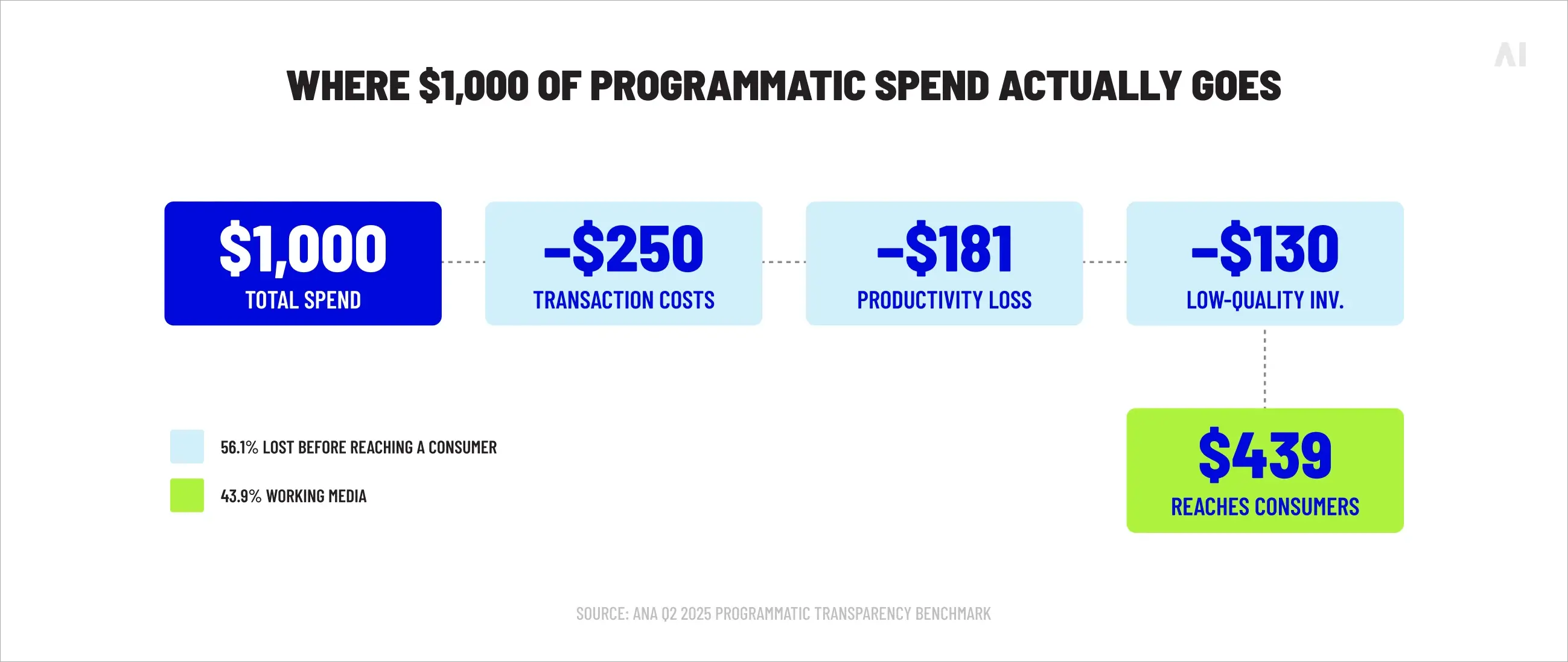
The scale of the problem is easier to grasp in dollar terms. US programmatic display spending surpassed $180 billion in 2025 and will clear $200 billion this year—which means the industry has never had more money moving through its pipes. It has also never lost more. The ANA's Q2 2025 Programmatic Transparency Benchmark found $26.8 billion in global media value disappearing annually to supply-chain waste, up 34% from just two years earlier. Put differently: for every $1,000 an advertiser puts into programmatic, just $439 reaches a real person viewing a quality ad placement. The rest bleeds out through transaction fees, intermediary markups, and impressions served on sites that exist for no purpose other than harvesting ad revenue.
Against that backdrop, the idea that you can reliably convert high-intent audiences on the open web by bolting together five or six specialised tools starts to look less like strategy and more like magical thinking.
💡 Related read: What is programmatic advertising?
What are high-intent audiences on the open web
A high-intent audience is not a demographic segment. It is not "women aged 25–34 who live in urban areas." It is a group of people whose observed behavior — right now, this week — indicates they are actively moving toward a decision. They are reading vendor comparisons. They are downloading spec sheets. They are spending four minutes on a pricing page and then searching for alternatives.
This is an important distinction, because it shifts what conversion hinges on:
- Demographic targeting asks whether you have found the right person.
- Intent targeting asks whether you have found them at the right moment.
Get the timing wrong and even a perfect audience match produces nothing.
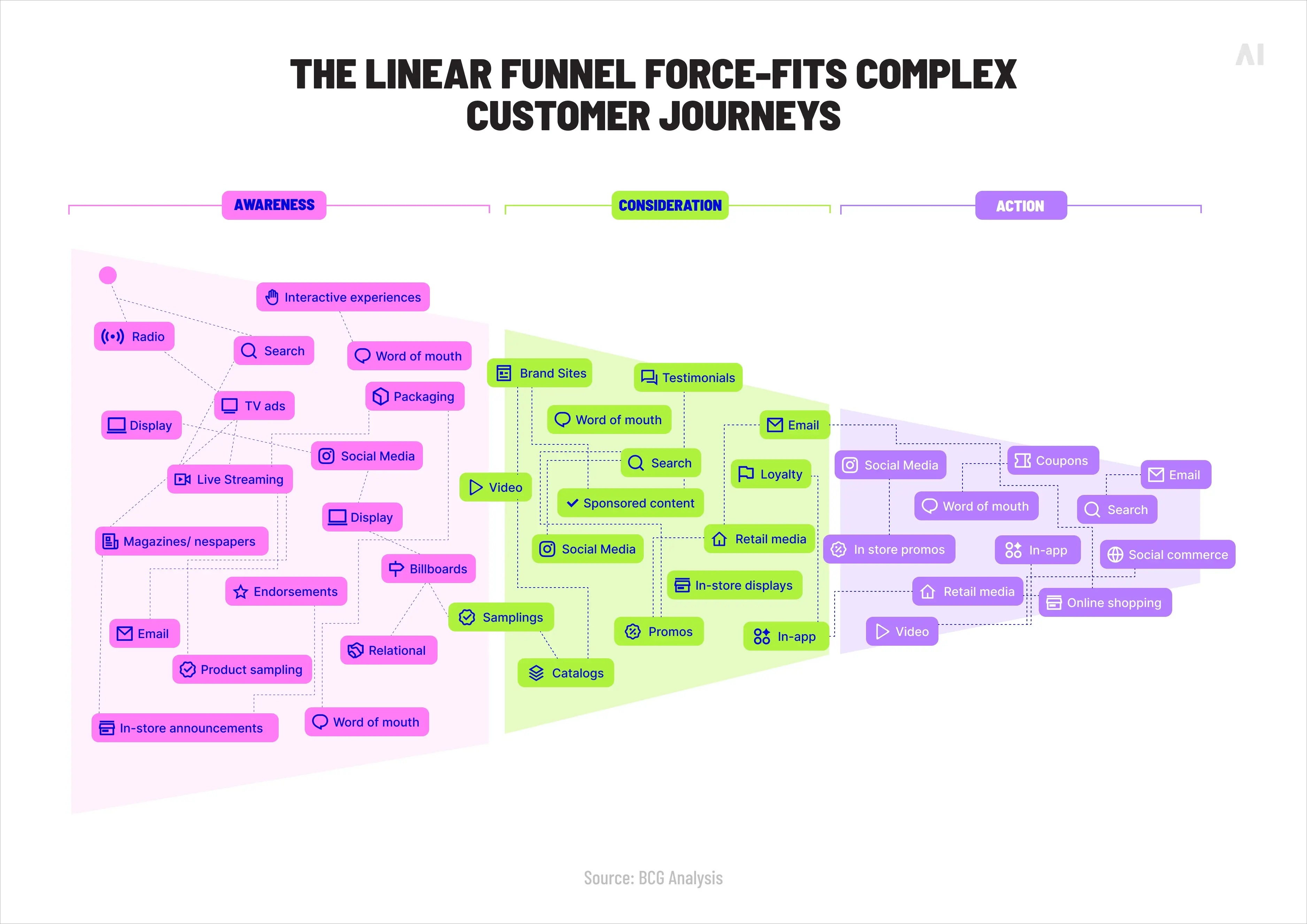
On the open web, this creates an uncomfortable paradox. Intent originates everywhere — across publishers, review platforms, industry sites, video channels — but it is captured almost nowhere in a unified way. 6sense's 2025 Buyer Experience Report surveyed 4,000 B2B buyers and found that 94% of buying groups had already ranked their preferred vendors before ever speaking to a salesperson. They consumed an average of 13 content pieces across the journey, overwhelmingly anonymously. The research happened in plain sight. The advertisers just couldn't see it.
{{26-High-Intent-Audiences-Open-Web-1="/tables"}}
*Note: Decay windows are directional estimates based on B2B buying cycle patterns. The point is that higher-value signals decay faster—and fragmented tool stacks rarely act fast enough to capture them.
💡 Related read: Walled gardens vs open internet: control, transparency, and trade-offs.
Why most high-intent strategies fail on the open web
The explanation is not complicated. It is, however, structural, which makes it harder to fix than anyone selling point solutions would like to admit.
- The tools don't talk to each other. A typical intent-based stack involves one vendor for signal detection (Bombora, 6sense), another for programmatic activation (a DSP or managed service), a third for on-site conversion (OptinMonster, Unbounce), a fourth for lead scoring (Leadspace, Clearbit), and a fifth for nurturing (HubSpot, Marketo). Each platform maintains its own identity graph, its own data model, its own sync cadence. Every handoff is a point of friction. Match rates drop. Behavioural context gets compressed into a single score. A signal that was rich and specific at detection arrives at activation as a blunt instrument.
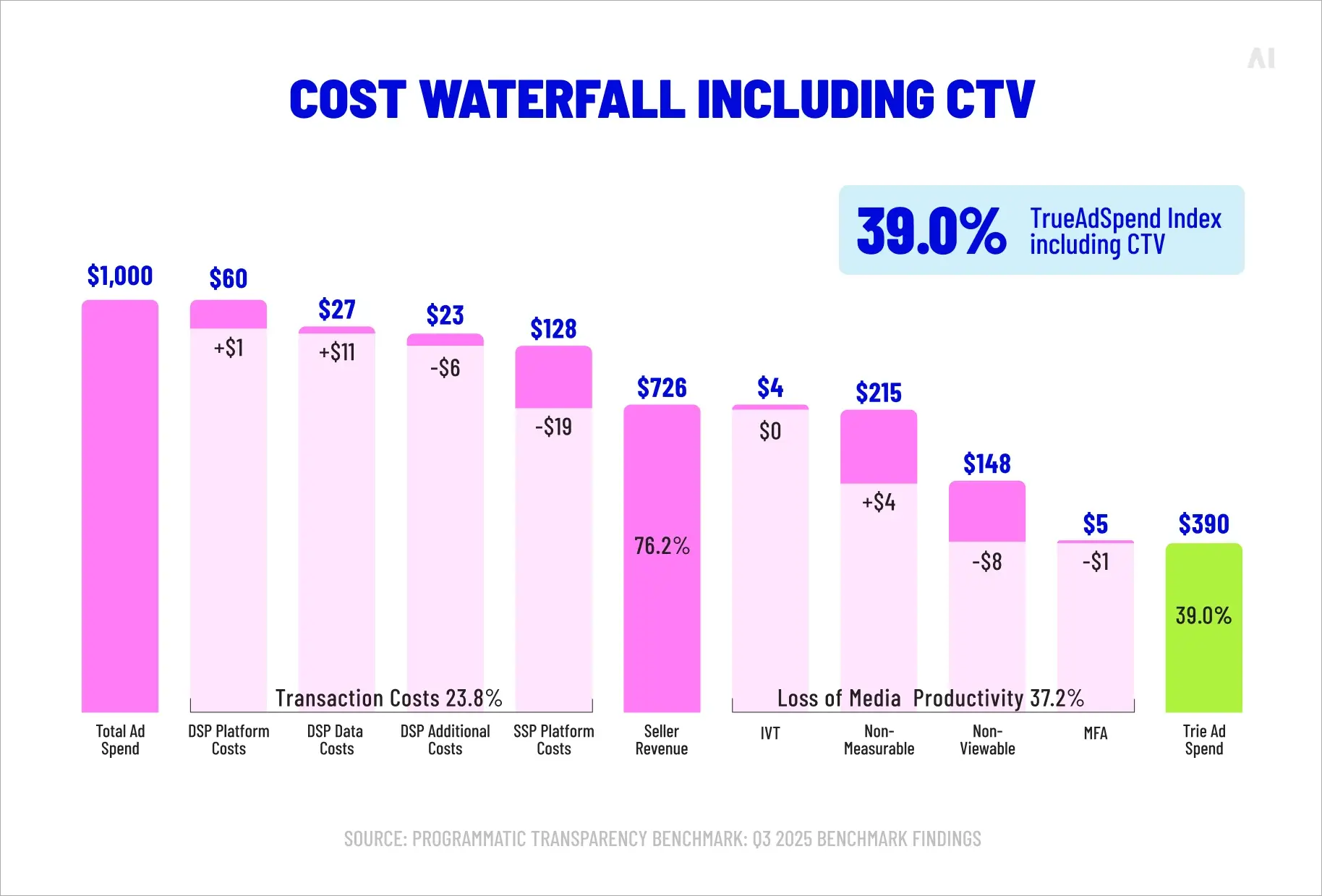
- The supply chain eats the signal. Even when intent data survives the tool-to-tool relay, the programmatic supply chain introduces its own distortions. The ANA's TrueAdSpend Index—measuring the share of spend that converts into working media—fell from 41.0 in Q1 2025 to 39.0 in Q3. That decline is not a rounding error. It means that fewer cents of each dollar are doing actual work, quarter after quarter, despite years of industry hand-wringing about transparency. For a high-intent campaign, where you need the right ad in front of the right person within a narrow window, routing impressions through low-quality inventory and redundant auction paths doesn't just waste money. It wastes the moment.
- Walled gardens hoard the rest. Google, Meta, and Amazon capture enormous volumes of intent data within their own ecosystems but will not let you take it out. You can optimize inside each silo, but you cannot stitch together the full picture. A user who searches on Google, encounters a display ad on a publisher site, and converts through a social retargeting campaign generates three separate data trails. They never merge.
As AdExchanger put it in its recent assessment of fragmentation: the complexity of today's programmatic landscape stands in sharp contrast to the original promise of the open internet.
💡 Related reads:
- What is supply path optimization (SPO) in programmatic advertising?
- What are walled gardens in digital advertising — definition, examples, and why they matter.
5 capabilities for intent-based lead generation on the open web
Converting high-intent audiences requires five things. Every one of them is necessary. And every one of them, in a fragmented stack, is also a place where the system can break.
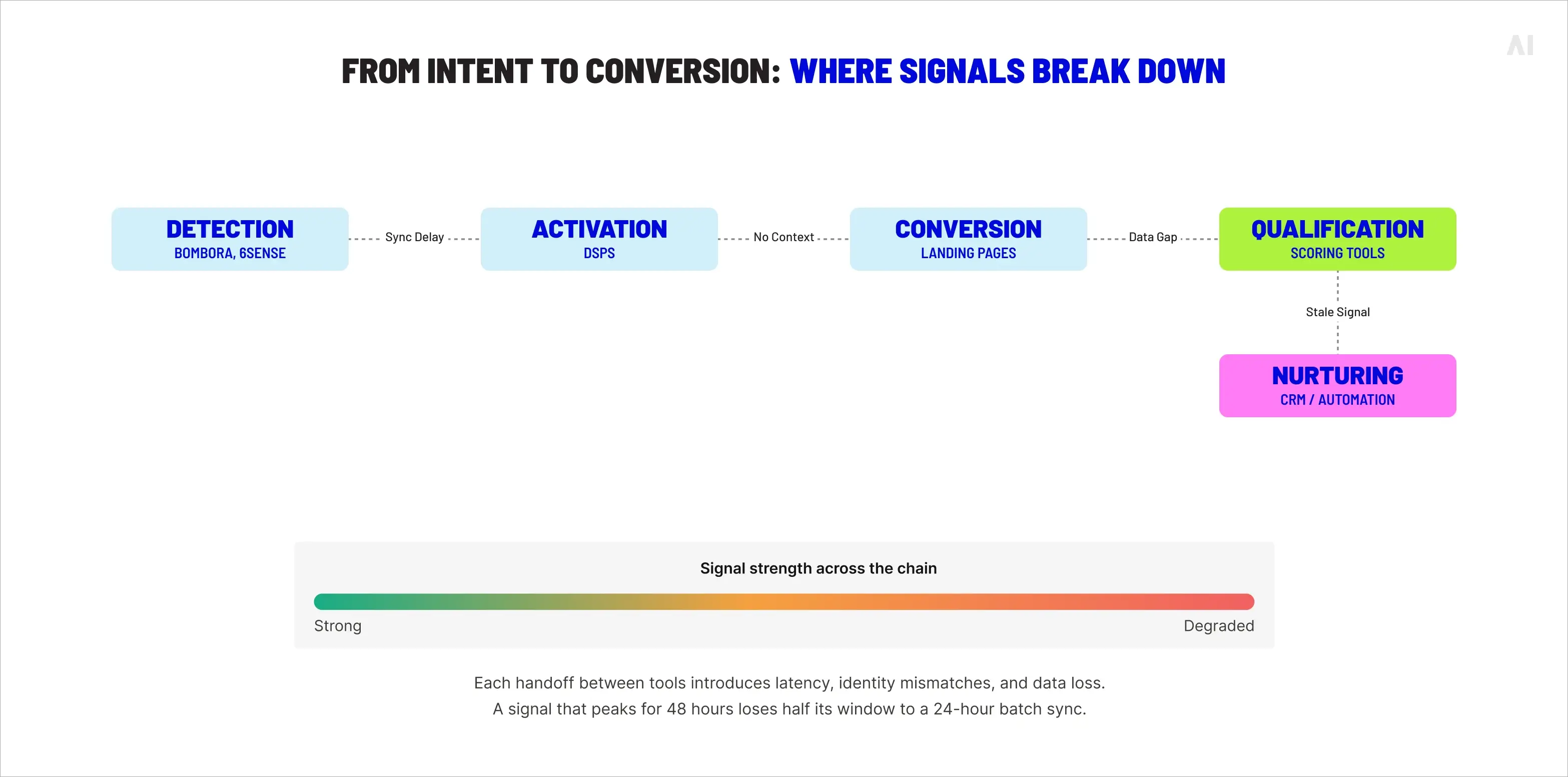
- Intent detection is the starting point. Bombora's cooperative data network and 6sense's signal processing—over one trillion buying signals daily—can identify when an account or individual is showing elevated research activity around specific topics. Forrester's Q1 2025 Wave evaluation of 15 B2B intent data providers confirmed the market has matured well beyond basic topic-surge scores, with leaders now offering persona-level intelligence and buying-group prediction. The problem is not detection. It is what happens next.
- Audience activation translates those signals into targetable segments and pushes them into programmatic channels. This is where latency kills. A 24-hour batch sync on a signal that peaks for 48 hours means half the opportunity window is already gone when the campaign goes live.
- Real-time conversion captures users at peak interest through low-friction experiences—adaptive landing pages, contextualized calls to action, streamlined forms. But these tools typically operate blind to the intent signal that drove the visit. They don't know how hot the lead is or what the user was researching five minutes ago.
- Lead qualification separates genuine buying signals from noise through scoring and enrichment. When it runs on a data set disconnected from the upstream intent signal, qualifying becomes guesswork dressed as science.
- Nurturing and conversion—the CRM and automation layer — inherits whatever data quality survived the preceding four stages. If the signal arrived degraded, the nurturing sequence is working with bad inputs.
Organizations that integrate intent data into their workflows without fragmentation see the difference. The evidence, such as it is, tells a fairly consistent story. Powell Software saw its MQL-to-SQL conversion rate rise from 20% to 28% after adopting ABM alongside intent-driven targeting— a 40% relative lift. Bombora points to work with Informa Markets where response rates sharpened considerably once intent data was added to the demographic mix. None of this is especially surprising. The difficulty is making that work in practice — and here, "unified" is the operative word. Bolting five tools together with API connectors does not produce a unified system. It produces a fragmented one with marginally better plumbing.
The core gap: fragmented tools and broken supply paths
It is worth pausing on what, exactly, fragmentation costs:
- Signal decay is the most direct loss. An intent signal that is 72 hours old by the time it reaches an activation platform is no longer actionable. The buyer has moved on—to a competitor, to a different stage of research, or out of the market entirely.
- Duplicate and conflicting records are subtler but equally corrosive. When detection, activation, and CRM platforms each maintain separate identity graphs, the same prospect can appear as multiple leads. This inflates cost-per-lead calculations and muddies pipeline forecasts.
- Supply-path leakage compounds everything else. The ANA's data shows transaction costs consistently above 23% of total spend. That is a tax on every campaign, including the ones where you got the intent signal, the audience match, and the creative right. You can do everything well upstream and still lose a quarter of your budget to intermediaries before the ad loads.
💡 Related reads:
- The Open Garden Framework: A New Operating Model for Programmatic Advertising
- Why fragmented data is breaking cross-platform performance
How the Open Garden drives higher conversions
AI Digital's Open Garden framework is built around a straightforward thesis: conversion performance is a system property, not a tool property. No individual platform (however sophisticated) can fix a problem that lives in the gaps between platforms.
In practice, the framework consolidates intent data, media activation, supply-path curation, and performance reporting into a single, vendor-neutral environment. Here is what that means concretely.
- Data and activation merge. AI Digital's recently relaunched Elevate platform processes intelligence from more than 150 billion data points monthly across 10,000+ audience attributes. Its AI-assisted media planner draws on 8,000+ campaigns across 12+ DSPs, meaning audience segments are matched to inventory sources within the same environment—no batch export, no sync delay. The platform was recently recognized with a B.I.G. 2026 AI Excellence Award in Analytics, validating its approach to replacing opaque, black-box optimization with what AI Digital calls "glass-box" intelligence — full visibility into every decision.
- Intent signals stay alive. Elevate's audience segmentation analyzes over one million audience pools to match intent profiles against behavioral, interest, and customer data. Because detection and activation happen in the same system, signals don't sit in a queue waiting for a sync window. When a prospect shifts from general research to vendor comparison, the targeting adjusts in near real-time.
- Peak-intent capture goes cookieless. The platform's cookieless targeting module scans 100,000+ websites, apps, and CTV apps with an AI crawler that maps content semantically. This allows campaigns to find high-intent users in the environments where they are actively consuming relevant content, without dependence on third-party cookies. When layered on top of standard segments, it picks up incremental reach that traditional targeting misses.
- Supply paths get cleaned up. AI Digital's Smart Supply solution selects inventory through direct relationships with 9+ top-tier SSPs and uses AI-powered filtering to strip out low-quality, non-viewable, and fraudulent traffic before it reaches a campaign. For high-intent work, where placement quality is the difference between a conversion and a wasted impression, this is not a nice-to-have. It is load-bearing infrastructure.
As AdExchanger reported, the Open Garden approach allows lean teams to combine AI-driven signal analysis with human expertise to coordinate campaigns across fragmented environments more efficiently, particularly for small and mid-size agencies that cannot absorb complexity by throwing bodies at it.
Before vs after
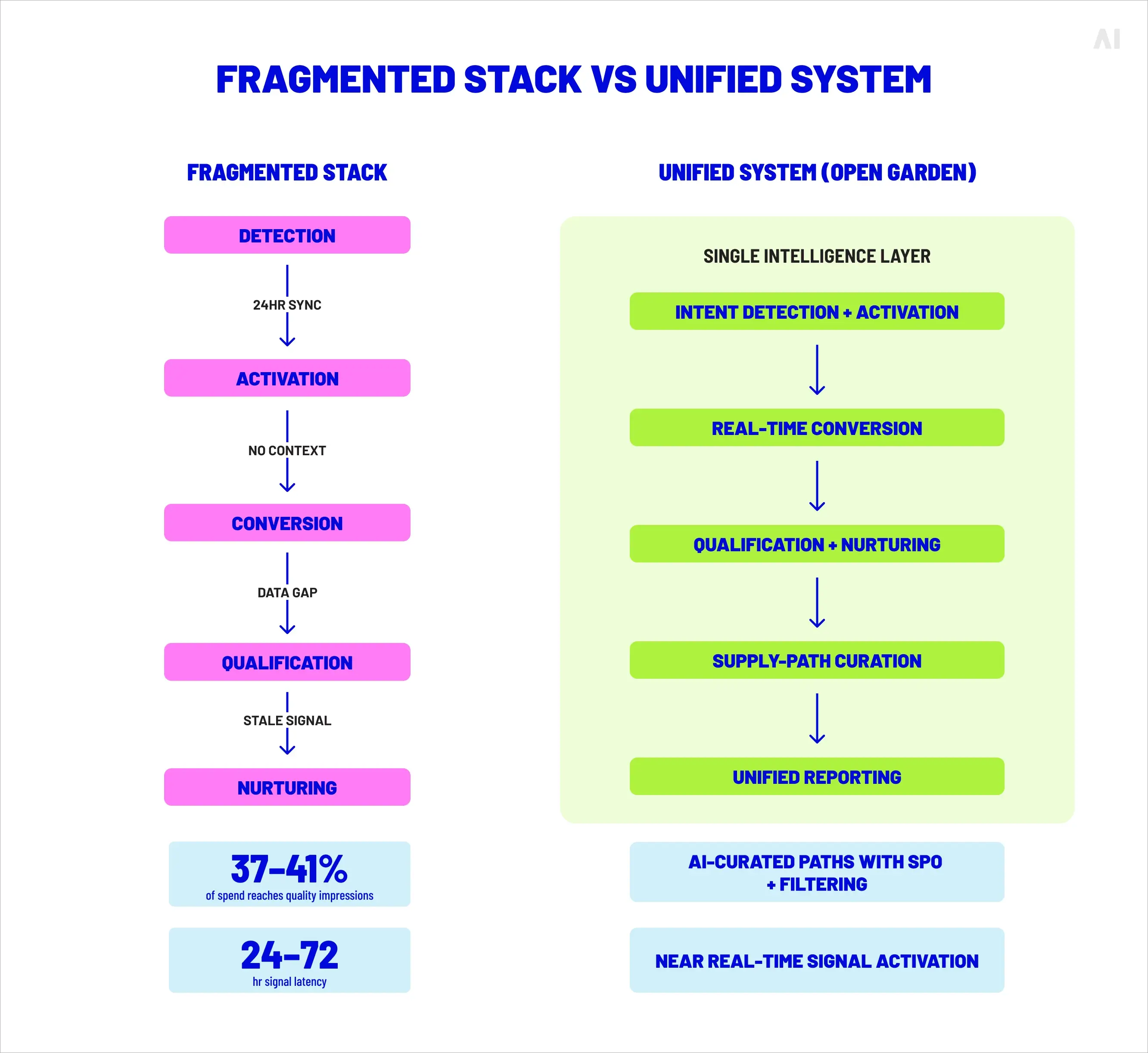
The contrast between a fragmented stack and a unified system is not marginal:
- Signal latency drops from 24–72 hours to near real-time.
- Identity resolution moves from multiple conflicting graphs to a single layer across DSPs.
- Supply-path efficiency improves from the ANA's reported 37–41% quality-impression rate to AI-curated paths with proactive fraud filtering and SPO.
- Cross-channel visibility shifts from siloed, platform-by-platform reporting to unified analytics across 15+ DSPs.
- And optimization cadence accelerates from manual, post-flight reconciliation to KPI-aligned adjustments every 15 minutes.
💡 Related reads:
How to measure high-intent conversion performance
If you are running high-intent campaigns and still reporting on impressions and CPM, you are measuring the container, not the contents. The metrics that actually track whether intent signals are converting to business outcomes are different.
- Conversion rate by intent tier segments outcomes by signal strength — topic surge versus pricing-page visit versus vendor comparison—to show which signals produce the highest-quality conversions and where the system is leaking.
- Cost per qualified lead (CPQL) captures both media efficiency and signal quality in a single number. When supply paths are clean and intent data flows without interruption, CPQL falls because fewer impressions are needed per qualified outcome.
- Signal match rate measures what percentage of detected intent signals successfully reach activation. A low rate points to identity-graph fragmentation or sync failures — the exact problems unification is meant to solve.
- Pipeline contribution connects media investment to revenue by tracking the share of pipeline originating from intent campaigns versus demographic or contextual targeting. This is the number that justifies future budget allocation.
- Marketing mix modelling provides a cross-channel view of how upper-funnel activity influences downstream conversion. Elevate's integrated MMM module runs within the same platform that manages activation, removing the reconciliation lag that typically delays attribution insights by weeks.
{{26-High-Intent-Audiences-Open-Web-2="/tables"}}
Conclusion: high-intent audiences open web requires system thinking
There is a temptation in advertising to treat every problem as a targeting problem. The audience wasn't right. The creative wasn't compelling enough. The bid wasn't high enough. And sometimes that is true. But the bigger problem in 2026, for anyone trying to convert high-intent audiences on the open web, is not that the individual components are broken. It is that the connections between them are.
The signals exist. The audiences are identifiable. The inventory is available. What falls apart is the infrastructure linking those things together—the handoffs, the delays, the supply-path waste that erodes delivery before it reaches anyone.
Advertisers gaining ground this year are the ones who stopped optimizing pieces and started optimizing the system. Unifying data, activation, and conversion into a single workflow. Controlling supply paths to protect signal quality. Measuring outcomes that reflect business impact rather than media delivery.
AI Digital's Open Garden framework, Smart Supply, and Elevate intelligence platform are one way to build that system. If the fragmentation described here mirrors your current stack, a conversation with AI Digital might be worth having.
Key takeaways:
- Unify fragmented tools into one system
- Preserve intent signals across the full journey
- Optimise supply paths to reduce data loss and cost
- Activate high-intent audiences in real time
- Align data, media, and conversion into one flow