Open Internet: What It Is and Why It Matters in Digital Advertising

Every advertising platform measures performance differently. Google reports conversions through its own attribution models. Meta uses its proprietary Business Manager dashboards. Amazon ties ad spend to retail outcomes within its closed ecosystem. Each of these platforms delivers useful data for campaigns running inside its walls. But when a brand's media plan spans display, connected TV, social, search, and independent publisher inventory simultaneously, platform-level reporting alone cannot deliver a complete picture.
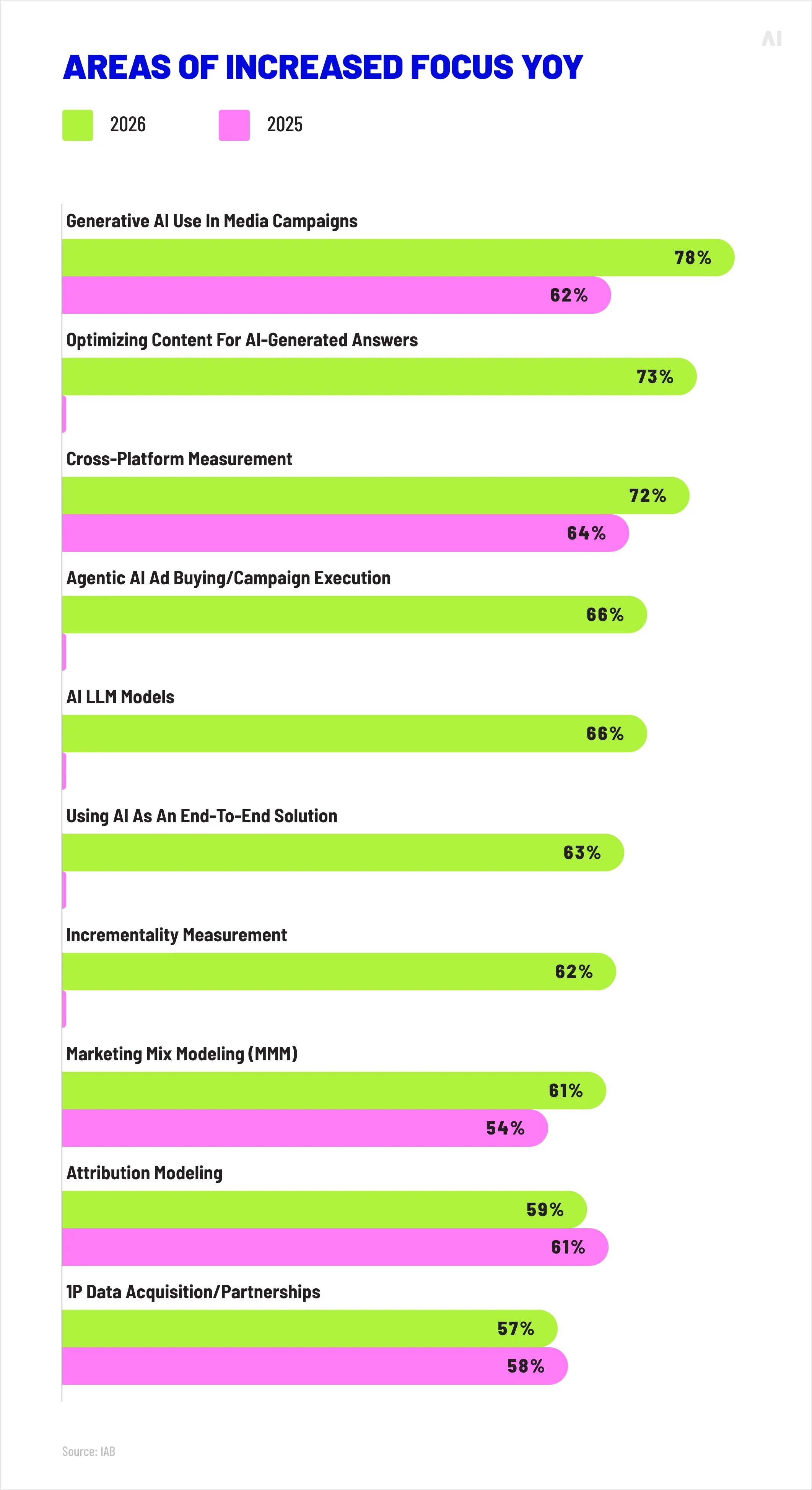
This disconnect between platform dashboards and actual cross-channel performance is growing. According to the IAB's 2026 Outlook Study, cross-platform measurement has risen to a priority for 72% of advertisers in 2026, up from 64% the previous year—a clear signal that brands are actively seeking visibility beyond any single platform's reporting.
This article explores what the open internet actually means in digital advertising, how its infrastructure works, what advantages it offers, and where its structural challenges lie. It also examines why the growing fragmentation of the broader ecosystem is pushing advertisers toward new frameworks for understanding performance across platforms.
What is open internet in digital advertising?
The open internet (sometimes called the open web) refers to the collection of independent websites, mobile applications, streaming services, and digital publishers where advertising inventory is available through open marketplaces and programmatic platforms. It is the portion of the digital ecosystem that operates outside the closed environments controlled by major tech platforms.
Unlike advertising within a single platform, the open internet runs on a distributed infrastructure. No single company controls the inventory, the data, or the measurement. Instead, a network of ad tech platforms connects advertisers to publishers through open-access bidding environments.
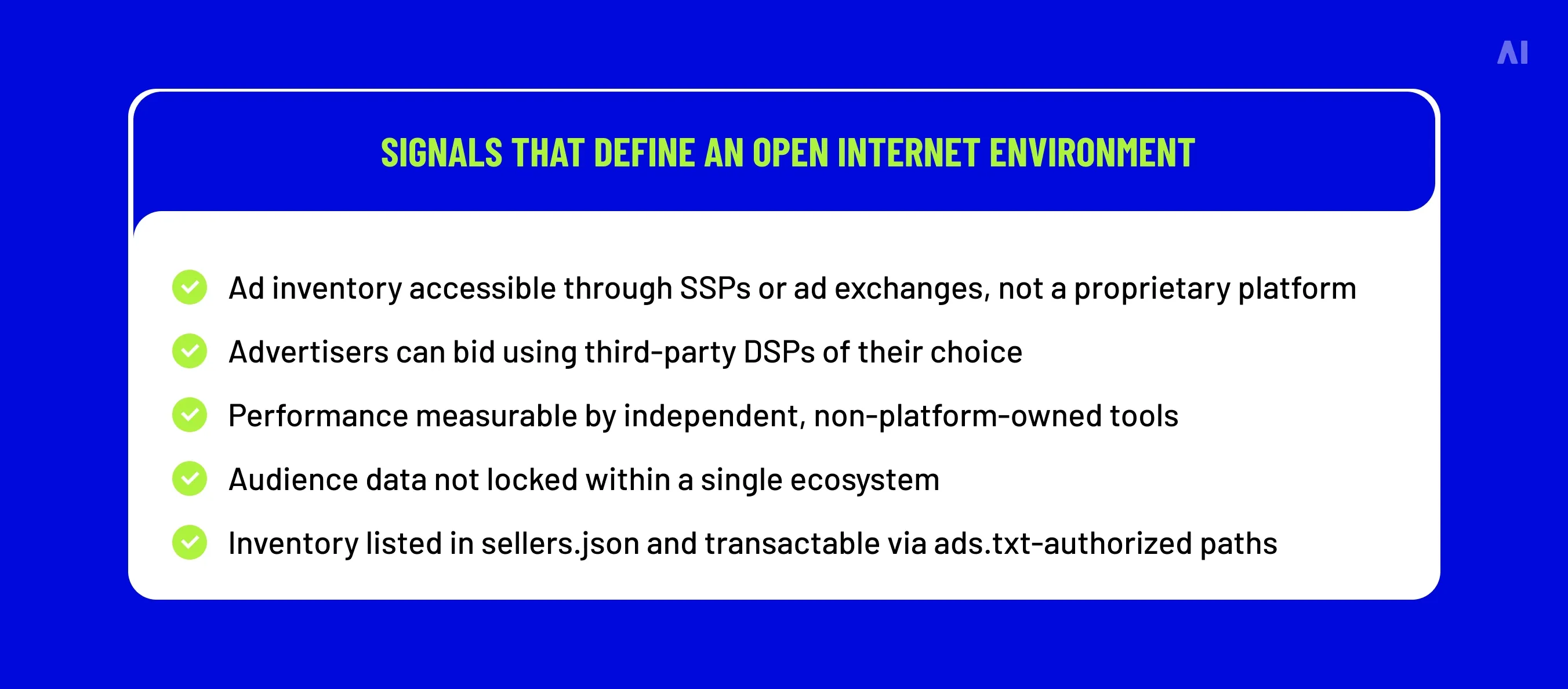
Several characteristics define the open internet as an advertising environment:
- Open-access inventory. Publishers make their ad space available through exchanges and supply-side platforms (SSPs), allowing any qualified buyer to bid on impressions.
- Independent publishers and media owners. The open internet includes everything from major news outlets and niche content sites to CTV apps and podcast networks—all operating independently from platform-owned properties.
- Programmatic buying infrastructure. Advertisers access open internet inventory primarily through demand-side platforms (DSPs) that automate bidding and targeting across thousands of properties in real time.
- Decentralized ecosystem design. Rather than a single platform dictating the rules, the open internet ecosystem is governed by industry standards, open protocols, and multiple competing technology providers.
This is the environment where programmatic open internet advertising operates at scale. It is also where the tension between reach and complexity plays out most visibly.
⚡ Think of the open internet as the full ecosystem of independent digital properties where advertisers can access audiences free from any single gatekeeper's control.
How the open internet differs from walled gardens
The difference between the open internet and walled gardens is structural. In a walled garden, a single platform controls inventory access, audience data, campaign measurement, and reporting. Google, Meta, and Amazon are the most prominent examples. In the open internet, these functions are distributed across multiple independent providers, giving advertisers more flexibility and more operational complexity.
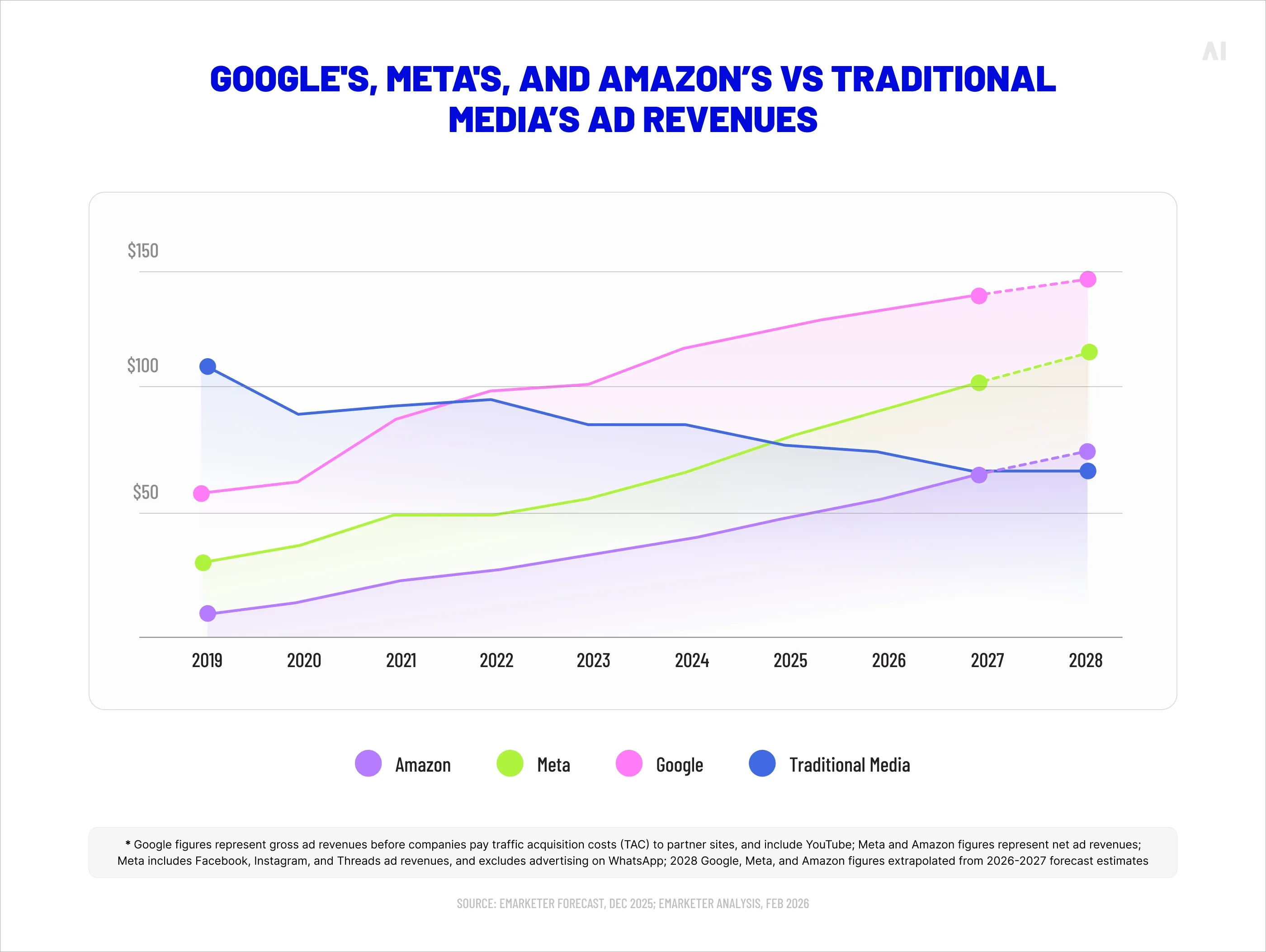
According to Statista, walled gardens accounted for approximately 78% of global digital advertising revenue in 2022, with that share projected to reach 83% by 2027. The open internet captures the remainder, yet it represents a disproportionately large share of where users actually consume content beyond social feeds and search results.
Here is how the two models compare across key structural dimensions:
{{26-Open-Internet-What-It-Is-and-Why-It-Matters-1="/tables"}}
The practical implication is straightforward. Walled gardens trade flexibility for convenience—they simplify execution within a single environment but restrict an advertiser's ability to compare, verify, or optimize across platforms. The open internet offers the opposite trade-off: broader access and greater transparency, but more coordination required.
💡 Related reading: What are walled gardens in digital advertising? | Walled gardens vs open internet
How the open internet ecosystem works
The technical infrastructure behind open internet advertising connects advertisers to publishers through a chain of specialized platforms. Each one serves a distinct function.
Publishers—the websites, apps, and streaming platforms that create content—make their ad inventory available by working with supply-side platforms (SSPs). SSPs manage the publisher's inventory, packaging it for sale and connecting it to ad exchanges, which function as open marketplaces where buying and selling happens in real time.
On the buying side, advertisers use demand-side platforms (DSPs) to place bids on available impressions. DSPs evaluate available inventory against the advertiser's targeting criteria—audience segments, contextual signals, geography, device type—and submit bids through real-time bidding (RTB) auctions. The entire process, from a user loading a page to an ad being served, takes roughly 100 milliseconds.
{{26-Open-Internet-What-It-Is-and-Why-It-Matters-2="/tables"}}
This infrastructure allows advertisers to reach audiences across thousands of independent properties through a single buying interface, rather than negotiating directly with each publisher. It is the mechanism that enables programmatic advertising at scale—and in the US alone, programmatic transactions have accounted for more than 90% of digital display ad spending since 2023.
The open internet ecosystem is not static. Connected TV, digital audio, and digital out-of-home inventory are increasingly transacted programmatically, expanding the range of environments where advertisers can buy through open marketplace infrastructure.
💡 Related reading: Programmatic advertising
The supply path behind open internet advertising
Understanding how ads move through the open internet supply chain matters because it directly affects cost, efficiency, and transparency.
A single impression on the open internet may pass through several intermediaries before reaching a user. The typical path runs from the advertiser through a DSP, into an ad exchange or SSP, and finally to the publisher. Some impressions travel even more complex routes—through multiple resellers or exchanges—before they find a buyer.
This structure creates both scale and fragmentation. On one hand, advertisers can access enormous reach and compete for inventory across diverse publisher environments. On the other, each intermediary in the chain introduces fees, latency, and potential opacity.
The economics are significant. According to ANA's Q2 2025 Programmatic Transparency Benchmark, roughly $26.8 billion of global programmatic media spend remains unrealized—lost to inefficiencies, poor ad quality, or mismatched supply paths. Separate analysis suggests that publisher revenue was materially lower than the top-line ad dollar, averaging 51% in the 2020 study and 65% in the 2022 follow-up, with stronger results in some PMP environments.
⚡ Every intermediary in the supply path either adds measurable value or subtracts from the advertiser's working media. The challenge is knowing which is which.
Industry standards like sellers.json and the SupplyChain Object (SChain) now allow buyers to trace exactly which intermediaries are involved in a transaction. Supply path optimization (SPO) has become a core discipline, focused on selecting the most direct, cost-efficient, and transparent routes to quality inventory.
💡 Related reading: The digital advertising supply chain explained
Benefits of the open internet for advertisers
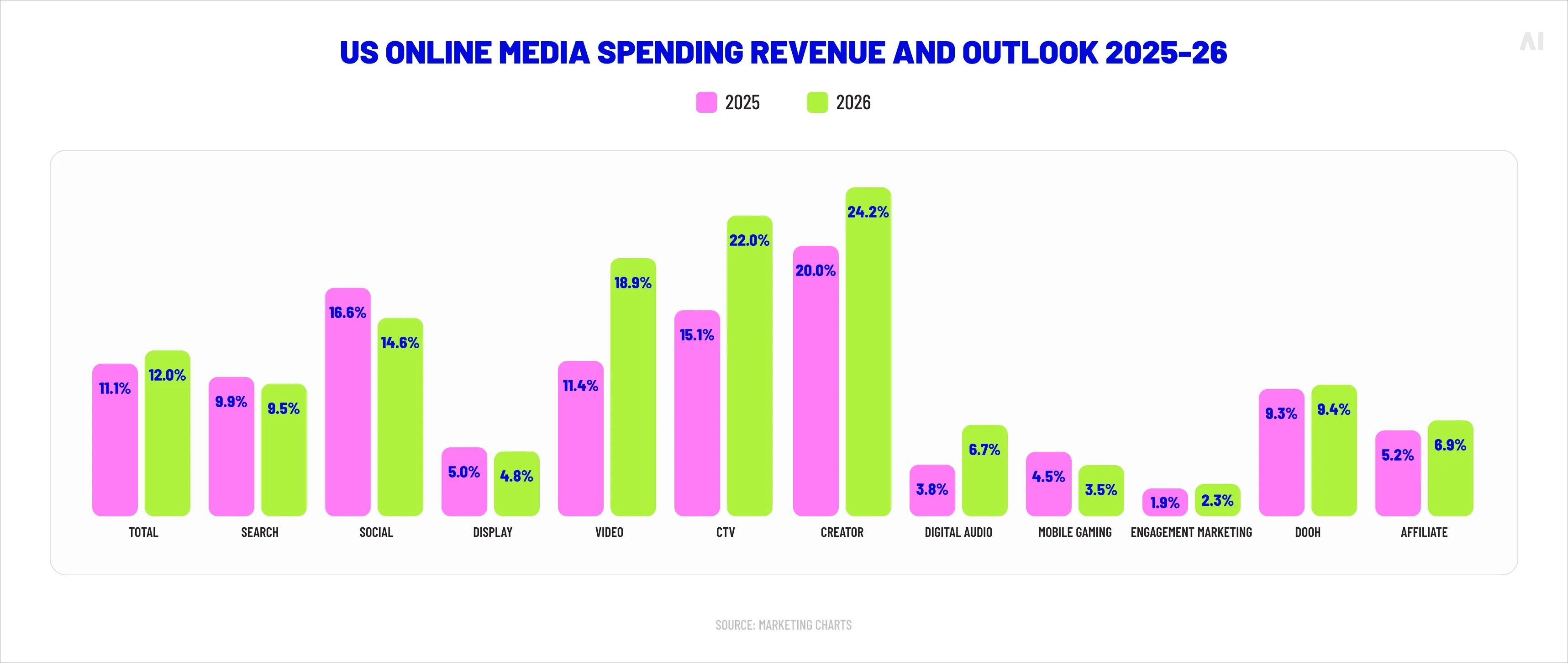
Despite its complexity, the open internet remains a critical component of the media mix. The IAB's 2026 Outlook Study projects 9.5% growth in total US ad spend for the year, with CTV—a core open internet channel—forecast to grow 13.8% year over year. Advertisers continue investing here for clear structural reasons.
Broader audience reach
The open internet encompasses millions of websites, apps, and streaming platforms. This means advertisers can reach audiences in environments that major platforms do not control—from niche publisher sites and news outlets to independent CTV apps and podcast networks.
CTV alone illustrates the scale of this opportunity. According to Winterberry Group data reported by Marketing Charts, US CTV ad spend grew 15.1% to $33.1 billion in 2025, with a further 22% increase forecast for 2026, bringing the total to approximately $40.4 billion. Much of this inventory is transacted through open programmatic infrastructure.
💡 Related reading: Streaming TV advertising
Greater transparency and control
Unlike walled gardens, where attribution and reporting remain proprietary, open internet advertising allows brands to work with independent measurement providers, third-party verification tools, and custom attribution frameworks. Advertisers can audit where their ads appear, verify viewability, and validate audience delivery through providers that are not owned by the same company selling the media.
More flexible media buying
The open internet supports a range of transaction types—from open RTB auctions to private marketplace (PMP) deals and programmatic guaranteed arrangements. Advertisers can adjust inventory sources, creative formats, and targeting strategies dynamically without being locked into a single platform's tools or optimization logic.
{{26-Open-Internet-What-It-Is-and-Why-It-Matters-3="/tables"}}
Diversification beyond platform ecosystems
Relying heavily on two or three platforms concentrates risk. Policy changes, algorithm updates, or pricing shifts within a walled garden can materially affect campaign performance overnight. Open internet campaigns distribute that risk across a broader set of publishers and technology partners, giving brands more resilience and negotiating leverage.
⚡ On the open internet, diversification serves two roles: media planning strategy and risk management discipline.
Structural challenges of the open internet
The same distributed architecture that gives the open internet its advantages also introduces operational and strategic friction.
Fragmented inventory
Inventory on the open internet is spread across thousands of publishers, exchanges, and SSP connections. This creates enormous reach, but also makes it difficult to maintain consistent quality standards, brand safety controls, and frequency management across all sources without dedicated infrastructure and expertise.
Complex measurement environments
With no single platform controlling both the buy side and the sell side, measurement on the open internet requires assembling insights from multiple tools and frameworks. The IAB's State of Data 2026 report found that between 60% and 75% of senior brand and agency decision-makers believe current advanced measurement approaches fall short on rigour, timeliness, and trust. This is a significant finding, and it points directly to the challenge of operating across disconnected systems.
Supply path inefficiencies
As noted in the supply path section, multiple intermediaries can erode the percentage of ad spend that reaches working media. Without active supply path optimization, advertisers risk overpaying for inventory that could be accessed more directly—or, worse, funding low-quality placements that deliver negligible business value.
The rise of ecosystem fragmentation
The advertising ecosystem no longer divides neatly into "walled gardens" and "open internet." A third category has emerged: retail media networks, commerce media platforms, and CTV-specific ecosystems that blend characteristics of both models.
US retail media spending through programmatic channels grew by 41.7% in 2024 and is projected to exceed $30 billion by 2026. Commerce media overall is forecast to grow 12.1% in 2026, nearly 30% faster than the rest of the ad market, per the IAB.
Each of these environments operates with its own data, its own measurement framework, and its own reporting dashboard. The result is a multi-layered fragmentation where advertisers must reconcile performance data from walled gardens, open internet campaigns, retail media buys, and CTV platforms—all simultaneously, all using different metrics.
This is not simply an operational inconvenience. It is a structural challenge that affects strategic decision-making. When no single view of performance exists across channels, budget allocation decisions are based on incomplete information. Attribution becomes contested. Incrementality is difficult to prove.
The industry's response is still emerging. The IAB launched Project Eidos in early 2026—a multi-year initiative to develop shared, interoperable standards for cross-channel advertising measurement. The need for this type of coordination underscores how far the ecosystem remains from a unified framework.
For advertisers, this means the question is no longer just "open internet or walled garden?" It is: how do we build independent visibility across an ecosystem that is fragmenting faster than measurement can keep up?
💡 Related reading: What is advertising governance in a fragmented ecosystem?
The future of the open internet in a privacy-first world
Privacy regulation, signal loss, and evolving identity frameworks are reshaping how the open internet operates—but they are not diminishing its importance.
The deprecation of third-party cookies has been the industry's dominant narrative for years. While Google ultimately reversed its plan to remove cookies from Chrome entirely, the broader shift toward privacy-first infrastructure continues. Advertisers are adapting through several parallel strategies:
- Contextual targeting has re-emerged as a core tactic, with adoption reaching an estimated 55% among programmatic advertisers globally. Advances in natural language processing now enable granular content analysis that was not possible even two years ago.
- First-party data strategies are becoming essential, as brands build consented data relationships directly with consumers to reduce reliance on third-party signals.
- Clean rooms and privacy-safe measurement allow advertisers and publishers to match data sets for attribution and analysis without exposing individual-level information.
- Alternative identity frameworks, including Unified ID 2.0 and publisher-authenticated traffic, offer open-internet-compatible identity solutions that respect user consent while maintaining targeting precision.
{{26-Open-Internet-What-It-Is-and-Why-It-Matters-4="/tables"}}
⚡ The open internet draws on multiple identity signals rather than relying on any single one. Its distributed architecture allows it to absorb privacy shifts through parallel solutions working simultaneously.
The open internet remains essential precisely because it is not controlled by a single entity's privacy framework. Where walled gardens impose their own rules on data access (and benefit commercially from doing so), the open internet allows the industry to develop and adopt shared, interoperable privacy standards collaboratively.
💡 Related reading: Walled gardens: The hidden cost for digital advertisers
Conclusion: building independent visibility in a fragmented ecosystem
The open internet is not a niche corner of digital advertising. It is the foundational infrastructure through which brands access audiences, publishers, and inventory beyond the control of any single platform. It provides reach, flexibility, and transparency that walled gardens, by design, do not offer.
At the same time, the open internet introduces real operational complexity. Inventory fragmentation, supply path inefficiencies, and disconnected measurement systems require dedicated strategy, technology, and expertise to manage effectively.
This is the challenge that AI Digital's Open Garden framework was built to address. Open Garden operates as a DSP-agnostic, cross-platform ecosystem designed to give advertisers complete transparency and control over their media investment, without being locked into a single platform's tools, data, or optimization logic. Rather than replacing the open internet's distributed architecture, Open Garden works with it, connecting advertisers to 15+ DSPs and unifying campaign performance data across channels that would otherwise remain siloed.
Supporting this framework are two complementary solutions. Smart Supply, AI Digital's supply-side service, uses AI-powered supply path optimization to filter out low-quality inventory, reduce intermediary fees, and ensure brand-safe placements across premium publisher environments. Elevate, AI Digital's intelligence platform, layers predictive analytics and real-time optimization across the entire media buying process, enabling faster, data-informed decisions while maintaining strategic human oversight.
Together, these solutions reflect a broader principle: that the open internet's advantages—reach, transparency, flexibility—are only fully realized when advertisers have the infrastructure to coordinate across its fragmented ecosystem, not just participate in it.
Key takeaways for marketers:
- The open internet expands audience reach far beyond major platform ecosystems, including access to CTV, independent publishers, and programmatic marketplaces.
- Independent measurement and third-party verification tools are available on the open internet—a structural advantage over closed-platform reporting.
- Diversifying media investment across open internet environments reduces dependency on any single platform's policies, pricing, or algorithm changes.
- Supply path optimization is essential for controlling costs and ensuring that ad spend reaches quality inventory through the most efficient routes.
- Cross-channel measurement and coordinated campaign management are no longer optional—they are the defining challenge for advertisers operating across a fragmented ecosystem.
If the themes in this article resonate with how you're thinking about your media strategy, get in touch with AI Digital—we're always happy to talk through the challenges of building cross-platform visibility and what a more coordinated approach could look like for your business.