From Fragmented to Sustainable: Rethinking the Programmatic Supply Path

Every programmatic impression travels a path. It moves from publisher to SSP, through exchanges and intermediaries, before arriving at a DSP and finally reaching a buyer. In theory, this journey should be direct. In practice, the same impression often travels multiple routes simultaneously, processed by overlapping vendors, evaluated in parallel auctions, and duplicated across competing supply paths. This fragmentation is a structural inefficiency baked into the architecture of programmatic advertising—one that drives up costs, erodes transparency, and generates a measurable carbon footprint.
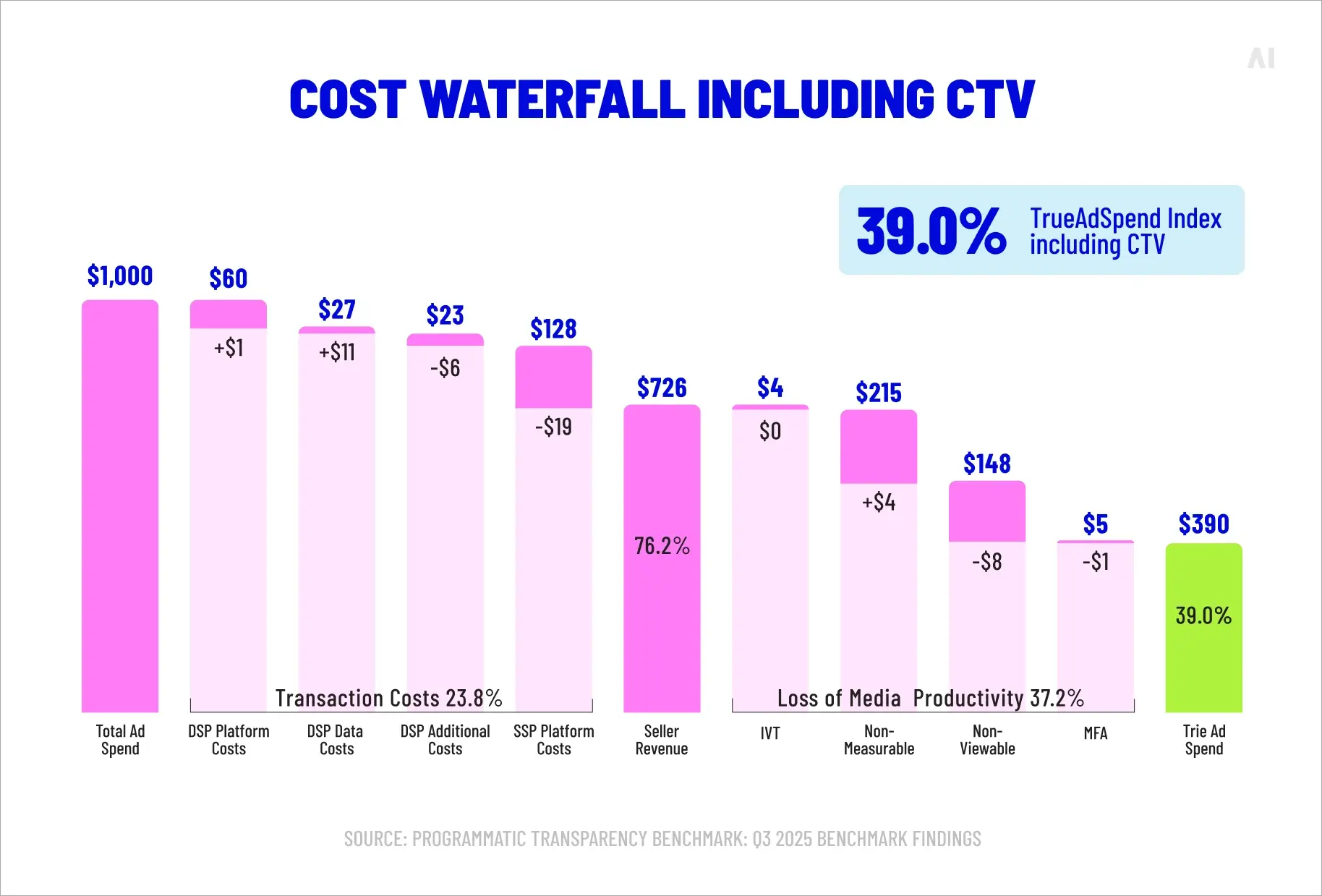
The sustainable programmatic supply path is not an abstract aspiration. It is a concrete design challenge: how to move impressions from seller to buyer with the fewest intermediaries, the least duplication, and the clearest line of sight. The ANA's Q2 2025 Programmatic Transparency Benchmark put a number on the problem: $26.8 billion in global media value is still being lost to supply chain inefficiencies every year. Transaction costs account for more than a quarter of total programmatic spend. Less than half of every dollar actually reaches the consumer as a viewable impression on quality inventory.
This article examines why fragmented supply paths create those losses, how duplication and parallel routing inflate carbon emissions, and what advertisers can do to restructure the path itself.
💡 Related reads: What is programmatic advertising?
What is a sustainable supply path in programmatic advertising?
A sustainable supply path is simply the cleanest, shortest, most transparent route an impression can take from the publisher who owns the ad slot to the advertiser who wants to fill it. Fewer middlemen. No redundant processing. Every participant in the chain identifiable and earning their place.
The important word here is "path," not "chain." Much of the industry's sustainability discourse fixates on the supply chain—the full map of vendors, platforms, and data partners that make up the programmatic marketplace. Useful as a reference, that framing glosses over a crucial difference.
- The supply chain describes who is available.
- The supply path describes what actually happens.
Two advertisers can sit within the same supply chain and have wildly different experiences of waste and efficiency, depending on which routes their impressions take.
A well-designed path typically runs through three to five trusted intermediaries, each performing a function that justifies the hop: demand access, fraud prevention, data enrichment, inventory curation. The impression is evaluated once, or as few times as auction mechanics genuinely require. The entire route can be audited. And because fewer redundant steps means less power consumed, efficiency and sustainability become two sides of the same coin—budget that flows to working media instead of intermediary fees, energy that serves a purpose rather than spinning in circles.
💡 Related reads:
- Digital Advertising Ecosystem: How It Actually Works in a Fragmented, Platform-Driven World
- Performance marketing strategy
Supply path vs Supply chain
The distinction deserves spelling out in full, because the two terms are routinely conflated.
- The supply chain is the full roster of participants: publishers, SSPs, exchanges, DSPs, verification vendors, data providers, and the small armies of intermediaries between them. It describes the infrastructure that exists.
- The supply path is the specific route a given impression takes through that infrastructure. One publisher's ad slot might travel through three different SSPs, each connecting to multiple exchanges, each routing bid requests to overlapping sets of DSPs. Each of those routes is a distinct supply path.
If the supply chain is the road network, the supply path is the journey you actually take—and taking six routes simultaneously to the same destination is not clever navigation. It is congestion.
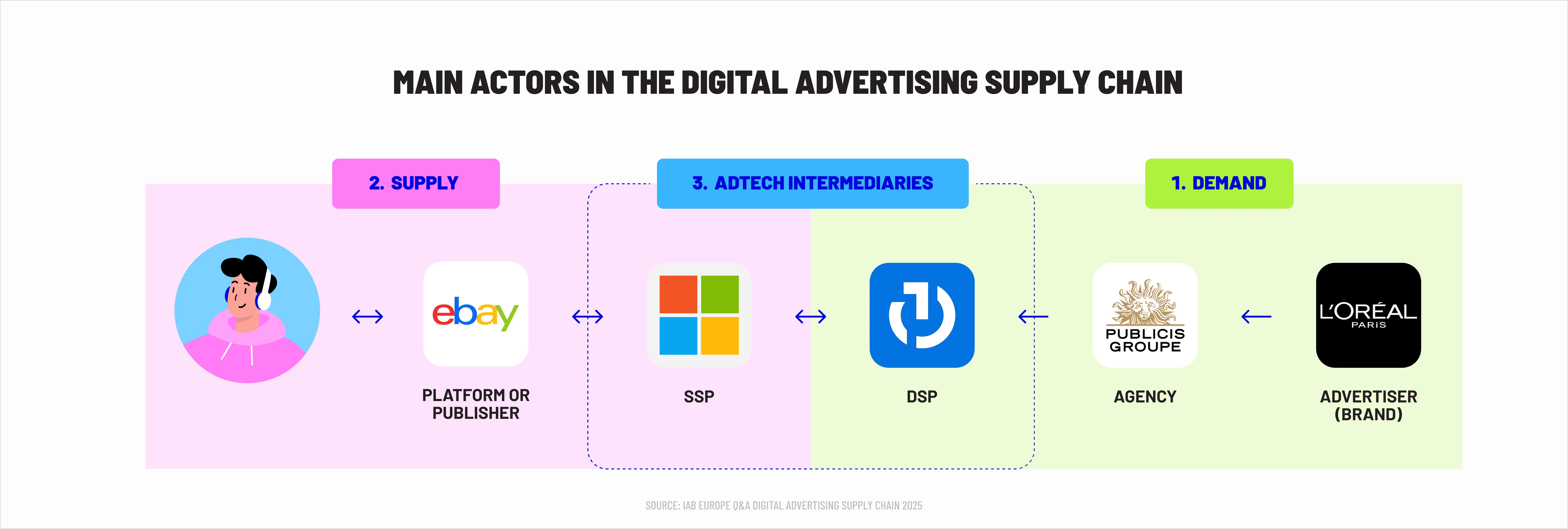
That is why cleaning up the supply chain—enforcing ads.txt, consolidating vendor rosters—does not automatically fix the path problem. A tidier ecosystem can still route impressions through redundant, energy-intensive loops. To make programmatic more sustainable, you have to look at the paths themselves.
Why programmatic supply paths are inefficient and fragmented
The growth of intermediaries over the past decade has been remarkable, even by the standards of an industry that has never been shy about adding layers. What began as a fairly linear publisher-to-advertiser pipeline now involves SSPs, exchanges, resellers, and aggregators—many of them processing the same inventory through parallel channels. According to industry analysis, average campaign runs across tens of thousands of top-level domains, when a few hundred would reach the overwhelming majority of audiences.
None of this was planned. It accumulated. Each new platform entered the market offering something plausible—unique demand access, better yield, proprietary targeting signals. Individually, these additions made sense. Collectively, they produced a system in which a single impression opportunity can generate dozens of bid requests across competing supply paths. The ecosystem became simultaneously vast in scale and deeply redundant in practice.
💡 Related reads: Why fragmented data is breaking cross-platform performance
The rise of SSPs, exchanges, and resellers
The story begins, roughly, with header bidding. When the technique replaced the waterfall model between 2015 and 2017, publishers gained the ability to solicit simultaneous bids from multiple demand sources. This was a genuine improvement—it lifted competition for inventory and increased publisher revenue. But it also introduced a structural side effect that the industry has yet to resolve: a multiplication of supply paths for every impression.
A publisher connected to six SSPs now sends the same impression opportunity to all six at once.
- Each SSP routes those bid requests to its connected DSPs, many of which overlap.
- The same buyer sees the same impression arrive through three or four different windows, each carrying slightly different pricing, latency, and data signals.
- Over time, resellers layered on top, repackaging supply from other SSPs and adding hops without corresponding value.
The ANA's Q2 2025 data showed that even as the industry consolidates—median SSP count per campaign has fallen from 19 to 17, active domains from nearly 54,000 to roughly 29,000—the underlying routing complexity has barely budged.
💡 Related reads:
- What is a supply-side platform (SSP)? How SSPs work in programmatic advertising
- DSP vs SSP vs ad exchange
Parallel paths in programmatic auctions
This is where the duplication problem lives. When the same inventory is offered simultaneously through multiple SSPs, each running its own auction, the result is a cascade of bid requests for a single ad slot. A DSP on the receiving end often cannot tell that it has already seen the same opportunity through another path, particularly when placement identifiers are inconsistent or absent entirely.
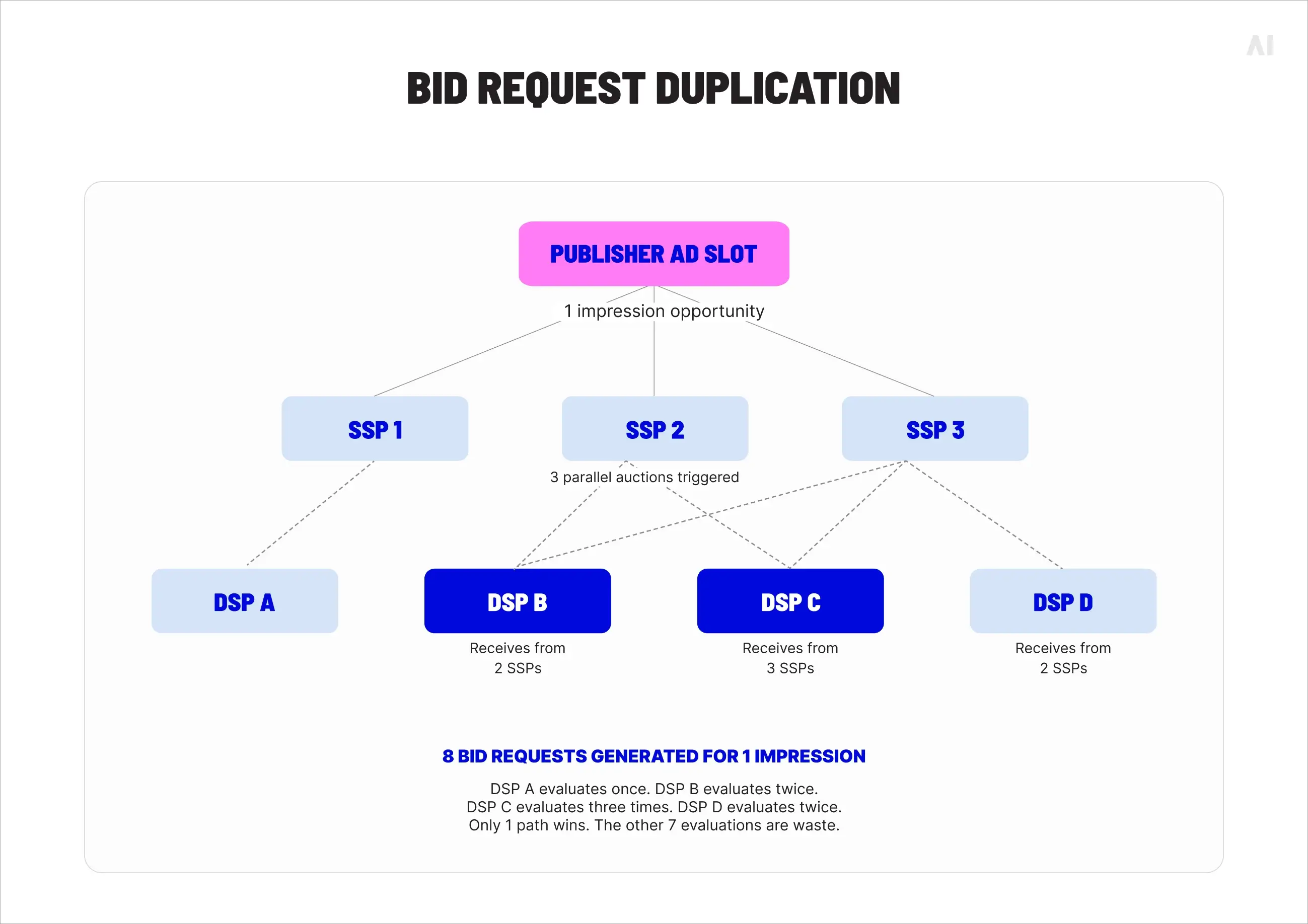
The numbers get large quickly. High-volume publishers generate thousands of queries per second, each multiplied by the number of SSPs in their stack. For buyers, a meaningful share of the bid requests they evaluate (and the computational resources they burn doing so) goes toward duplicate opportunities that can never convert into a win. This is not just an accounting problem. Every redundant server call draws electricity and adds to the industry's aggregate carbon footprint.
Limited transparency across supply paths
Even advertisers who understand the fragmentation problem often lack the tools to measure its scale. Most DSP reporting surfaces performance data at the campaign or placement level, not at the supply path level. A buyer can see which SSP won a given impression. What remains invisible is how many parallel paths were evaluated and discarded, and how much budget and compute disappeared in the process.
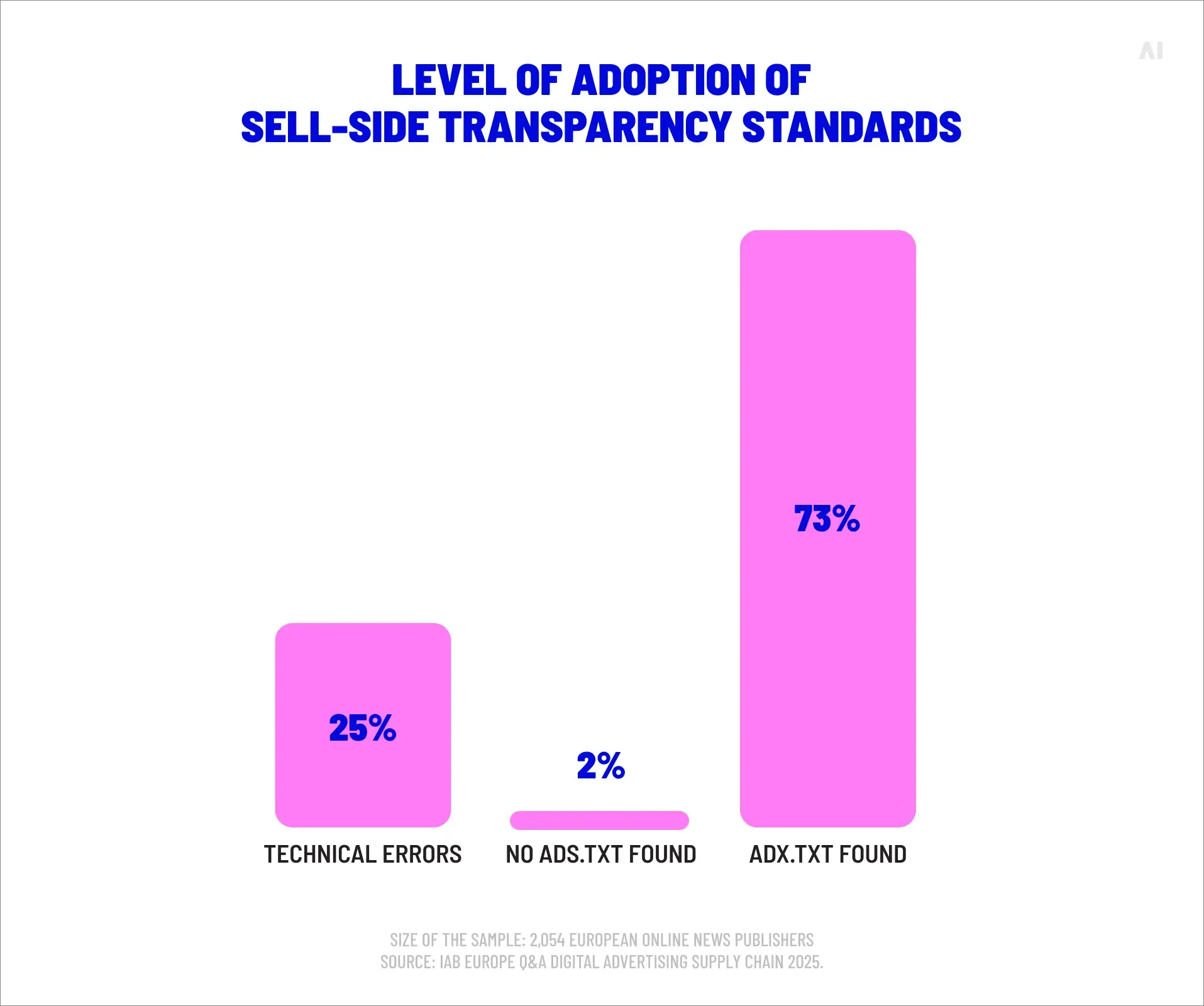
Standards like ads.txt and sellers.json have established a baseline by clarifying who is authorized to sell a given publisher's inventory. But authorization is not the same as routing transparency. An advertiser may know that five SSPs are all legitimate sellers of a publisher's inventory, without ever seeing that all five are sending overlapping bid requests for the same slot—each extracting a fee, each burning server capacity, each delivering diminishing marginal value.
💡 Related reads: Digital advertising transparency: why it matters in a fragmented ecosystem
How fragmented supply paths increase costs and carbon emissions
Every step in a supply path consumes energy. Every bid request transmitted from publisher to SSP, from SSP to exchange, from exchange to DSP and back again requires server processing, data transfer, and storage. Through optimized, direct paths, this energy cost is the price of doing business. Through ten to fifteen intermediaries—which industry analysis suggests is typical for a single impression—it is largely the price of structural neglect.
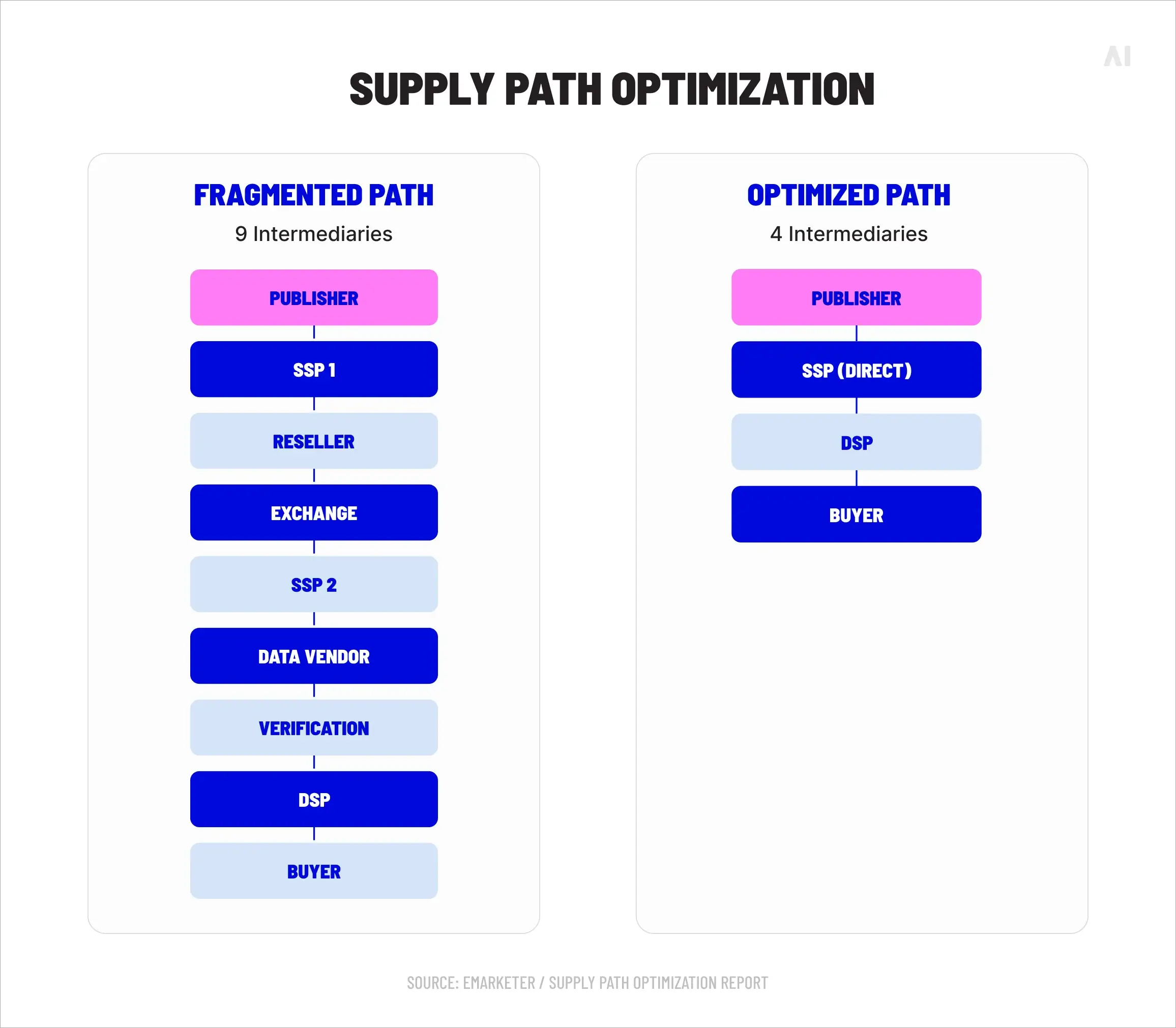
Three dynamics are at work here:
- Each hop draws power. Every server interaction in the path—computation, cooling, data transmission—requires energy. A twelve-intermediary path consumes roughly three times the energy of a four-intermediary path, all else being equal. The Global Media Sustainability Framework (GMSF v1.2), which became fully operational in late 2025, now provides standardized emissions factors for these activities, making the relationship between path length and carbon output measurable for the first time.
- Duplicate processing multiplies the waste. When three paths process the same impression, the ecosystem spends three times the energy required for a single transaction—but only one path can win. The other two complete cycles of fraud-checking, targeting, and bidding that produce precisely nothing.
- Infrastructure waste compounds at scale. Programmatic operates in the billions of daily bid requests. Small per-impression inefficiencies accumulate into a staggering aggregate load. The industry's collective infrastructure—data centres, CDNs, ad servers—is sized for this inflated volume. Fragmentation does not just waste energy impression by impression; it inflates the total infrastructure footprint the ecosystem needs to operate.
What most sustainability approaches in programmatic get wrong
Give the industry credit: it has acknowledged the problem. Initiatives like Ad Net Zero, Scope3's carbon measurement tools, and the IAB Tech Lab's Sustainability Playbook have raised awareness and offered frameworks. But many of the approaches adopted so far amount to treating symptoms while the underlying condition persists.
- Carbon offsets, for instance, address emissions after the fact without reducing the structural inefficiencies that generate them.
- Renewable-powered data centres improve the energy mix but do nothing about the volume of redundant processing flowing through those centres.
- ESG reporting demonstrates good intentions but does not alter how impressions are routed.
The pattern is consistent: the supply chain is treated as a fixed structure, and sustainability efforts are layered on top—cleaner energy here, better reporting there, offset credits somewhere else. Nobody asks the more uncomfortable question: why are impressions processed so many times, through so many paths, with so little visibility into any of it?
When reducing programmatic waste and addressing issues, such as excessive reselling, ad tech platforms will also be tackling their largest source of emissions." — IAB Europe, Programmatic Emissions Report
Until the industry restructures how impressions move—fewer intermediaries, less duplication, shorter and more transparent paths—sustainability gains will remain incremental, and the numbers will keep getting worse.
How to measure supply path efficiency and sustainability
You cannot optimize what you do not measure. Five metrics provide the foundation for evaluating supply path performance and identifying where the most impactful changes can be made.
{{26-From-Fragmented-to-Sustainable-Rethinking-the-Programmatic-Supply-Path-1="/tables"}}
💡 Related reads: Cross-platform measurement governance in digital advertising
Requests per impression (QPS efficiency)
This is the ratio of bid requests generated to impressions actually served. A high ratio—many requests per win—indicates that the supply path is pumping excessive volume into the bidstream relative to outcomes. It helps buyers identify which SSPs and exchanges are flooding the pipeline with redundant or low-probability opportunities.
Path length (number of hops)
A count of the intermediaries an impression passes through from publisher to buyer. Shorter is not automatically better—an intermediary that provides genuine fraud filtering or unique demand access justifies its presence. But each additional hop should be measured against the value it delivers. Industry benchmarks point to three to five hops as efficient for most inventory types. Beyond eight to ten, scrutiny is warranted.
Bid duplication rate
How often does a buyer receive the same impression opportunity through multiple supply paths? High duplication signals significant overlap in a buyer's SSP portfolio—redundant auctions, wasted compute, and energy spent evaluating opportunities that can only be won once.
Win rate vs request ratio
The number of impressions won divided by the total number of bid requests processed. A low ratio suggests a buyer is churning through large volumes of inventory on paths where wins are improbable. Improving it typically means prioritising paths with higher historical win rates and pruning those that consume resources without delivering results.
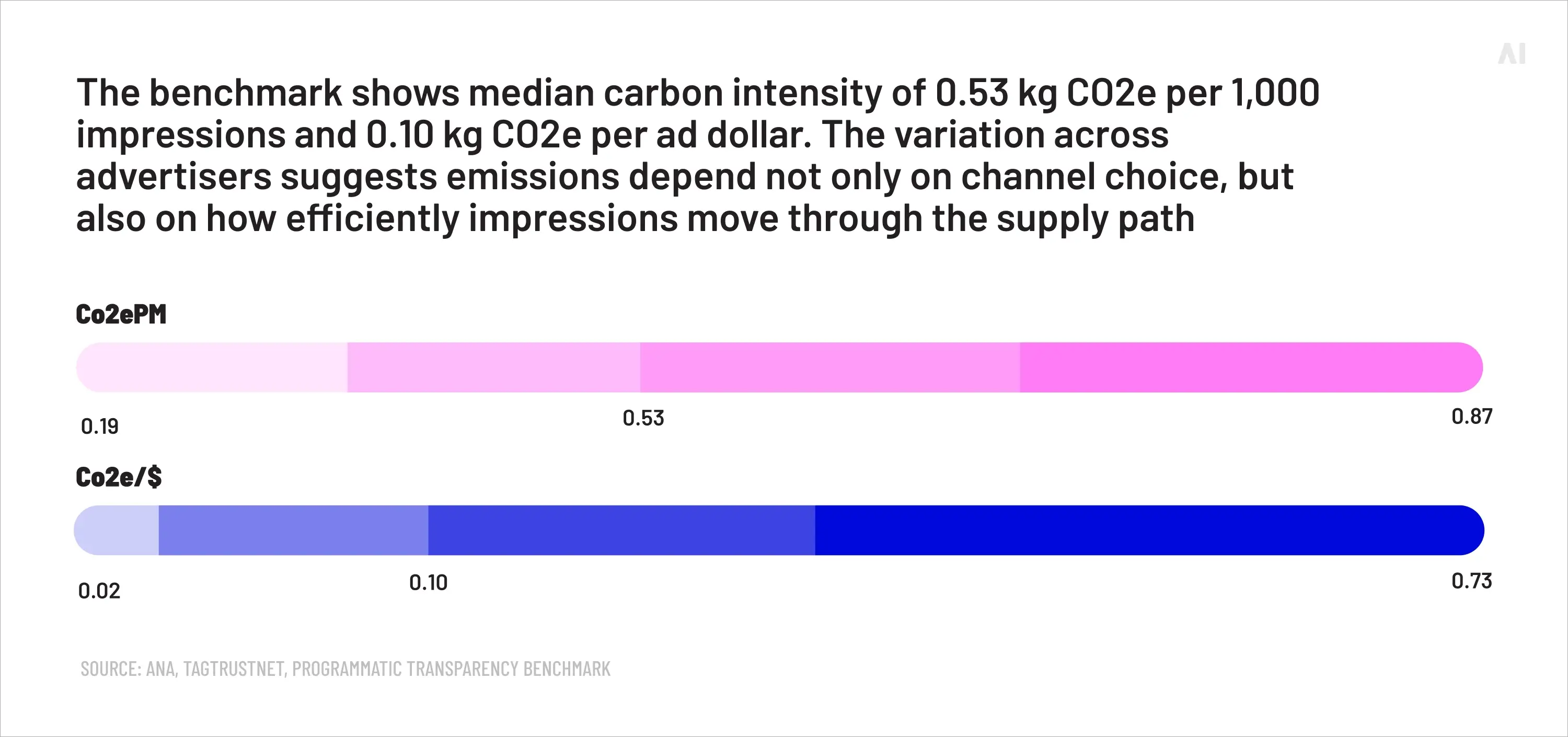
Carbon per impression (emerging metric)
The estimated emissions associated with a served impression across the media supply path. Enabled by the GMSF, it is still an evolving metric, so it works best as a directional signal rather than a settled benchmark. In practice, higher carbon per impression often points to cluttered, inefficient paths—ones that may also carry weaker media quality—making it useful for spotting waste as well as environmental impact.
How to optimize supply paths for efficiency and sustainability (SPO framework)
Supply path optimization is not a sustainability bolt-on. It is a performance practice—one that happens to deliver environmental benefits by design. Solutions like Smart Supply and Elevate support this approach by curating premium inventory through AI-powered path analysis and providing cross-platform intelligence that surfaces redundancy and waste before they consume budget.
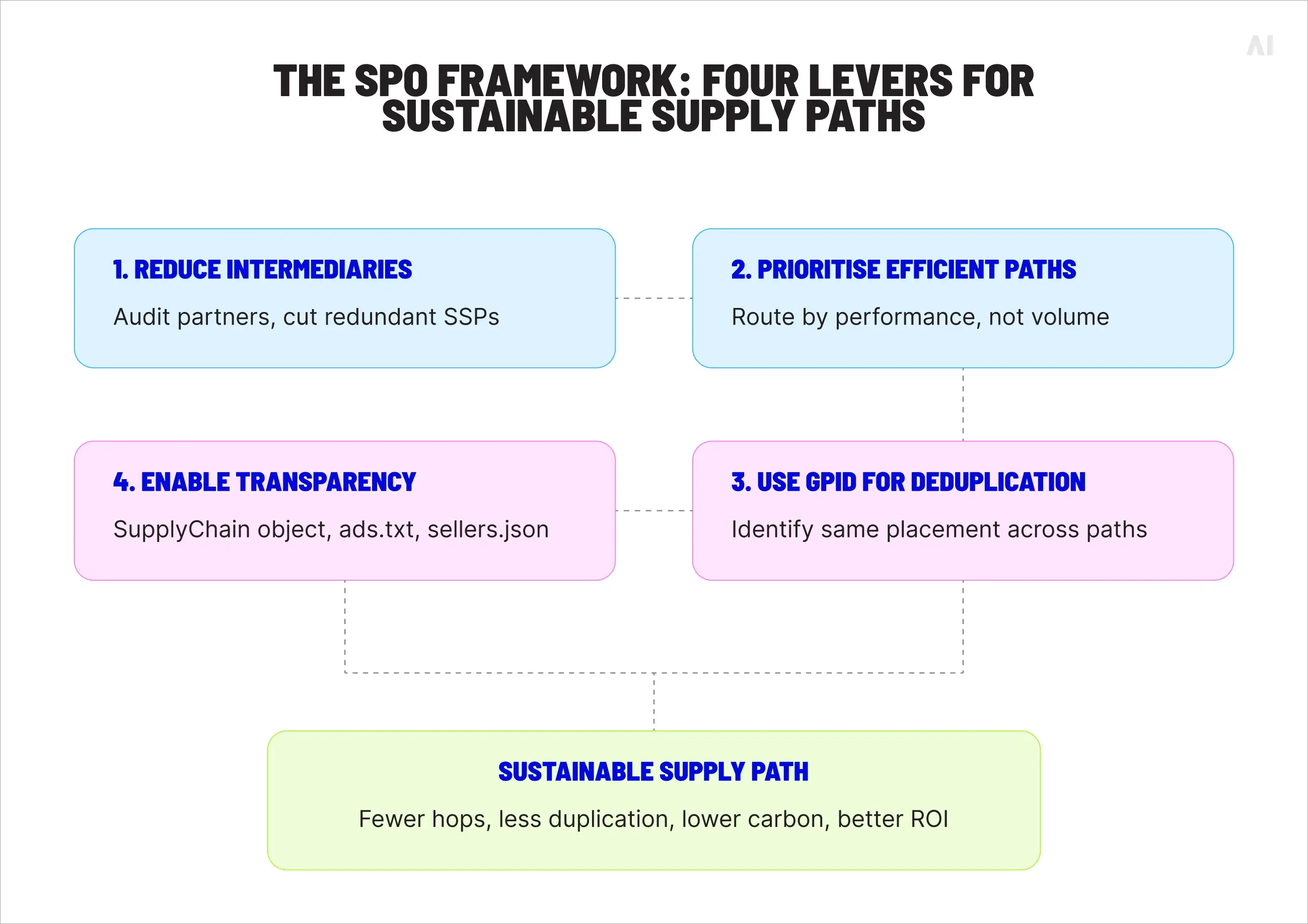
1. Reduce unnecessary intermediaries
Start with an audit. For every SSP, exchange, and reseller in your supply paths, ask three questions:
- Does it provide unique inventory access?
- Does it deliver measurable performance uplift?
- Does it add data or verification value unavailable through another path?
If the answer to all three is no, it is a candidate for removal.
The practical version: run a 30-day analysis of win rates, CPMs, and unique inventory access by SSP. Partners that consistently overlap with others in the stack—delivering similar inventory at similar or higher prices—can usually be consolidated without performance loss. The ANA's 2025 data bore this out: campaigns that reduced their SSP count saw improved efficiency without sacrificing reach.
2. Prioritize efficient supply paths
Not all paths to the same inventory are equal. Two SSPs may offer access to the same publisher, but one might deliver consistently lower latency, higher win rates, and better viewability. SPO means selecting paths based on measurable performance signals, not just availability.
This requires a shift from volume-first thinking (connect to as many SSPs as possible for maximum reach) to quality-first thinking (route through the paths that deliver the best outcomes per dollar). Tools like Elevate's cross-platform analytics give buyers the ability to compare paths at the placement level, distinguishing the routes that perform from those that generate noise.
3. Use GPID for deduplication
The Global Placement ID (GPID) is a standardized identifier that publishers assign to individual ad placements. It stays the same regardless of which SSP carries the impression, meaning buyers can recognize the same placement across multiple paths and avoid bidding on it twice.
Without GPID, a DSP receiving the same opportunity from three SSPs treats each as a distinct placement. It bids on all three, burning compute and budget on auctions it can only win once. With GPID, the duplication becomes visible and fixable. Publishers on exchanges with GPID enabled see measurably higher bid rates and CPMs, because buyers can allocate spend with greater precision.
4. Enabling transparency with industry standards
The SupplyChain object (schain), specified in OpenRTB, records each node an impression passes through before reaching the buyer. It creates an auditable trail—a receipt for the journey, showing every intermediary that touched the impression along the way.
Combined with ads.txt and sellers.json, the SupplyChain object provides the transparency layer without which path optimization is largely guesswork. Buyers can spot multi-hop reselling, compare path lengths across inventory sources, and verify that every intermediary in the chain is authorized and accountable. Standards do not optimize paths on their own. But they make optimization possible.
Business impact of optimizing supply paths
SPO is not a CSR programme with incidental business benefits. It is a performance strategy whose environmental upside follows from its commercial logic.
Lower infrastructure and tech costs
Fewer intermediaries mean fewer fees.
As Digiday noted in its reporting on The Trade Desk's OpenPath, cutting the number of parties between buyer and publisher improves price efficiency for the simple reason that fewer middlemen are taking a slice on the way through. The Trade Desk's work with Goodway Group tells a similar story: a more tightly curated supply approach brought CPMs down by 18% across both CTV and audio, while reducing cost per unique household in CTV by 25% and cost per completed listen in audio by 27%.
The business case is not complicated. Simpler paths do not just look tidier on a diagram. They lower transaction costs and let more of the working budget reach inventory that actually does something.
Improved bidding efficiency and win rates
When duplication falls, buyers spend their compute and budget on genuinely distinct impression opportunities rather than repeatedly evaluating the same placement through different windows. Win rates improve because the bidding model can concentrate resources where success probability is highest, rather than spreading them across a fog of overlapping signals.
More stable CPMs and yield
Fragmentation introduces pricing volatility. The same impression clears at different prices depending on which path processes it, creating inconsistent CPMs and unpredictable yield for publishers. Consolidated paths stabilize pricing by reducing auction overlap and enabling cleaner price discovery—a benefit that flows to both sides of the transaction.
Reduced QPS load and operational overhead
Lower bid request volume translates directly to reduced server load, lower bandwidth costs, and less engineering time spent managing high-volume infrastructure. For DSPs processing billions of requests daily, even moderate QPS reductions free significant operational capacity.
Trade-offs between efficiency and yield
There are trade-offs, and they should be named. Reducing a publisher's SSP count may lower processing costs and carbon emissions, but it can also reduce demand competition and, in some cases, yield.
The point is not to optimize blindly. It is to measure the trade-offs explicitly—to understand where consolidation improves efficiency without sacrificing revenue, and where maintaining a broader path portfolio is justified by demonstrable performance gains.
How supply path sustainability varies across industries
Not all fragmentation is created equal. Supply path complexity varies by industry, and so should the approach to optimizing it.
High-volume industries (e.g., retail, gaming)
Retail and gaming advertisers generate enormous volumes of bid requests, targeting broad audiences across display, video, and mobile. This scale creates the most fertile ground for parallel pathing and duplication—and, consequently, the largest opportunity for SPO.
A retail brand running national campaigns across tens of thousands of placements stands to gain the most from consolidation: cutting paths from eleven intermediaries to four can deliver both the largest carbon reductions and the most significant cost savings in the ecosystem.
💡 Related reads: Retail forecasting: a guide to smarter planning, media, and growth
Premium / brand-focused industries
Luxury, automotive, and pharmaceutical advertisers typically operate with fewer, more controlled supply paths. Quality matters more than scale—brand safety, contextual alignment, and premium placement take precedence over reach maximisation.
SPO here is less about cutting paths than about choosing the right ones: ensuring that the routes used are the most transparent, brand-safe, and performant available. Smart Supply's AI-powered inventory curation addresses this directly, filtering at the supply level so that only premium, verified inventory reaches the buyer.
Data-driven verticals (e.g., finance, travel)
Finance and travel advertisers depend heavily on audience data and targeting layers, requiring specialized data providers and identity resolution partners within their supply paths. This increases complexity by design—each data integration adds a node.
The challenge is balancing targeting precision with path efficiency: removing a data intermediary that provides unique audience signals may degrade accuracy, but keeping it adds a hop and a fee. SPO in these verticals demands granular evaluation of each intermediary's targeting contribution against its cost and carbon impact.
What a sustainable programmatic supply path looks like
An optimized supply path is not a thought experiment. It is a measurable state with specific structural features. Combining path optimization with transparency frameworks — Smart Supply for inventory selection and Open Garden for cross-platform neutrality — helps achieve this architecture at scale.
{{26-From-Fragmented-to-Sustainable-Rethinking-the-Programmatic-Supply-Path-2="/tables"}}
"Programmatic shouldn't be a black box. With Elevate, we're giving agencies clear, AI-powered intelligence that cuts complexity, saves time, and keeps every decision focused on the client's KPIs — not platform incentives." — Stephen Magli, CEO, AI Digital (source)
💡 Related reads: The Open Garden Framework: A New Operating Model for Programmatic Advertising
Limited and transparent intermediaries
A sustainable path involves a small number of clearly defined partners, each with a demonstrable role. Publisher to SSP to DSP to buyer—with verification and data layers integrated where they earn their keep, not stacked for marginal coverage. Every participant is identifiable through sellers.json and the SupplyChain object.
Minimal duplication and controlled routing
Each impression is processed once, or only as many times as legitimate auction mechanics require.
- GPID ensures that buyers can recognize identical placements across paths, eliminating redundant evaluation.
- Publishers control which SSPs receive their inventory.
- Buyers control which supply paths they evaluate.
Neither side passively accepts whatever the bidstream delivers.
Measurable and continuously optimized paths
Sustainable paths are not configured once and left alone. They are tracked against the metrics outlined earlier—QPS efficiency, path length, duplication rate, win-to-request ratio, carbon per impression—and refined continuously. Platforms like Elevate provide the cross-platform analytics layer needed to monitor path performance in real time, spot emerging inefficiencies, and adjust routing decisions on the basis of current data rather than inherited assumptions.
"No one in programmatic needs another reminder about fragmentation. This complexity stands in sharp contrast to the original promise of the open internet." — Stephen Magli, CEO, AI Digital (AdExchanger, 2026)
💡 Related reads: Creating a data-driven marketing strategy
Conclusion: From fragmented infrastructure to sustainable programmatic supply paths
Sustainability in programmatic advertising will not be achieved by carbon offsets, ESG dashboards, or incremental improvements to a system whose architecture remains unchanged. It requires confronting the structural source of the problem: supply paths that process the same impression multiple times, through multiple intermediaries, with limited visibility and considerable waste.
The tools for this exist. SPO frameworks reduce unnecessary intermediaries. GPID enables deduplication across paths. The SupplyChain object provides the transparency needed to audit and improve routing. Intelligence platforms like AI Digital's Elevate and inventory solutions like Smart Supply operationalize these principles at scale—combining AI-driven analysis with human oversight to produce cleaner, faster, more accountable supply paths.
The path forward is not perfection. It is measurable, systematic improvement in how impressions move through the programmatic ecosystem—every redundant hop removed, every duplicate auction eliminated, every opaque intermediary replaced with a transparent partner. That is how programmatic advertising becomes both more sustainable and more effective. Not by adding another layer. By removing the ones that should never have been there.
Key takeaways:
- Fragmentation drives inefficiency, increasing both infrastructure load and carbon impact across the programmatic ecosystem
- Duplicate impression processing amplifies unnecessary computation and energy usage, with the same opportunity often evaluated across ten or more parallel paths
- Limited transparency across supply paths restricts effective optimization—buyers cannot measure what they cannot see
- Supply path optimization (SPO) improves efficiency and visibility, but does not eliminate structural complexity without deliberate path redesign
- Achieving sustainable outcomes requires restructuring how impressions move—fewer intermediaries, less duplication, and measurable accountability at every step