The Zero-Click Paradox—Monetizing Invisible Attention in 2026
This is uncomfortable if your entire measurement stack depends on session data. It is also a misreading of what is actually happening. A brand can be the decisive factor in a purchase—named, recommended, framed as the category leader—and show nothing in Google Analytics.
That gap between influence and attribution is the zero-click paradox. And ignoring it will cost more than adapting to it.
The scale is no longer hypothetical
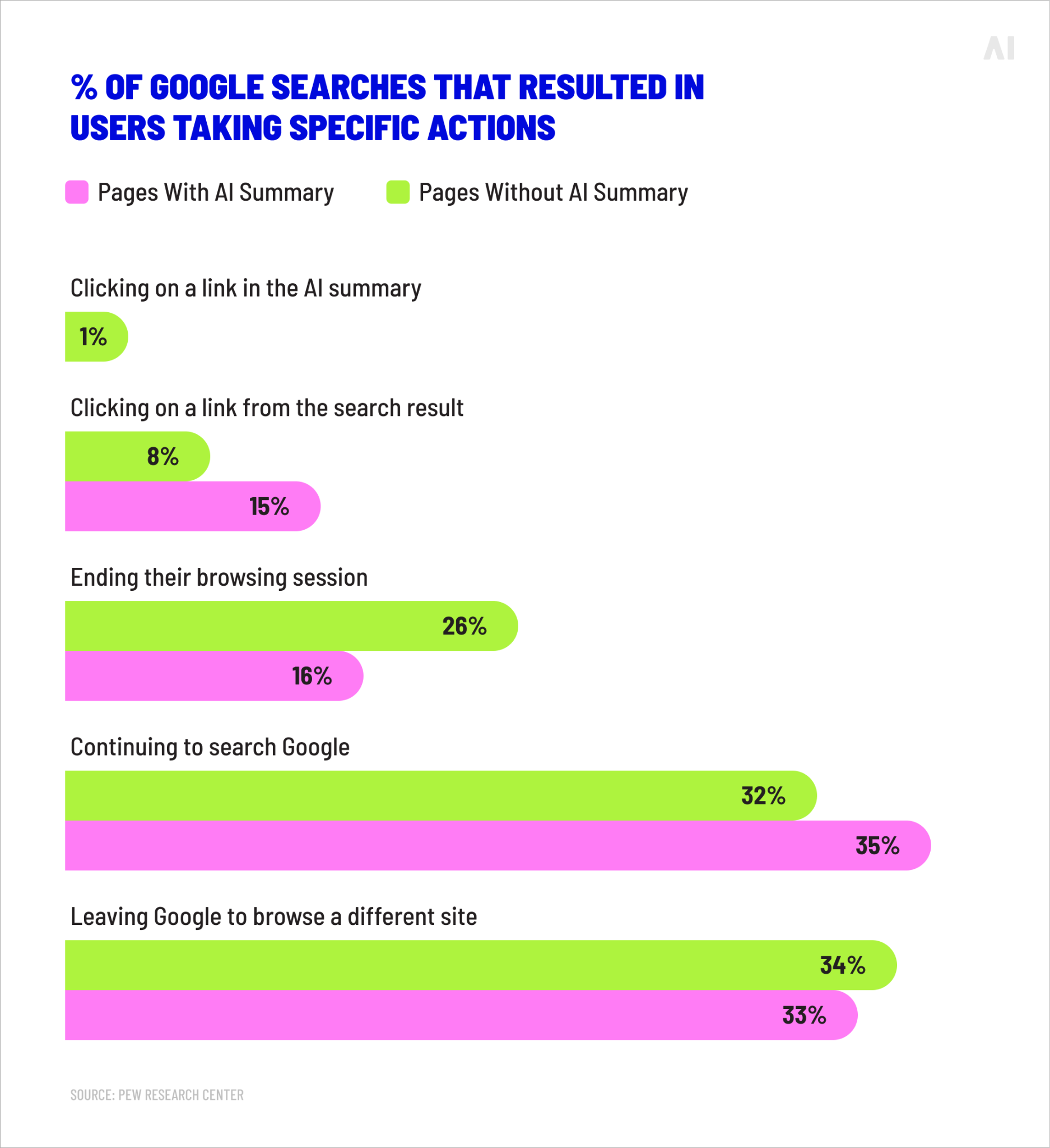
At I/O 2025, Google confirmed that AI Overviews had reached 1.5 billion monthly users across 200 countries and territories. By late 2025, Conductor's analysis of 21.9 million searches found that 25% of all queries were triggering an AI Overview—up from roughly 16% just a quarter earlier. And when they did, the effect on clicks was severe: Ahrefs' study of 300,000 keywords found that they now reduce the click-through rate for the top-ranking result by 58%, nearly double the 34.5% decline the same team measured eight months prior.

These are not edge cases. McKinsey's consumer research found that half of all consumers now intentionally seek out AI-powered search engines, and that unprepared brands could see traditional search traffic decline by 20% to 50%. Reuters Institute reported that publishers expect search-engine traffic to fall by more than 40% over the next three years.
The instinct is to read those numbers as a crisis. They are, but not the crisis most teams are planning for. Traffic may fall. The harder question—the one worth building around—is whether influence is disappearing, or whether it has simply moved somewhere your current tools cannot see it.

Winning the interaction, losing the dashboard
Consider what actually happens when an AI system fields a high-intent query. A user asks which platform suits their needs, or which provider offers the best terms, or which product has the strongest track record. The AI synthesizes evidence from across the web—reviews, technical documentation, editorial coverage, third-party validation—and presents a recommendation. The user gets a decision. The brand gets nothing in the analytics.
But "nothing" is the wrong word. The brand was named. It was positioned as the answer. The user left with a preference they did not have thirty seconds earlier. That is not a failed impression. It is a high-intent impression that resolved earlier than the reporting model expected.
McKinsey's data puts weight behind this: 44% of AI-powered search users now call it their primary source of insight for buying decisions, ahead of traditional search, retailer sites, and review platforms. If people are deciding inside the AI layer, then the job is no longer to rank on a results page. It is to be chosen, cited, and framed correctly inside the answer itself.
What replaces the click
Not a single metric. A tighter cluster of them:
- Recommendation rate—how often the AI names your brand as a top choice.
- Citation presence—whether your evidence appears in the synthesised response.
- Sentiment accuracy—whether the AI's framing matches the story you are actually telling.
- Brand inclusion rate—the frequency with which you appear at all.
The question shifts from "did they click?" to "what happened next?" Did branded search rise? Did direct traffic lift? Did assisted conversions move? Did recall improve among exposed audiences?

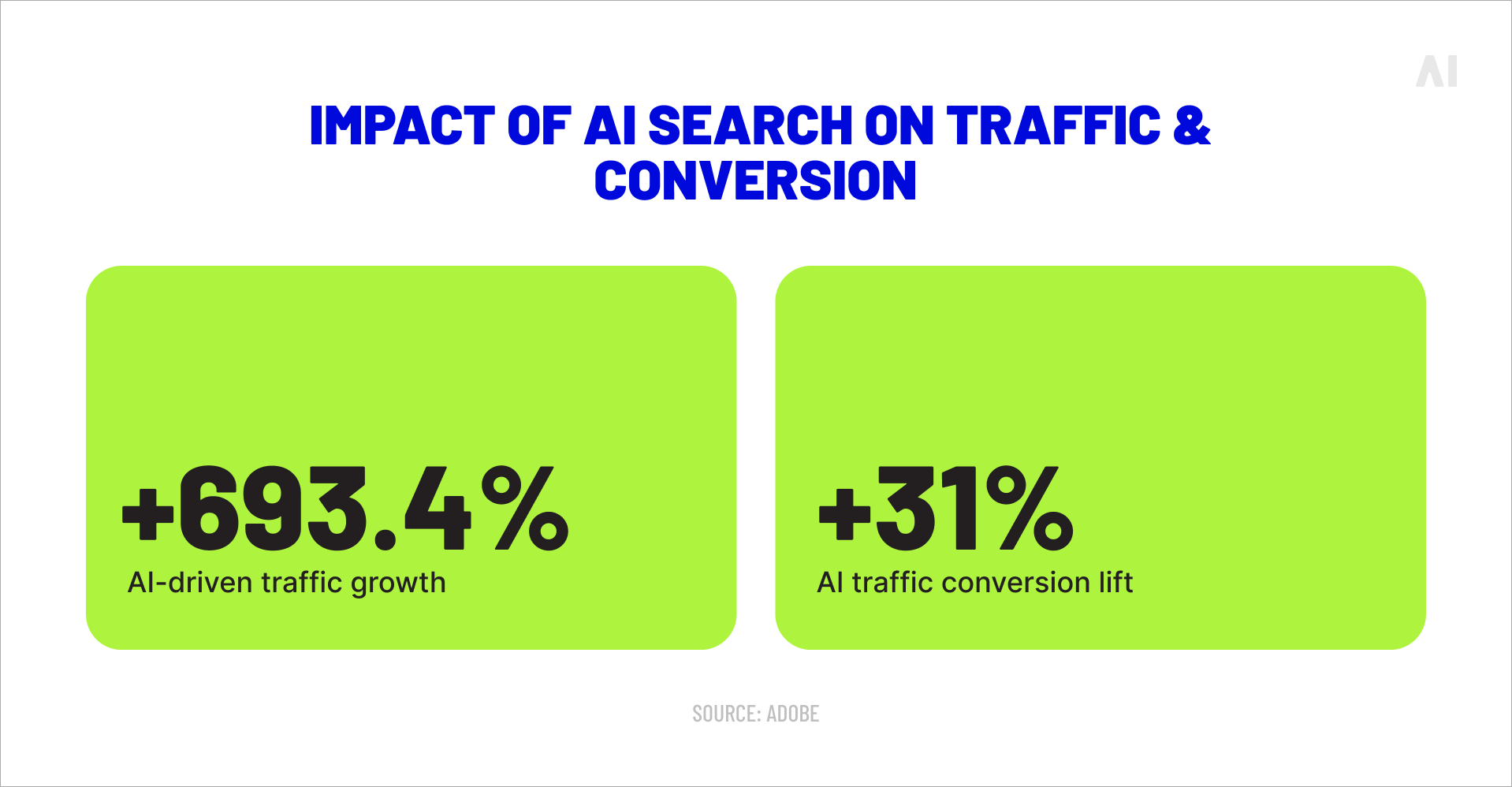
There is already evidence that the two patterns—zero-click resolution and high-quality referral—coexist rather than cancel each other out. Adobe found that traffic from generative AI tools to retail sites rose 693% year over year during the 2025 holiday season, and that those AI referrals converted at a 31% higher rate than traffic from other sources. Fewer visits, but better ones. The volume game is thinning. The value game is getting sharper.
Paid visibility arrives, but trust still has to be earned
OpenAI began testing ads in ChatGPT in the US in early 2026, initially for logged-in users on the Free and Go tiers. The ads are clearly labelled and visually separated from the answer. Industry projections put AI search ad spend at roughly $2 billion this year, scaling to around $26 billion by 2029. Conversational interfaces are becoming media environments, not just answer engines.
But placement can buy visibility. It cannot buy trust. If the organic answer contradicts your paid claim—if the AI's synthesized evidence frames a competitor as stronger, or if your brand appears with weak validation and vague differentiation—the ad unit does little more than spotlight the gap. At a premium CPM, that is an expensive way to expose a positioning problem.
The useful takeaway is not that paid presence in AI search is pointless. It is that paid and organic work harder when they agree with each other. A brand that dominates both the recommendation and the sponsored placement leaves the user with a single, reinforced conclusion. A brand that shows up in the ad but not in the answer creates friction where there should be none.
The real moat: being easy for machines to trust
McKinsey makes a point that deserves more attention than it tends to get: a brand's own websites may account for only 5% to 10% of the sources an AI search system references. The rest—reviews, editorial coverage, technical documentation, third-party benchmarks, forum discussions—is assembled from a wider evidence field. Your reputation in AI systems is being built from material you may not control, and in many cases, may not even be tracking.

This changes what "content strategy" means. The old model optimized for search engine crawlers. The next model optimizes for synthesis—content built to withstand summarization, to survive compression, to remain accurate and attributable after an AI has distilled it into three sentences. Clearer claims, tighter evidence, and stronger third-party validation. More consistent language across every surface the AI can reach.
Call it evidence marketing if you want a label. The point is that the brands most likely to survive the zero-click era are not the loudest but the most citable.
Reading the full picture
The old model of digital success was tidy: win the click, win the customer. The next model is less neat but closer to how decisions are actually made. Be the answer. Be the citation. Be the name that survives synthesis intact. Then prove—with independent, cross-platform measurement—that this visibility changed behavior, whether or not it produced an immediate visit.
This is where an Open Garden approach earns its relevance. Not as a media-buying philosophy alone, but as a way of auditing how a brand is represented across fragmented systems—where it appears, how it is framed, whether performance is being distorted by one platform's self-reporting. DSP-agnostic execution, cross-platform visibility, and KPI-led optimization are not abstract principles here. They are the operational prerequisites for measuring influence that no longer fits inside a click.
If this shift is already showing up in your reporting—if traffic is down but branded search is up, if conversions are holding but attribution looks thinner—the planning and measurement models may be the thing that need replacing. That is exactly the conversation AI Digital is built to have. So why not get in touch!