TV in Pharma Marketing: Why Omnichannel Strategies Break Without It

If you run U.S. pharma marketing, you already know the paradox: you’re expected to prove business outcomes while operating inside some of the strictest privacy and regulatory boundaries in advertising. Meanwhile, your audience spans wildly different viewing behaviors—patients, caregivers, and HCPs do not move through the journey in one neat funnel.
Here’s the bet we’re making: TV is the closest thing pharma has to a “shared layer” across the journey. Not because it’s magical, but because it still delivers reach at scale, it’s increasingly addressable through streaming, and it can be measured in privacy-safe ways that align with how pharma outcomes are defined (scripts, new-to-brand starts, adherence, and follow-up actions).
⚡ Omnichannel isn’t more channels. It’s one system that behaves predictably.
From there, we can rebuild omnichannel around TV as the backbone—then connect digital, search, and point-of-care into a plan that behaves like a single operating model.
The reality of pharma omnichannel in 2026
Omnichannel in pharma is often described as orchestrated, personalized, and consistent. The reality is more constrained—and more interesting.
The U.S. market is structurally different
The United States is one of the only countries that permits direct-to-consumer (DTC) prescription drug advertising at scale, alongside New Zealand. That single fact changes the media math, because awareness and education aren’t optional add-ons; they’re a core growth lever.
The money shows where pressure is
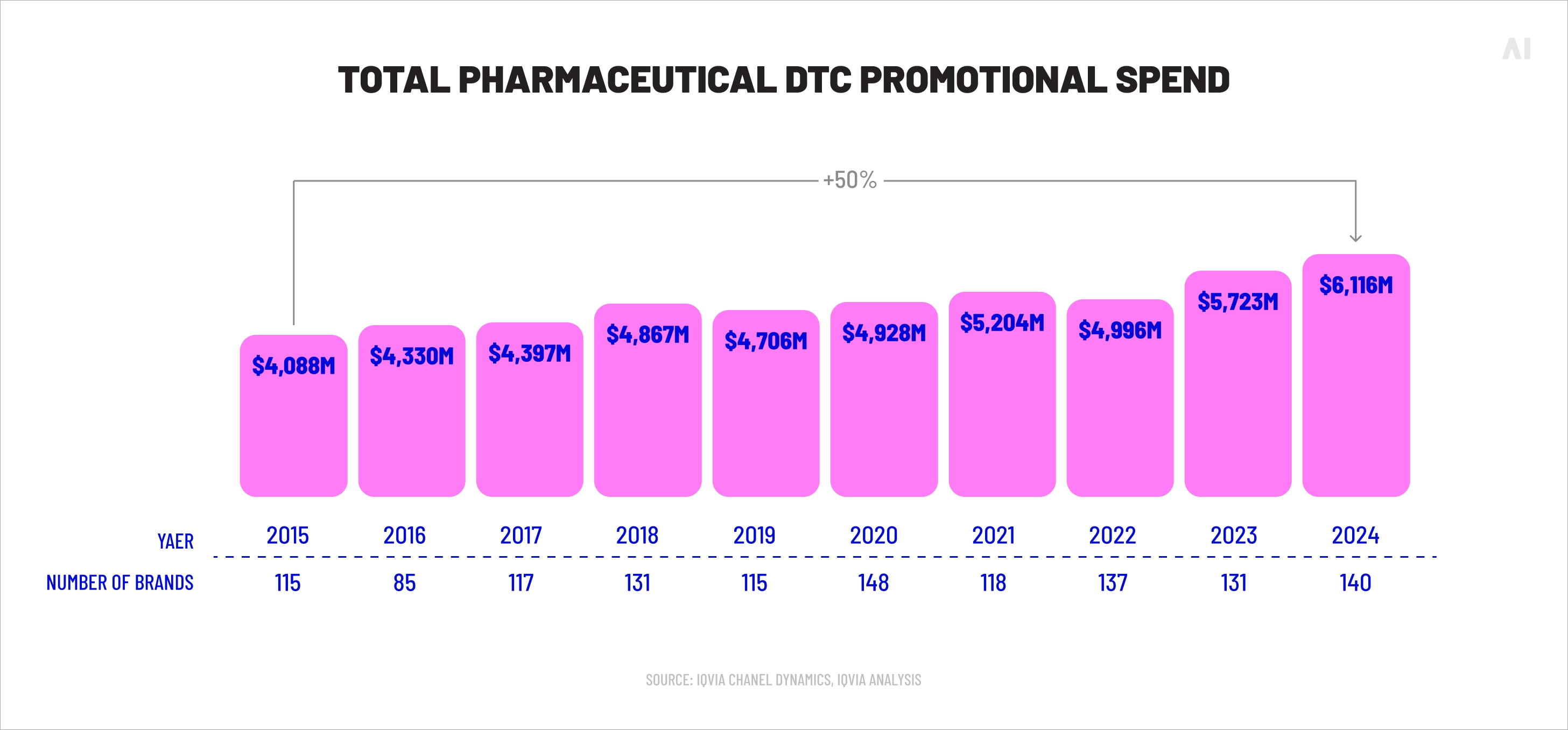
Healthcare and pharma advertising is large and still expanding. EMARKETER estimated ~$30B in U.S. healthcare + pharma ad spending in 2024, with digital continuing to take share. By late 2025, EMARKETER reported pharma TV ad spending reached ~$5.4B through November 2025 (surpassing 2024’s full-year ~$5.1B), based on iSpot data.
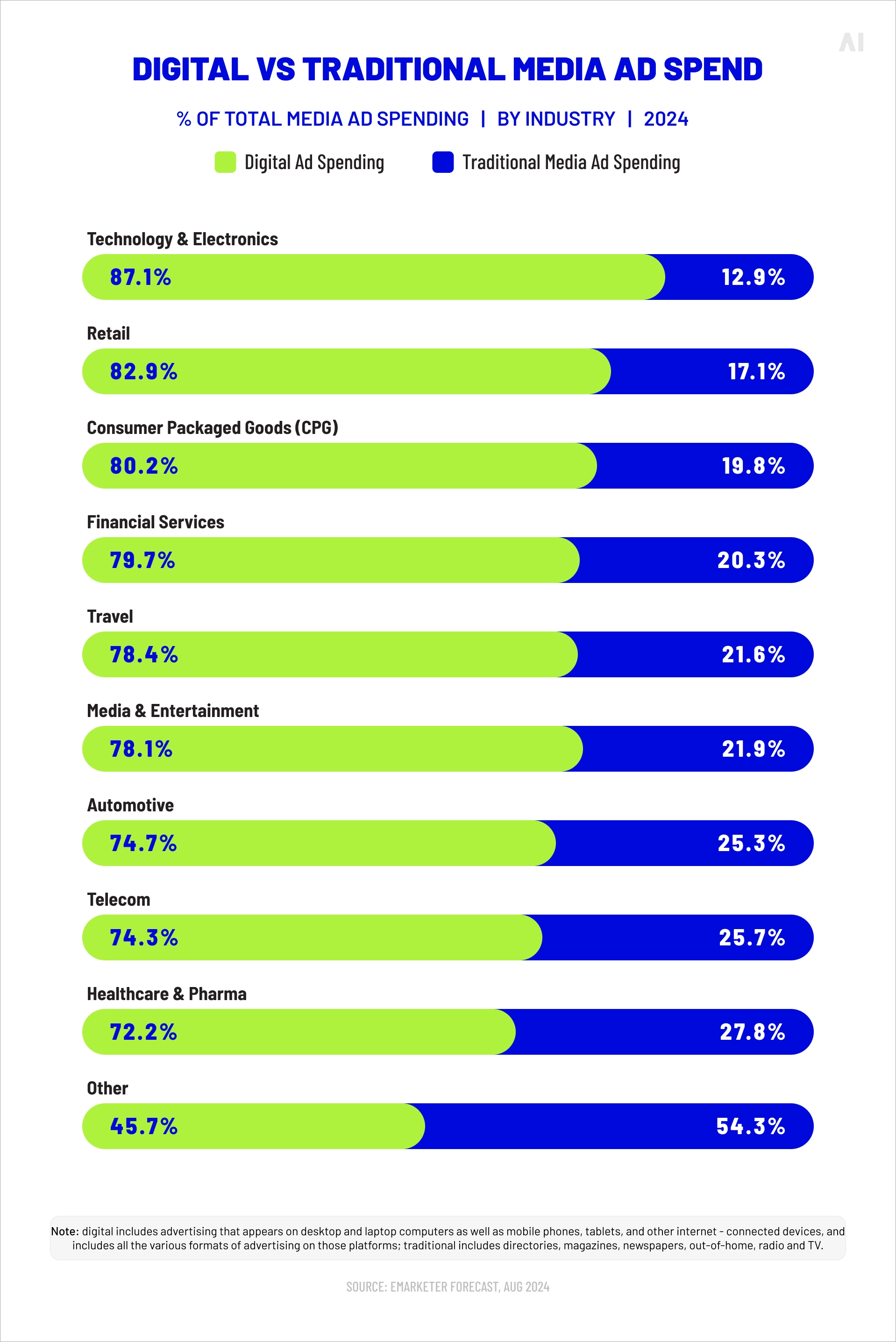
Those numbers matter for one reason: TV is not behaving like a legacy channel in pharma budgets. It’s still a primary investment, even as teams talk “digital-first.”
Audience behavior has shifted, but not away from TV
Nielsen’s Gauge showed streaming hit 44.8% of total TV usage in May 2025, edging past broadcast + cable combined for the first time. Then Nielsen’s Ad Supported Gauge found ad-supported viewing accounted for 72.9% of overall TV viewing in Q3 2025, with streaming representing a large chunk of ad-supported time.
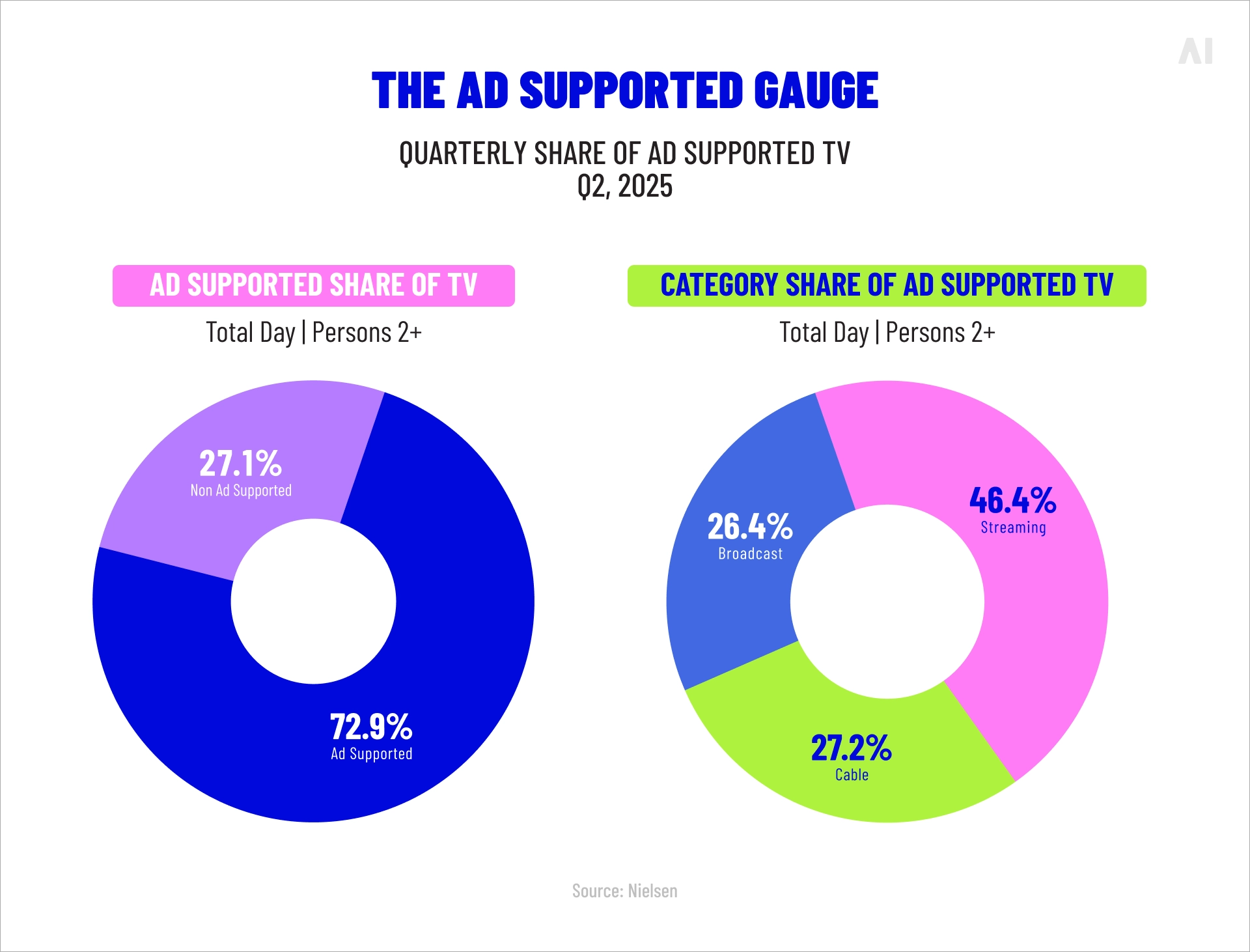
Translation: “TV” is now a blended environment—linear still delivers scale, while streaming delivers incremental reach, household-level delivery, and new measurement surfaces.
Regulation and scrutiny are rising (and that changes creative and proof)
In September 2025, HHS and FDA announced actions and messaging focused on prescription drug ad transparency and enforcement, with FDA also publicizing a crackdown on deceptive drug advertising. Whether or not any specific policy direction sticks long-term, the implication is immediate: pharma marketers need better proof, tighter substantiation, and cleaner measurement.
Key takeaways (reality check):
- TV still anchors DTC scale in the U.S., even as budgets shift across formats.
- Streaming has become mainstream TV behavior, not a niche.
- Regulatory scrutiny raises the bar on proof, which pushes measurement maturity from “nice-to-have” to survival.
That reality sets up the next question: if digital keeps growing, why do so many digital-first pharma strategies stall?
{{26-TV-in-Pharma-Marketing-1="/tables"}}
💡 For a primer on trends shaping up in 2026, see the dedicated report: 2026 media trends.
Why digital-first strategies hit a ceiling in pharma
Digital-first works—until it doesn’t. In pharma, the ceiling tends to show up in three places: privacy, saturation, and missing the “shared layer” of the journey.
Privacy rules don’t just restrict targeting
Pharma can’t treat health data like retail data, and it can’t behave like a typical performance advertiser without triggering compliance and consumer trust issues. AdExchanger summarized the core tension well: pharma struggles with targeting and measurement because patient data is highly regulated, and condition-based targeting can feel invasive.
At the broader advertising level, signal loss and privacy legislation continue to tighten the learning loop. IAB’s State of Data 2024 reported that 95% of data decision-makers expected continued legislation and signal loss, and 3 in 4 expected reduced ability to collect integral consumer data.
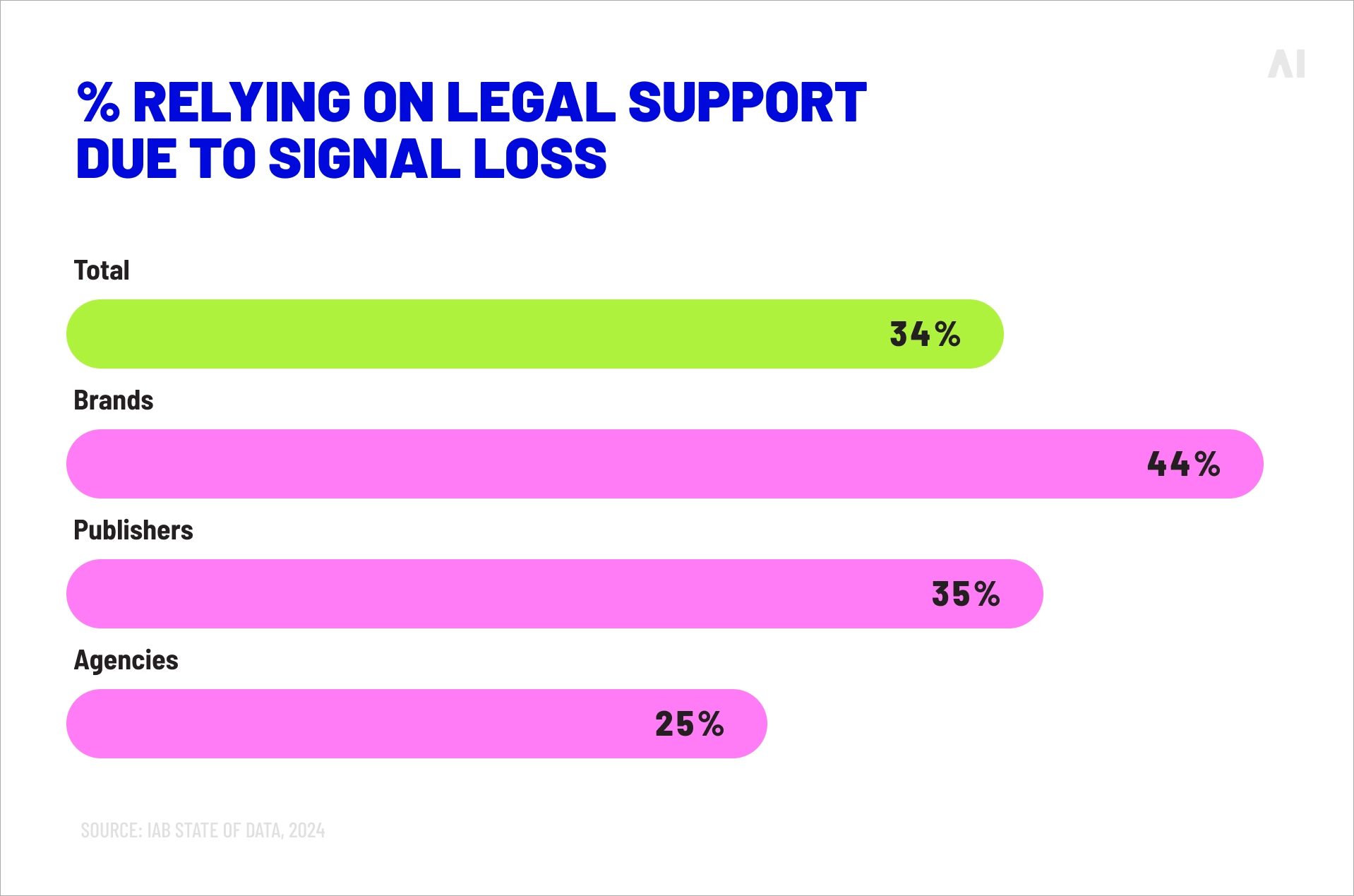
Digital-first plans often assume they can “optimize their way out” of weak performance. In pharma, you frequently cannot observe enough to optimize safely.
Digital can saturate before it scales the full journey
Search and social are powerful for capturing existing intent. But pharma demand creation still relies heavily on education, awareness, and memory—especially for chronic conditions and categories where patients aren’t actively shopping.
EMARKETER noted that pharma’s digital spend skews toward paid search, and also pointed to how difficult it is to drive “offline” outcomes like prescriptions from digital interactions alone. When digital is optimized primarily for clicks, it can miss the mid-funnel work that creates future intent.
The pharma journey requires shared context (and digital often fragments it)
The patient journey isn’t one device, one platform, or one decision-maker.
- Patients see an ad, then talk to a physician.
- Caregivers influence the next step.
- HCPs have their own evidence needs and time constraints.
- Formularies, prior auth, and affordability shape what happens next.
A digital-first plan can end up as a set of platform-specific tactics with no consistent narrative thread. TV, for all its imperfections, is often the only channel that delivers shared context at population scale.
⚡ Digital can be precise. TV can be shared. Pharma needs both.
So if digital-first hits a ceiling, what does TV actually do across the journey—beyond “awareness”?
💡 For more context on reliable metrics and the impact of walled gardens, see: Why your marketing metrics are lying about growth & Walled gardens: The hidden cost for digital advertisers
Why TV works across the pharma journey
TV works in pharma because it can do three jobs at once:
- create broad awareness and memory,
- support education and reassurance,
- connect to measurable outcomes through modern identity and clean-room approaches (when set up correctly).
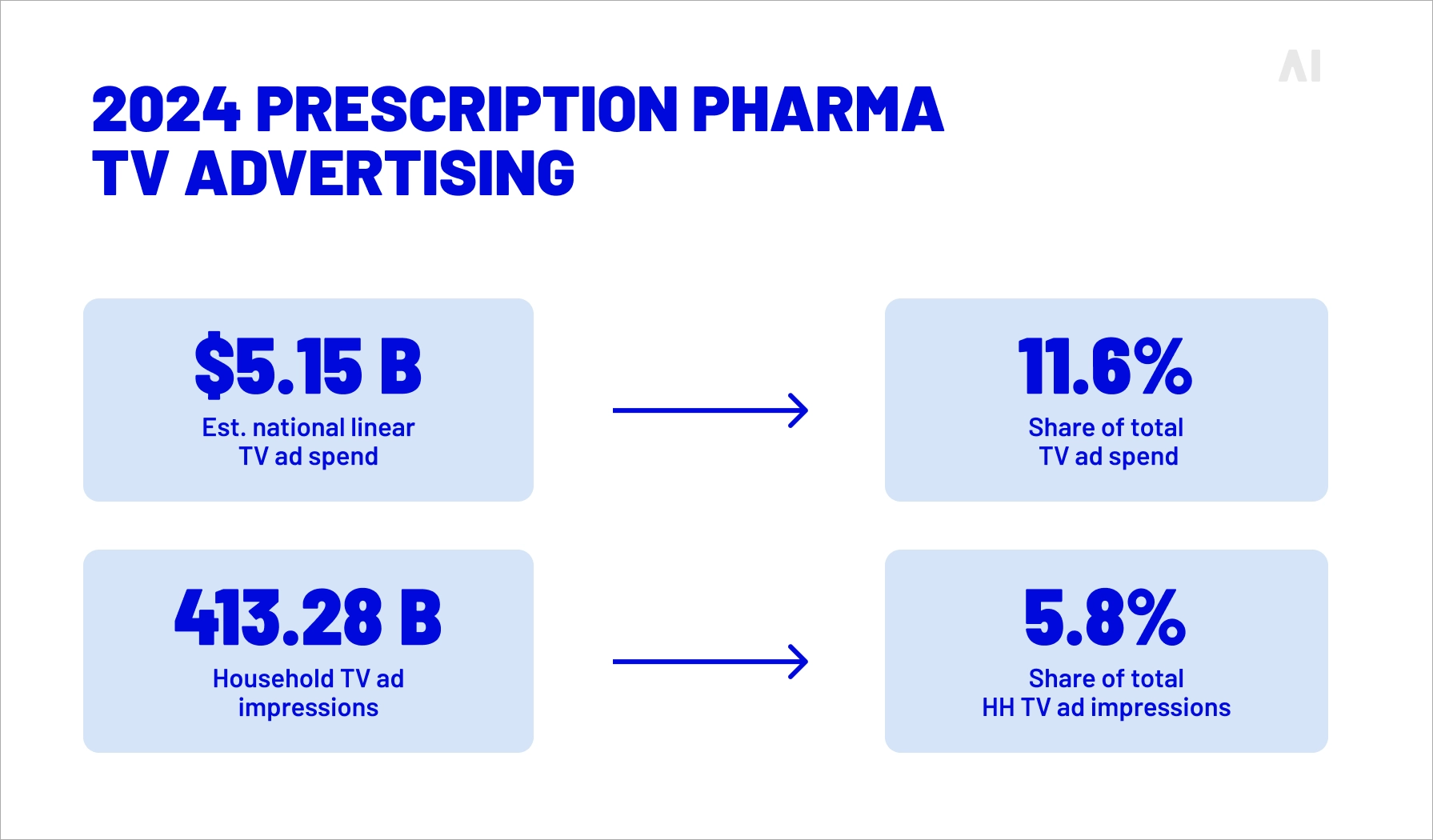
iSpot’s 2024 transparency report puts hard numbers on the baseline: prescription pharma advertisers invested over $5.15B in linear TV ads in 2024, delivering 413B impressions across 271 brands. This is not a channel pharma is “moving on” from. It’s a channel pharma is re-instrumenting.
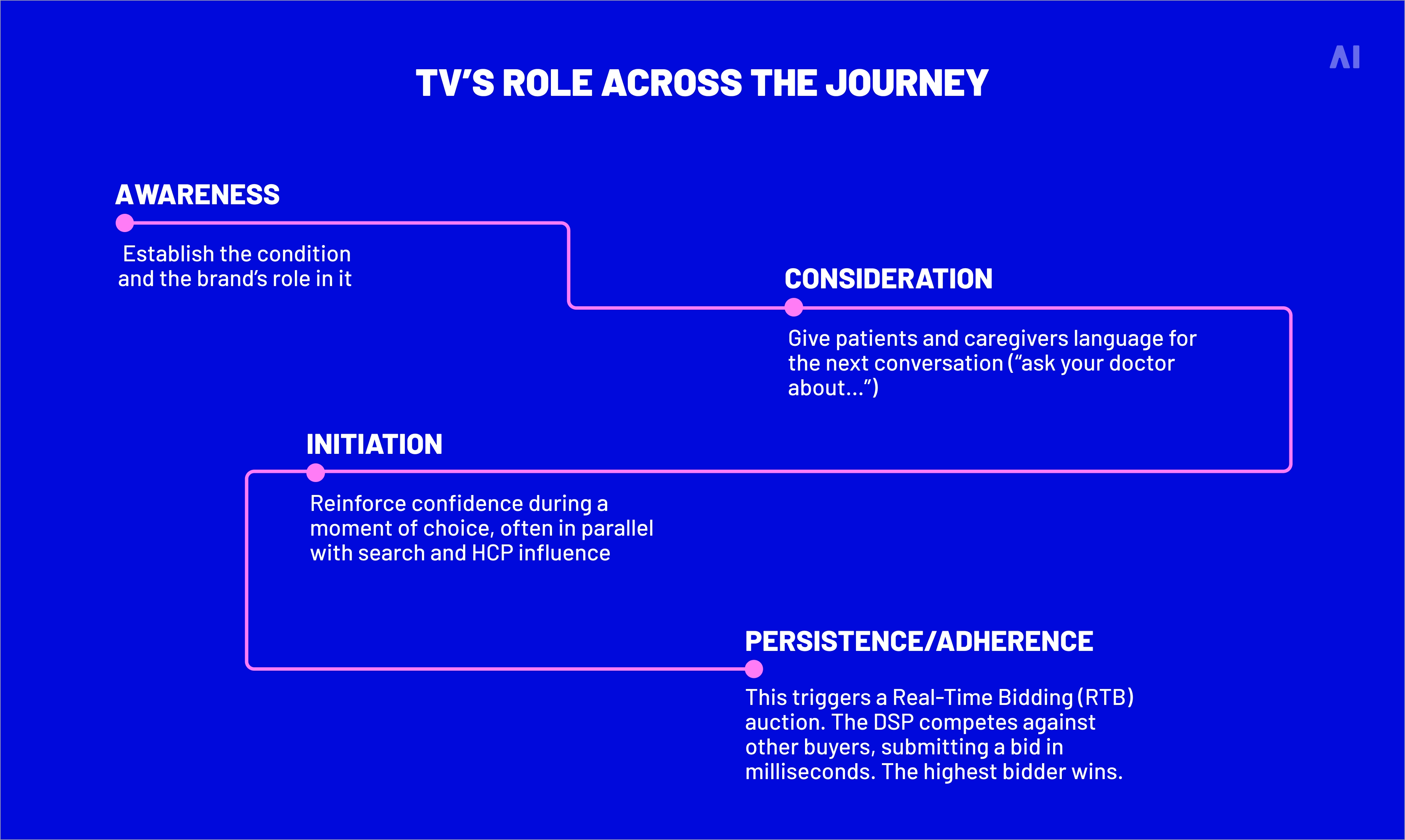
Before we break out linear, CTV, and addressable, it helps to map where TV contributes across the journey.
💡 For a primer on broader TV advertising, see: What is television advertising? Key benefits and disadvantages in 2025
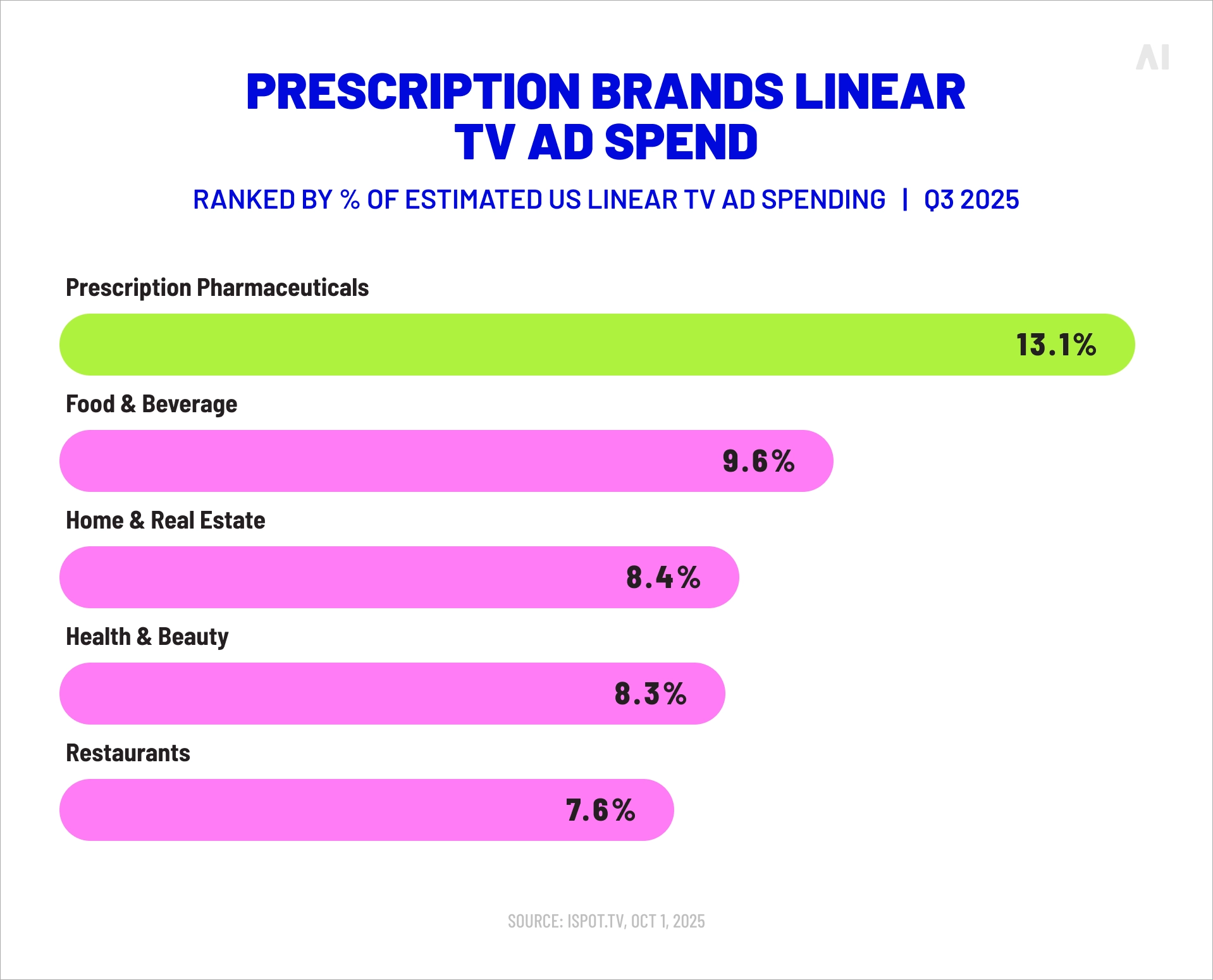
⚡ Almost everyone has seen prescription drug ads, which is exactly why TV remains a behavior-shaping channel in the U.S. The point is not that TV reaches “everyone”; it’s that TV creates shared awareness faster than most digital-first plans can.
Linear TV and pharma marketing
Linear is still the fastest path to broad, repeated exposure in a regulated category. It also gives pharma a familiar set of buying patterns (dayparts, networks, tentpole programming) and an environment that tends to be perceived as more “mainstream” than many digital placements.
iSpot also noted a concentration dynamic: over 52% of national TV pharma spend went into just five networks in 2024. That implies two things:
- pharma still values premium context and predictable delivery, and
- there’s likely meaningful waste unless cross-platform planning is designed to manage frequency.
Where linear shines:
- Launch or relaunch moments where memory matters
- Categories with high caregiver influence
- Broad public education and condition framing
Where linear strains:
- Frequency waste at the household level
- Limited “next-step” interactivity
- Harder to connect to outcomes without additional infrastructure
💡 For a primer on linear & CTV, see the guide: CTV vs linear TV
Connected TV and pharma TV marketing
CTV is not “digital video on a TV screen.” It behaves differently because it blends:
- TV attention (lean-back viewing),
- digital-like delivery mechanics (household-level ad serving),
- and measurement pathways that can be privacy-safe (when you avoid individual-level health targeting).
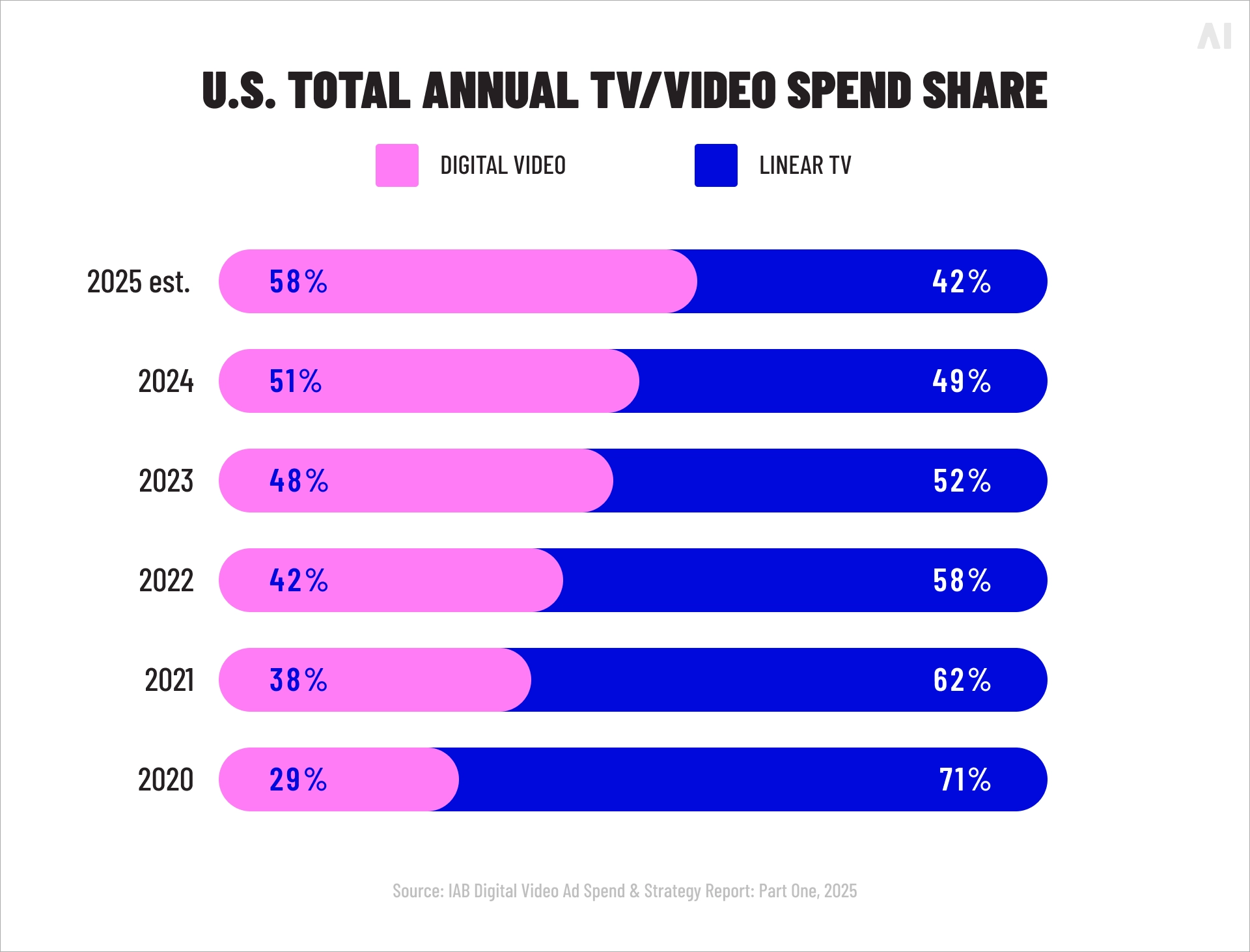
The macro trend is obvious: IAB reported digital video ad spend grew 18% in 2024 to $64B and was projected to reach $72B in 2025, with digital video expected to capture nearly 60% of total TV/video ad spend in 2025. Pharma doesn’t need to follow every macro trend—but these shifts expand inventory, tooling, and measurement options that pharma can use.
How pharma uses CTV well:
- Incremental reach beyond linear-heavy plans
- Sequencing messages (broad → specific → support)
- Aligning exposure with regional access realities (within compliant bounds)
A useful detail from iSpot: weight-loss brands like Zepbound used streaming first to test messaging before expanding to linear. That’s a modern pattern: treat streaming as a faster creative feedback loop, then scale what works.
💡 For context on CTV, please see: Connected TV advertising in 2025
Addressable TV and pharma marketing
Addressable TV is often misunderstood. It doesn’t mean “target people with condition X.” In pharma, it usually means:
- serving different creative to different households based on non-sensitive proxies (geography, age bands, life-stage, viewing behavior), and
- controlling frequency and sequencing more tightly than linear.
Addressable becomes especially valuable when:
- you need to manage frequency to reduce fatigue,
- you want to tailor messaging by region or access realities,
- you need a controlled way to test creative variations.
And because so much TV viewing is ad-supported (as mentioned previously), the practical opportunity is large.
💡 For context on addressable TV and differences between CTV and addressable, see explainers: Addressable advertising in 2026 & CTV or addressable TV
{{26-TV-in-Pharma-Marketing-2="/tables"}}
Measuring TV impact in a privacy-first world
Measuring TV in pharma is not about finding a perfect attribution model. It’s about building a stack of evidence that holds up under privacy constraints and reflects how pharma outcomes happen.
A practical measurement system usually includes four layers:
- Delivery and audience truth (reach, frequency, incremental reach)
- Behavioral response (site visits, search lift, engagement proxies)
- Clinical/commercial outcomes (new scripts, refills, adherence signals)
- Incrementality (did TV drive outcomes that wouldn’t have happened?)
{{26-TV-in-Pharma-Marketing-3="/tables"}}
The privacy-first constraint (and the opportunity)
AdExchanger’s reporting on Blockgraph and Datavant describes the direction of travel: use clean room approaches to match de-identified claims data with anonymized TV exposure data to measure outcomes like script lift, without enabling household-level targeting based on claims.
⚡ If TV can drive real-world actions, you should expect to see it in outcomes like doctor conversations and prescription behavior, not just site traffic. In a KFF poll, a meaningful share of adults said they talked to a doctor about a medicine they saw advertised, and many reported receiving that prescription.
This matters because it aligns measurement with pharma’s real outcome language:
- new-to-brand starts
- switches
- persistence and refills (where available)
- follow-up actions that correlate with treatment initiation
What “good” looks like (a realistic checklist)
A TV measurement plan is usually stronger when it includes:
- A defined outcome hierarchy: Not every campaign should be judged on scripts. Some should be judged on qualified actions that are known precursors.
- A test design you can defend: Geo-based tests, holdouts, matched markets, or controlled comparisons that don’t require individual-level tracking.
- A clean-room or privacy-safe match strategy: Especially if you want to connect exposure to claims-based outcomes.
- A cross-channel view of frequency: Because overexposure can quietly kill efficiency.
- A compliance-forward data policy: That treats health data and sensitive inference as a “do not touch” zone for targeting, while still enabling aggregated learning.
Don’t skip the “incrementality” conversation
If your organization is still relying on last-click style thinking, TV will look worse than it is, because TV does not behave like a click channel.
One reason this conversation is intensifying is the broader data environment: as noted earlier, IAB found widespread expectation of ongoing signal loss and reduced ability to collect consumer data.
TV measurement in pharma is evolving not because it’s trendy, but because it’s one of the few places where privacy-safe outcome linkage is becoming more standardized.
💡 On TV/CTV measurement approaches, see: How to measure TV advertising ROI & CTV measurement: The key metrics
What changes when TV is part of the system
When TV becomes the backbone, three things change: planning, creative, and organizational behavior.
Planning becomes journey-based instead of channel-based
Instead of asking, “How much CTV should we buy?” you ask:
- What does the audience need to believe at each stage?
- What is the next best action we want to trigger?
- Where do we need shared context vs personalized reinforcement?
This shift turns TV from a blunt instrument into a sequencing and reinforcement engine.
Creative becomes modular (without losing the big idea)
Pharma creative often has to carry a lot: condition framing, benefits, safety balance, support programs, and brand trust signals.
A TV-led system encourages:
- a consistent “master narrative” (what this brand stands for in the category),
- plus modular variants (by audience proxy, region, or stage),
- plus digital companions that handle depth and FAQs.
iSpot’s 2024 report highlights how brands are evolving creative and cross-platform strategy, including examples of streaming-led testing before scaling.
{{26-TV-in-Pharma-Marketing-4="/tables"}}
Measurement becomes an organizational forcing function
Here’s the underappreciated advantage: once you set up TV measurement that connects to outcomes, teams stop arguing about platform vanity metrics and start aligning on the same scorecard.
The above-mentioned Blockgraph–Datavant approach described by AdExchanger is a good example of what “system-level” measurement aims for: connecting anonymized exposure to de-identified claims-based outcome reporting, focused on measurement rather than sensitive targeting.
A simple case example (how the system behaves)
Imagine a category launch where:
- Linear creates fast national awareness.
- CTV extends reach to lighter-linear households and enables sequencing.
- Addressable manages household frequency and rotates education vs support messaging.
- Search and site content capture intent created by exposure.
- A clean-room measurement approach evaluates script lift and regional differences.
Even without perfect attribution, you now have a system where:
- TV creates and reinforces memory,
- digital captures and educates,
- and outcomes measurement is designed for pharma realities.
⚡ When TV is the backbone, digital stops carrying the whole weight.
Rebuilding pharma omnichannel around TV
A rebuild doesn’t start with an upfront plan. It starts with operating principles, then media architecture, then measurement design.
Step 1: Define the backbone role TV will play
Pick one primary job for TV per major initiative:
- Category education (condition-first framing)
- Brand differentiation (why this option, why now)
- Confidence and persistence (support, expectations, adherence cues)
The mistake is trying to do all three at once in every spot.
Step 2: Build a video architecture, not a channel plan
A practical architecture usually includes:
- Linear for fast scale and shared context
- CTV for incremental reach + sequencing
- Addressable for frequency control + message rotation
iSpot’s 2024 data makes the case that the industry is already moving toward cross-platform strategies as streaming momentum grows.
Step 3: Design the “handoff layer” into digital
If TV is the backbone, digital becomes the handoff:
- Search strategy aligned to TV claims and condition language
- Landing experiences that match the TV promise
- FAQ and support content that reduces anxiety and drop-off
- Provider discussion guides (where appropriate and compliant)
This is where most omnichannel breaks today: TV says one thing, digital assumes a different intent state.
Step 4: Put frequency and wear-out controls in the plan
Because a huge share of viewing is ad-supported (as mentioned previously), your plan can drift into over-frequency quietly. Use addressable and CTV to manage:
- exposure caps at household level (where available),
- creative rotation by stage,
- and pacing rules that prevent “same spot, same message” fatigue.
Step 5: Build an outcome measurement stack that leadership will trust
At minimum:
- Cross-platform reach and frequency reporting
- Behavioral response tracking (site/search lift proxies)
- Outcome linkage where feasible (claims-based or modeled), using privacy-safe approaches
- Incrementality tests (geo, holdout, matched markets)
And remember: IAB’s 2024 findings suggest the data environment will not get simpler. Build for constraint.
Step 6: Operationalize governance (this is the unglamorous part)
A TV-led omnichannel model tends to fail when:
- brand and performance teams optimize against different KPIs,
- agencies report in incompatible formats,
- and measurement is treated like a post-campaign add-on
Governance fixes that:
- one KPI hierarchy,
- one definition of “success,”
- one cadence for creative and measurement decisions.
With the operating model clear, the natural next question is how teams actually run this without drowning in dashboards and inconsistent reporting.
How AI Digital helps pharma make TV omnichannel-ready
A TV-led omnichannel model adds moving parts fast. The risk is building an analytics project instead of an operating system that helps teams make decisions.
AI Digital is built for that reality. The model is DSP-agnostic, designed to reduce “walled garden” blind spots, and structured around transparent execution and outcome-led optimization.
Here are a few practical ways AI Digital helps pharma make TV omnichannel-ready.
Cross-platform strategy through Open Garden
Major platforms restrict cross-channel visibility, which makes TV + digital coordination harder than it should be. AI Digital’s Open Garden framework is positioned as a neutral alternative, built to unify performance insights across channels instead of keeping them siloed.
Open Garden is designed to support:
- Complete transparency into where budget is going (no “black box” buying)
- DSP-agnostic execution (AI Digital connects advertisers to 15+ DSPs)
- Cross-platform data and insights to improve multi-channel visibility
Managed service execution that includes CTV/OTT
Running TV-led omnichannel means you need consistent planning and optimization across channels, not separate playbooks. AI Digital’s managed service covers end-to-end execution and explicitly includes CTV and OTT within a broader cross-channel mix.
Supply quality and compliance controls with Smart Supply
TV-led omnichannel lives or dies on inventory quality, especially in regulated categories where brand safety and transparency matter. Smart Supply is AI Digital’s programmatic ad buying platform focused on:
- filtering low-value or fraudulent traffic before it hits client campaigns
- supply path optimization (SPO) to reduce unnecessary ad tech fees
- brand safety and compliance with transparent reporting
Elevate for decision support, not just reporting
Elevate is AI Digital’s intelligence platform that combines AI recommendations with human oversight, with a focus on cross-platform insight.
For pharma teams building TV-led omnichannel, the most relevant parts are:
- Real-time optimization cadence (campaign parameters adjusted every ~15 minutes)
- Predictive planning and automated budget allocation to support KPI-led media decisions
- Impact Score System that prioritizes high-impact optimizations
- “Ask Elevate” for fast, plain-language interrogation of performance drivers
- Multi-touch attribution analysis to understand conversion drivers across touchpoints
💡 Related POV: Elevate by AI Digital leads the industry shift with transparent, AI-powered media intelligence
All of this supports the broader point of the article: TV becomes more powerful in pharma when it’s planned as part of a measurable system, not treated as a standalone line item.
Conclusion on pharma TV marketing
Pharma marketing doesn’t need another channel trend. It needs a backbone.
TV—linear for scale, CTV for modern delivery, and addressable for control—can provide that backbone because it creates shared context across the journey and supports privacy-safe measurement approaches that align with pharma outcomes. Meanwhile, digital can do what it does best: capture and educate intent, and support the handoffs that TV initiates.
In 2026, the winners won’t be the teams that buy the most CTV. They’ll be the teams that build the cleanest system: one narrative, one architecture, one measurement stack, one governance model.