What Is Supply Path Optimization (SPO) in Programmatic Advertising?
%2520in%2520Programmatic%2520Advertising_.webp)
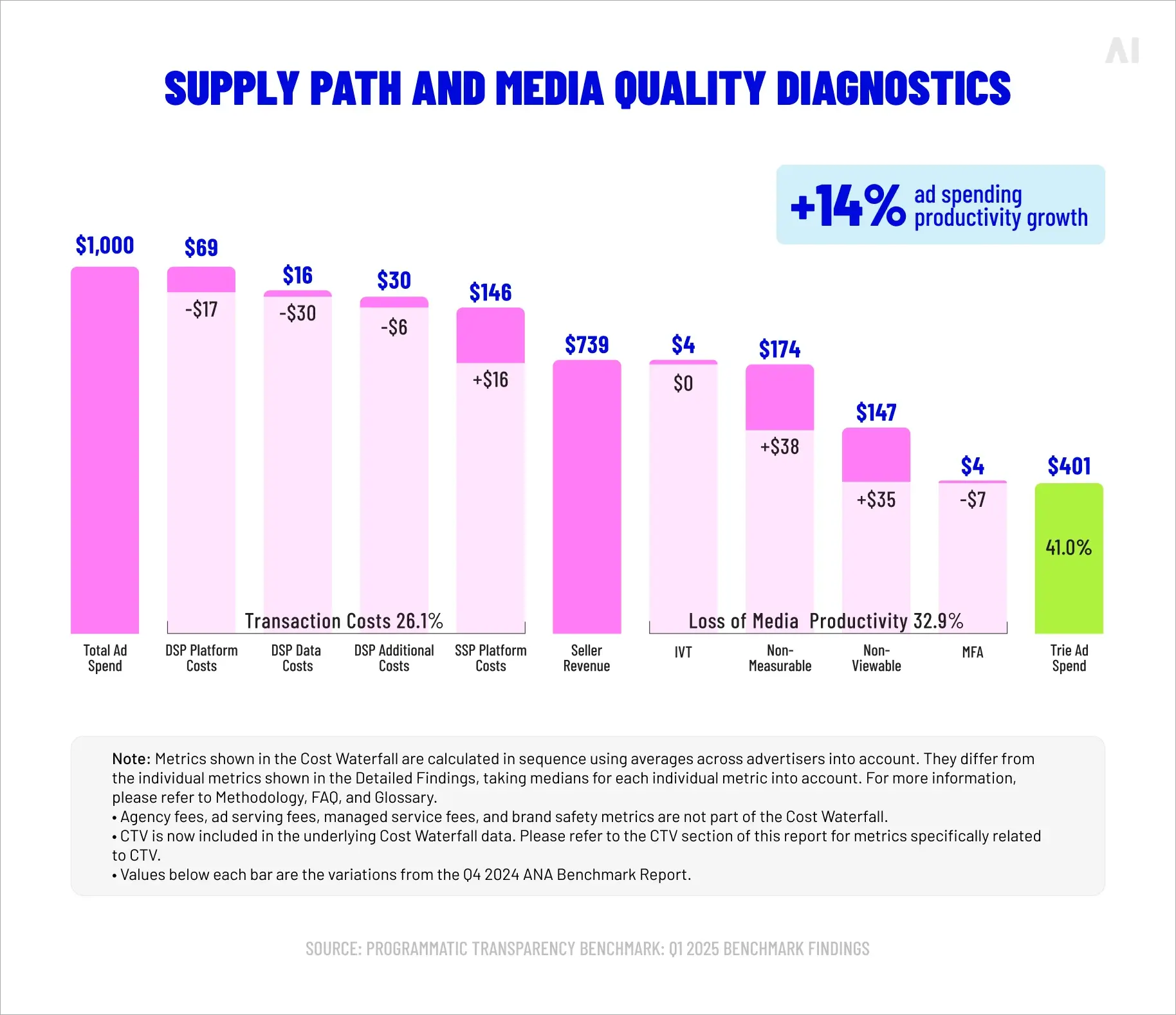
But that infrastructure comes at a cost. Every layer in the programmatic supply chain introduces fees, data handoffs, and points of opacity. An impression may travel through several intermediaries before it reaches the advertiser who bid on it. According to the ANA's Programmatic Media Supply Chain Transparency Study, only 41 cents of every dollar entering a DSP ultimately reached consumers through brand-safe, viewable, non-MFA inventory — with $22 billion in efficiency gains available across the open web programmatic marketplace.
This is where supply path optimization — commonly known as SPO — has become a critical strategy. SPO is a methodical approach to analyzing how impressions move through the programmatic supply chain, then simplifying those paths to reduce unnecessary intermediaries, improve transparency, and lower costs. The same impression can appear through multiple supply routes, each involving different SSPs, resellers, and fee structures. Jounce Media's research found that the average publisher is now directly integrated with 24.5 sell-side technology platforms, with 15.3 of those authorized to initiate resold auctions.
This article explains what SPO is, how it works in practice, why it became necessary, and where its limitations lie. It also examines why SPO alone cannot resolve the broader coordination challenges posed by fragmented platforms, disconnected measurement systems, and siloed media environments.
💡 Related reading: Digital Advertising Transparency.
What is Supply Path Optimization (SPO)?
Supply path optimization is a programmatic advertising strategy focused on selecting the most efficient and transparent supply routes between advertisers and publishers. Rather than allowing impressions to flow through every available intermediary, SPO involves evaluating how ad inventory travels through the ecosystem and prioritizing the supply partners that deliver the strongest combination of pricing efficiency, inventory quality, transparency, and direct publisher access.
In practical terms, SPO advertising means that a DSP or media buyer analyzes the available paths to a given impression and makes a deliberate choice about which SSPs, exchanges, and resellers to route spend through. The goal is not simply to reduce the number of supply partners for its own sake. It is to identify which paths add genuine value — and which introduce cost, latency, or opacity without contributing anything meaningful to campaign outcomes.
A buyer running campaigns across display, video, and connected TV (CTV) inventory might find that the same publisher's ad slot is available through eight different SSPs. Some of those paths are direct integrations; others involve resold auctions that add intermediary fees and increase the risk of bid duplication. SPO is the discipline of distinguishing between them.
SPO offers critical help — enabling buyers to hone in on the buying paths that are low cost, transparent, and high quality. Done well, SPO can create real differentiated value for a business and potentially save real money. — IAB Europe, Guide to Supply Path Optimization (IAB).
According to IAB Europe, 87% of brands, agencies, and DSPs are actively implementing SPO strategies, citing brand safety, reduced fraud, and improved KPIs as the primary drivers.
Why Supply Path Optimization became critical for programmatic advertising
SPO did not emerge in a vacuum. It became necessary because the programmatic ecosystem developed structural inefficiencies that, left unchecked, erode advertiser budgets and obscure how media dollars move from buyer to publisher.
Increasing supply chain complexity
The programmatic supply chain grew more layered as the ecosystem matured. The adoption of header bidding after 2014 allowed publishers to receive simultaneous bids from multiple demand sources—a significant improvement over the sequential waterfall model. But it also meant that each publisher could integrate with dozens of SSPs, each of which maintained connections to dozens of DSPs.
The result is an extraordinarily dense web of connections. According to Jounce Media (as reported by AdExchanger), authorized ads.txt entries have tripled since 2020, and web publishers now initiate roughly 30 million ad auctions per second. On average, media sellers work with 24 SSPs— more than half of which participate in resold auctions. This complexity is not inherently problematic, but it creates an environment where inefficiency can accumulate unnoticed.
💡 Related reading: What is programmatic advertising?
Hidden take rates and intermediary fees
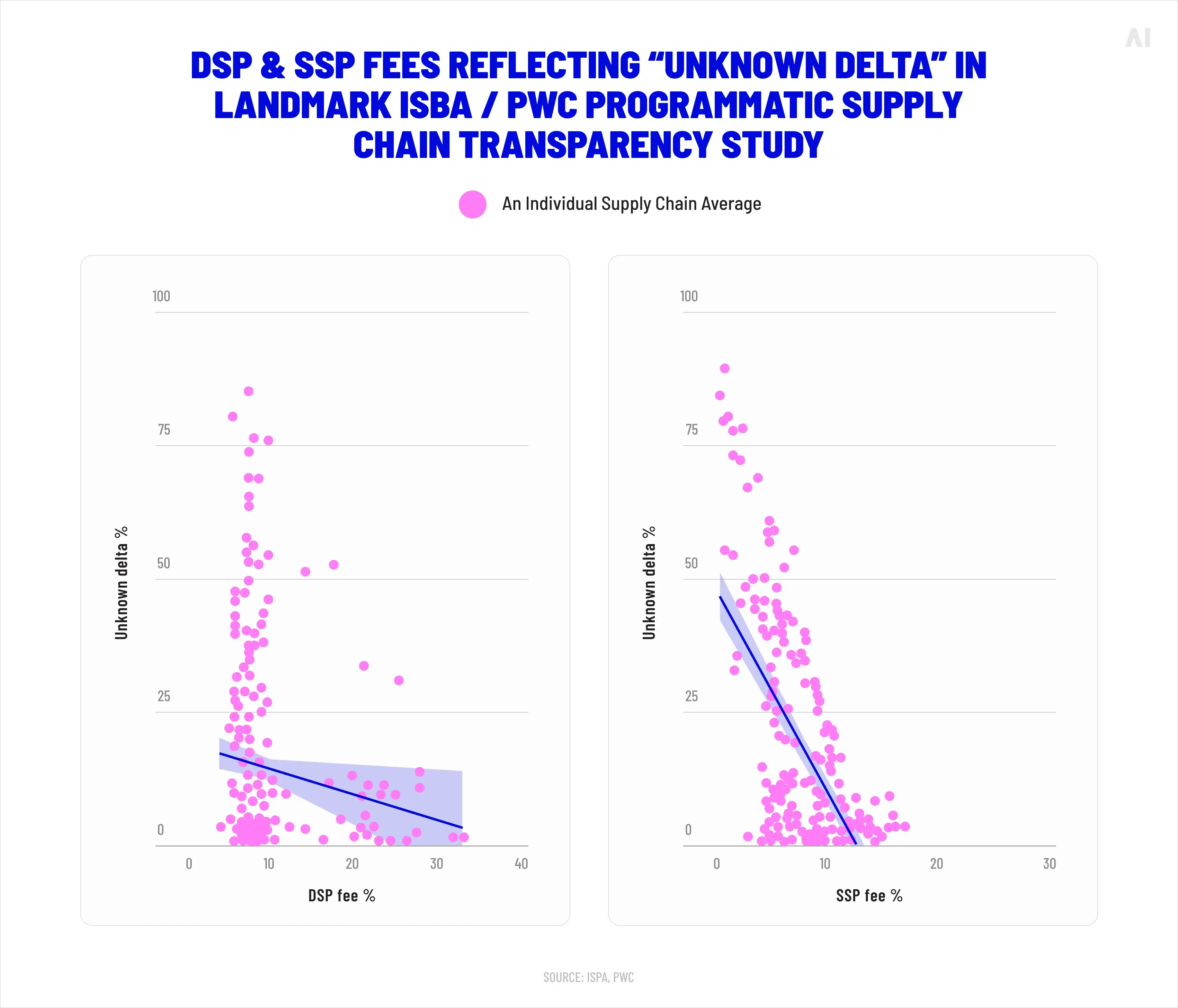
Each intermediary in the supply chain applies its own fees. DSPs charge technology fees. SSPs take a percentage. Resellers layer additional costs. When a single impression passes through multiple intermediaries, the cumulative effect is significant.
The ANA's ongoing Programmatic Transparency Benchmark tracks how these costs evolve. The Q1 2025 report found that transaction costs—DSP platform fees, DSP data costs, and SSP fees combined—consumed 26.1% of total programmatic spend, down 3.7 percentage points from the 29.8% recorded in the original 2023 study. Even with that improvement, only 41 cents of every dollar entering a DSP reaches consumers through quality impressions—up from 36 cents in 2023, but still leaving a $21.6 billion global optimization opportunity on the table. The problem is compounded when advertisers lack access to granular log-level data. While 39 marketers are now actively enrolled in the benchmark, the original 2023 study found that only 21 out of 67 advertisers who sought to participate could obtain access to their impression-level data. Without that visibility, hidden fees are not merely opaque, they are invisible.
Duplicate inventory paths
The same impression frequently appears through several different supply routes. A publisher integrated with eight SSPs may generate eight separate bid requests for a single ad slot, each arriving at the same DSP through a different path. The advertiser, in effect, may be competing against themselves across multiple auctions for the same placement.
This bid duplication inflates auction prices and creates what Jounce Media's Chris Kane has called "bidstream congestion"—a crowding-out effect where publishers compete fiercely with one another simply for the opportunity to appear in a DSP's limited sampling of the bidstream. It also incentivizes further duplication, because publishers that try to reduce redundant paths risk losing visibility to DSPs altogether.
These compounding factors—complexity, hidden fees, and duplicate paths—are what pushed advertisers toward supply path optimization as a strategic discipline rather than an optional efficiency exercise.
How Supply Path Optimization actually works
Implementing SPO is not a single action. It is an ongoing operational discipline that involves supply chain analysis, partner evaluation, and continuous monitoring. Here is how advertisers and agencies typically approach it.
1. Supply partner evaluation
The first step in any SPO strategy is evaluating existing SSP and exchange relationships. Advertisers assess each supply partner against criteria including transparency of fee structures, inventory quality and viewability rates, fraud detection and brand safety capabilities, directness of publisher integrations, and auction mechanics.
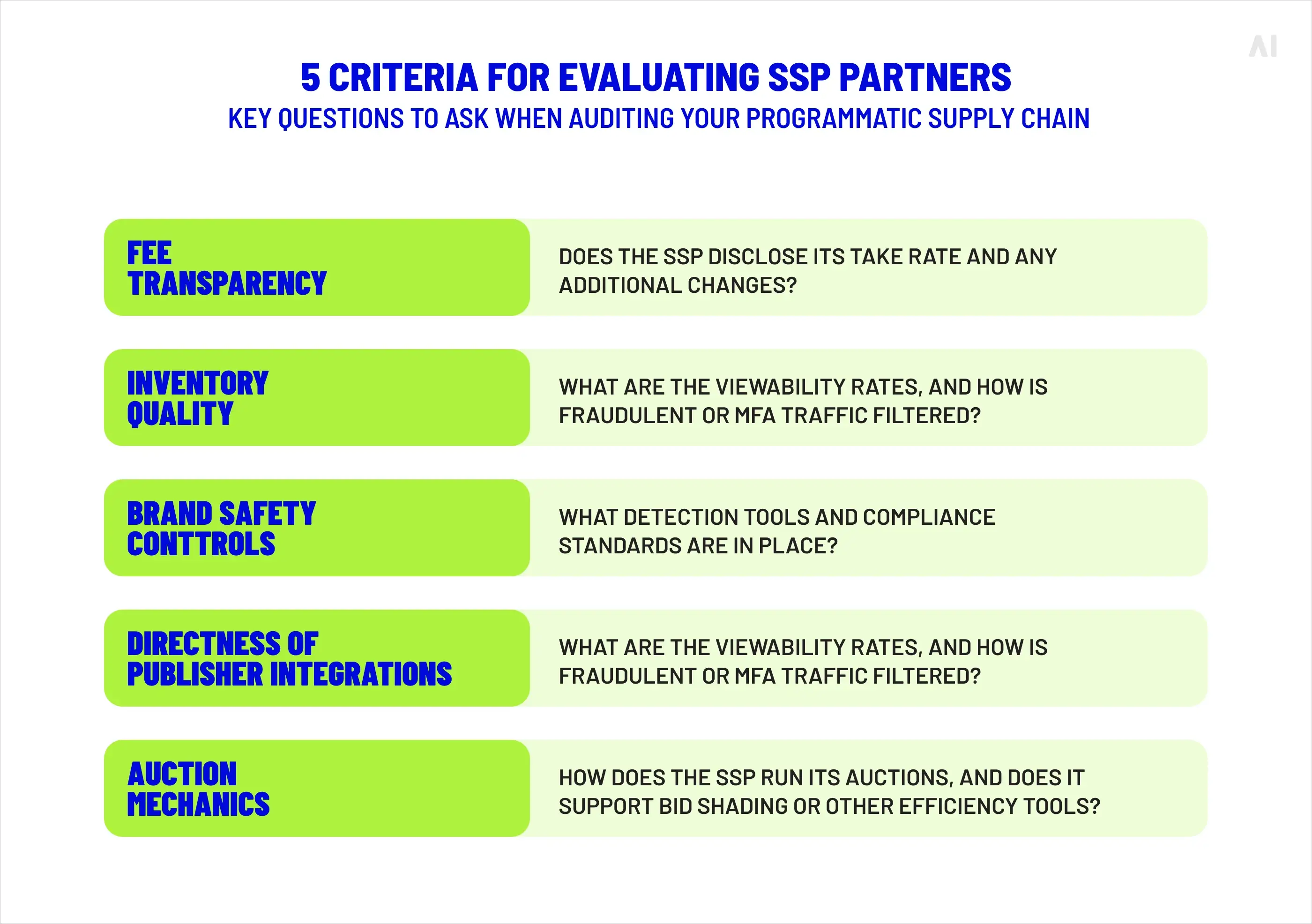
This is not a one-time audit. Supply partner performance shifts as SSPs adjust pricing, onboard new publishers, or change auction logic. Effective SPO requires regular reassessment.
💡 Related reading: What is a supply-side platform (SSP)?
2. Reducing redundant supply paths
Once partners have been evaluated, the next step is removing duplicate or low-value inventory routes. If three SSPs offer access to the same publisher's inventory but only one provides a direct integration with competitive fees, the other two paths can be deprioritized or removed from the bidding environment entirely.
The ANA's Q1 2025 Programmatic Transparency Benchmark illustrates both the progress and the remaining challenges. Since the original 2023 study, ad spending productivity has grown 14%. However, the median number of domains and apps on which campaigns appeared rose to 53,799, even as 90.3% of impressions concentrated on just 3,000 sites—a pattern that suggests many advertisers have yet to fully consolidate their supply paths and still carry a significant long tail of low-value placements.
3. Direct publisher relationships
SPO strategies increasingly prioritize direct integrations between buyers and publishers, or between DSPs and SSPs that maintain first-party publisher relationships. Direct paths reduce intermediary count, lower cumulative fees, and provide better visibility into where ads appear.
Industry frameworks like ads.txt and sellers.json, developed by the IAB Tech Lab, support this shift by allowing buyers to verify which sellers are authorized to offer a publisher's inventory and whether those sellers are direct partners or resellers.
4. Bidstream analysis
The most technically intensive component of SPO is bidstream analysis—examining the raw data generated by programmatic auctions to understand how impressions travel through the ecosystem. This involves tracking bid density (the number of bid requests per impression opportunity), auction duplication rates, win rates by supply path, SSP take rates, and latency across different routes.
Effective bidstream analysis requires collaboration between advertisers, DSPs, agencies, and supply-side platforms. It also depends on access to log-level data—which, as mentioned previously, remains a barrier for many advertisers.
Understanding the programmatic supply chain is no longer optional for stakeholders in the ad tech space. It requires the operational mindset of an insider — someone willing to get their hands dirty in the technical details of how inventory is auctioned, sold, and bought. You have to deepen the dependencies to really understand how money moves in the supply chain. — Chris Kane, Founder, Jounce Media (AdMonsters)
💡 Related reading: The digital advertising supply chain explained
SPO vs Traditional programmatic optimization
Traditional programmatic optimization focuses on campaign performance metrics—click-through rates (CTR), conversions, cost per acquisition (CPA), and return on ad spend (ROAS). It operates within the bidding environment of a given platform, adjusting targeting parameters, creative rotation, bid levels, and audience segments to improve outcomes.
Supply path optimization operates on a different layer entirely. SPO focuses on improving the programmatic infrastructure through which inventory is sourced—not the campaign settings applied after inventory has been acquired. Where traditional optimization asks "are we bidding on the right audiences?", SPO asks "are we reaching those audiences through the most efficient and transparent routes?"
{{26-Supply-Path-Optimization-SPO-1="/tables"}}
The two approaches are complementary. An advertiser can optimize their campaign targeting with precision, but if the underlying supply paths are redundant, opaque, or inflated with intermediary fees, a portion of every impression's cost is wasted before the ad is ever served. SPO addresses the plumbing; campaign optimization addresses what flows through it.
💡 Related reading:
- CTR vs CPC vs CPM vs CPA vs CPV: Understanding Ad Metrics and Pricing Models
- Digital Advertising Ecosystem: How It Actually Works in a Fragmented, Platform-Driven World
5 Key benefits of Supply Path Optimization
Advertisers adopt SPO advertising strategies because the benefits extend across cost, transparency, quality, and performance. Here are the five most significant.
Lower programmatic costs
By removing unnecessary intermediaries, SPO reduces the cumulative take rates applied to each transaction. Fewer hops between buyer and publisher mean fewer fees extracted along the way. In practical terms, this means a larger share of the advertiser's budget reaches working media. One case study cited at Programmatic I/O 2025 described publishers working with optimized supply partners reporting average CPM reductions of 20% through pre-bid optimization, achieved not by crude path reduction but through data-informed supply selection.
Improved supply chain transparency
SPO forces advertisers to examine how their budgets move through the ecosystem. This examination itself creates transparency—even before any paths are removed, the process of auditing supply partners reveals fee structures, reseller relationships, and auction mechanics that would otherwise remain hidden. Frameworks like ads.txt, sellers.json, and the OpenRTB SupplyChain object provide the technical infrastructure for this visibility.
💡 Related reading: The digital advertising supply chain explained
Higher quality inventory access
When advertisers prioritize trusted supply partners with direct publisher relationships, the inventory they access tends to be higher quality. Direct paths reduce the risk of made-for-advertising (MFA) sites, domain spoofing, and invalid traffic. The ANA's original 2023 study found that 15% of programmatic spend in the cost waterfall went to MFA websites. By Q1 2025, that figure had dropped to 0.4%, reflecting the impact of a growing focus on higher-quality ad placements.
Better performance alignment
Cleaner supply paths improve auction efficiency. When bid duplication is reduced, DSPs can make better-informed bidding decisions because they are not competing against the same impression appearing through multiple routes. This can lead to improved win rates, more efficient budget allocation, and better alignment between bidding strategies and actual campaign outcomes.
SPO 1.0, focused solely on reducing hops and fees, has outgrown itself. Today's winners focus on the smartest path, not the cheapest one. — Gabriella Aversa, Strategy Associate Director, AI Digital (AI Digital)
Limitations and trade-offs of Supply Path Optimization
SPO improves efficiency, but it is not without constraints. Advertisers implementing SPO strategies should be aware of several trade-offs.
Limited publisher visibility
Even with SPO in place, advertisers may not have full transparency into every publisher relationship within their supply chain. Some SSPs aggregate inventory from networks of smaller publishers, making it difficult to trace exactly where impressions are served. While ads.txt and sellers.json have improved visibility significantly, gaps remain—particularly in mobile app and CTV environments where supply chain standards are still maturing.
Dependence on supply partners
SPO relies on cooperation across the ecosystem. DSPs need to provide log-level data and bidstream analysis tools. SSPs need transparent fee structures and accurate supply chain signals. Publishers need clean ads.txt files and limited unauthorized resellers. If any part of this chain breaks down, SPO's effectiveness is compromised. As mentioned previously, the ANA study found that only 21 of 39 actively enrolled marketers could access and use log-level data—with the study pointing to ongoing supplier resistance as a key barrier, even where those suppliers use the same data for their own purposes. Effective SPO remains contingent on technology partners choosing to participate.
{{26-Supply-Path-Optimization-SPO-2="/tables"}}
💡 Related reading: DSP vs SSP vs ad exchange
Operational complexity
Running an effective SPO program requires technical expertise, ongoing data analysis, and regular supply partner reviews. It is not a set-and-forget exercise. Smaller advertisers or agencies without dedicated programmatic operations teams may find it difficult to sustain the level of analysis SPO demands—one reason many work with specialized partners or managed service providers to execute these strategies.
SPO in the open web vs Walled garden platforms
Supply path optimization is primarily relevant within open internet programmatic ecosystems—environments where ad inventory passes through multiple intermediaries before reaching the advertiser. The open web, mobile apps, and CTV inventory sold through header bidding or open auctions all present the multi-layered supply chains that SPO is designed to address.
Walled garden platforms—Google, Meta, Amazon, and other closed ecosystems—operate differently. The platform controls inventory, audience data, auction mechanics, and measurement. There are no independent SSPs, no resellers, and no duplicate supply paths in the traditional sense. The platform is the supply path.
{{26-Supply-Path-Optimization-SPO-3="/tables"}}
This does not mean walled gardens are inherently more efficient or transparent. Their opacity takes a different form: advertisers often cannot see granular placement data, verify pricing independently, or compare performance across platforms using consistent measurement. But the specific problem that SPO addresses—redundant intermediaries inflating costs within a distributed auction system—is largely an open internet phenomenon.
For advertisers running campaigns across both environments, this creates an asymmetry. SPO can improve efficiency on the open web, but walled garden spend operates under fundamentally different rules.
💡 Related reading:
- Walled gardens vs open internet: Control, transparency, and trade-offs
- Open internet: What it is and why it matters in digital advertising
Why Supply Path Optimization alone doesn’t solve ecosystem fragmentation
SPO improves how advertisers buy within programmatic environments. But it does not address the broader fragmentation that defines modern digital advertising.
Today's advertisers run campaigns across social platforms, search engines, retail media networks, streaming services, and open web programmatic—often simultaneously. Each environment operates with its own measurement frameworks, audience definitions, and attribution models. An advertiser with well-optimized supply paths on the open web may still face disconnected reporting from CTV buys, incompatible measurement from social campaigns, and no cross-platform view of frequency or reach.
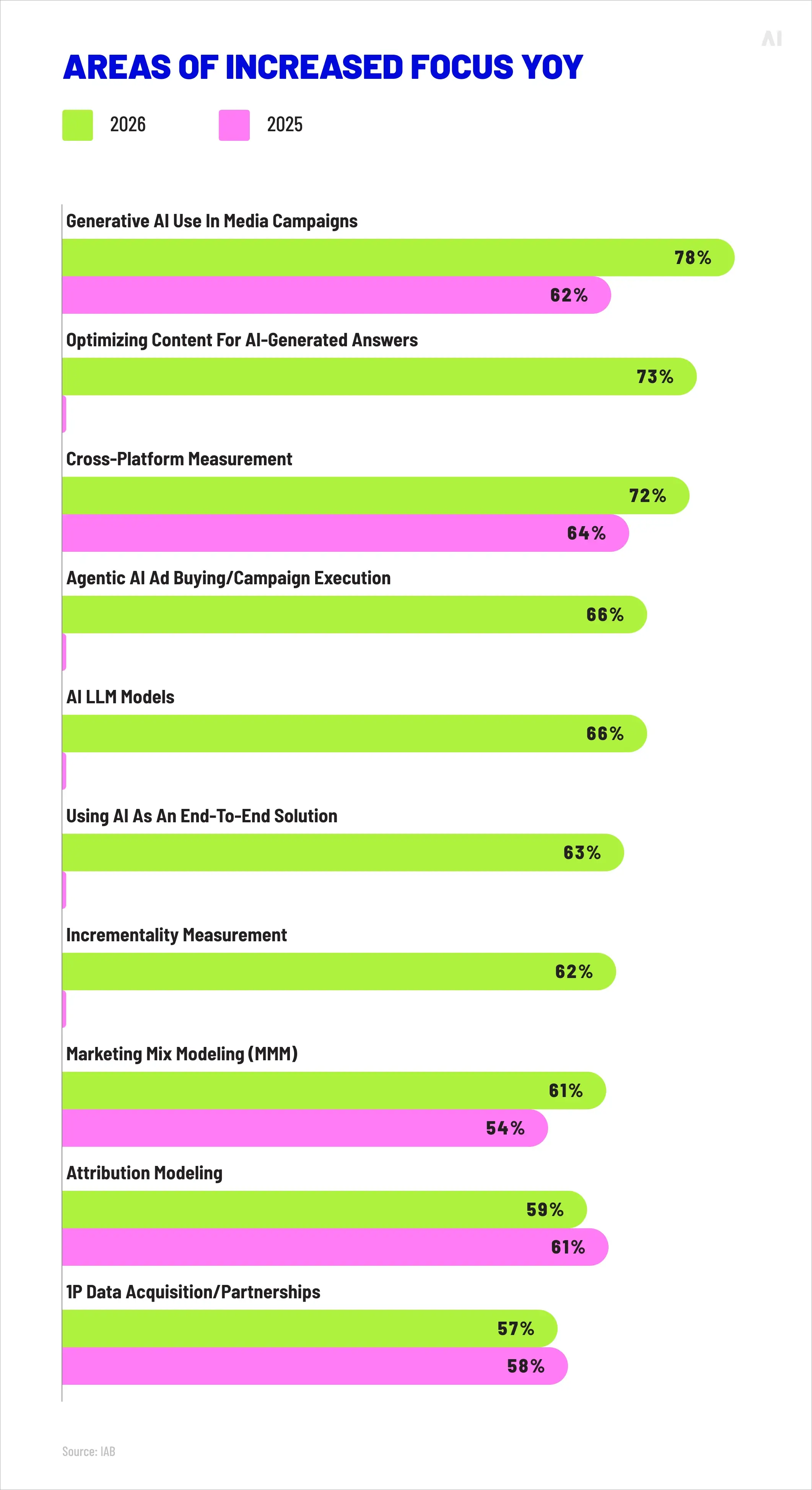
The IAB's 2026 Outlook Study reflects this tension: cross-platform measurement rose to a top priority for 72% of advertisers, up from 64% the previous year—a recognition that optimizing within individual channels is no longer sufficient.
Addressing this fragmentation requires more than supply path efficiency. It requires a framework-level approach—one that coordinates supply paths, measurement, and inventory access across platforms rather than optimizing each in isolation. This is the strategic thinking behind frameworks like the Open Garden, which aims to provide advertisers with neutral, cross-platform coordination rather than confining them to single-platform ecosystems.
💡 Related reading: Open web programmatic advertising: How infrastructure drives fragmentation
Conclusion: Building more efficient programmatic supply chains
Supply path optimization helps advertisers improve transparency and cost efficiency within programmatic advertising by simplifying supply chains and prioritizing trusted supply partners. Its adoption reflects a broader industry shift—away from the assumption that more intermediaries mean better reach, and toward the recognition that deliberate, data-informed supply chain management delivers stronger results.
Key takeaways:
- SPO focuses on optimizing the infrastructure behind programmatic media buying—the paths through which inventory is sourced, not just the campaign settings applied after purchase.
- It helps advertisers reduce hidden fees and inefficient supply routes, ensuring a greater share of media spend reaches working media.
- Cleaner supply paths can improve transparency and campaign performance by reducing bid duplication, lowering latency, and enabling more informed bidding decisions.
- SPO is most relevant within open internet programmatic ecosystems, where inventory passes through multiple intermediaries before reaching the buyer.
- While valuable, SPO alone cannot solve broader cross-platform fragmentation. Advertisers operating across social, search, retail media, and programmatic need coordinated frameworks that connect supply path efficiency with unified measurement and cross-channel visibility.
For advertisers looking to improve the efficiency of their programmatic investments, AI Digital's Smart Supply provides supply-side service that filters low-performing inventory, eliminates unnecessary bid hops, and ensures direct paths to premium placements—all operating DSP-agnostically and without added cost. Combined with the Open Garden framework, it offers a way to move beyond single-channel optimization toward a coordinated, transparent approach to digital media investment.
💡 Related reading: From Fragmented to Sustainable: Rethinking the Programmatic Supply Path